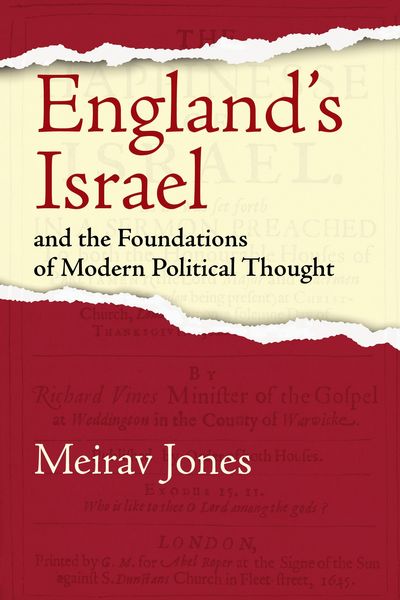
England's Israel and the Foundations of Modern Political Thought
67,40 €
inkl. gesetzl. MwSt.Beschreibung
Produktdetails
Format
ePUB
Kopierschutz
Nein
Family Sharing
Nein
Text-to-Speech
Ja
Erscheinungsdatum
08.07.2025
Verlag
Princeton University PressSeitenzahl
248 (Printausgabe)
Dateigröße
590 KB
Sprache
Englisch
EAN
9781512827811
The foundations of modern political thought, presumed secular, were laid in conversation with theologically motivated politics and in negotiation with Jewish ideas
Mid-seventeenth-century England was a hotbed in which crucial ideas of modern politics were conceived: Thomas Hobbes presented his social contract; John Selden wrote major treatises which were foundational for modern natural and international law; and England participated in the wave of republicanism that swept over Europe. This was also the period of the English Civil War-which has been portrayed as a "war of religion" and a "revolution of saints"-and was characterized by religious ends and motivations guiding politics and politicians.
In England's Israel and the Foundations of Modern Political Thought, Meirav Jones proposes that the foundational political theory conceived in this period was significantly related to the theological politics of the time. Through an examination of the language and imagery shared by theorists and saints, Jones finds that, in the twenty-year period between 1640 and1660, when Hobbes, Selden, and their contemporaries published, over 40 percent of all texts published in England contained one or more of the terms "Hebrew," "Israel," "Jerusalem," "Zion," or "Jew." Further, all known works of political theory from the period employed these terms. While preachers in English parliament addressed and understood England as "Israel," foundational theorists of the modern state employed ancient Israel as a political model and explicitly preferred Hebrew over Greek wisdom.
Modern politics did not develop solely from within a conversation among elites, neither was it conceived as a Godless enterprise, even by its most renowned secular architects. Instead, as the book demonstrates, it spoke the language of religiously motivated politics and was conceived in its terms. Ultimately, Jones argues that it was through a sweeping revival of Hebrew in early modern Europe that the foundations of modern politics were laid in conversation with theological politics and in negotiation with Jewish ideas and ideas of the Jews.
Noch keine Bewertungen vorhanden
Verfassen Sie die erste Bewertung zu diesem Artikel
Helfen Sie anderen Kundinnen und Kunden durch Ihre Meinung.
Kurze Frage zu unserer Seite
Vielen Dank für Ihr Feedback
Wir nutzen Ihr Feedback, um unsere Produktseiten zu verbessern. Bitte haben Sie Verständnis, dass wir Ihnen keine Rückmeldung geben können. Falls Sie Kontakt mit uns aufnehmen möchten, können Sie sich aber gerne an unseren Kund*innenservice wenden.
zum Kundenservice