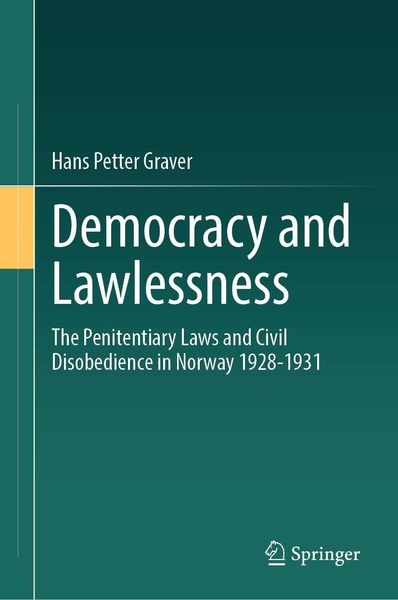
Democracy and Lawlessness The Penitentiary Laws and Civil Disobedience in Norway 1928-1931
-
- Hardcover
- Taschenbuch
- eBook ausgewählt
-
Form:Einzelkauf Download
-
Sprache:Englisch
153,99 €
inkl. gesetzl. MwSt.Beschreibung
Produktdetails
Format
Kopierschutz
Nein
Family Sharing
Nein
Text-to-Speech
Nein
Erscheinungsdatum
14.09.2024
Verlag
SpringerSeitenzahl
163 (Printausgabe)
Dateigröße
2273 KB
Sprache
Englisch
EAN
9783031690556
The book addresses efforts to politically influence and curb the judicial system, by telling the story of the enactment of controversial laws in Norway in 1927. It draws parallels to current challenges to the autonomy of the legal order, both in countries where populist forces seek control over the courts, and in other countries where increasing levels of conflict, such as around the climate crisis and the pandemic, challenge the rule of law.
In 1927 the Norwegian Parliament enacted three laws that changes the rules of the game in the relation between Labor and Capital. The law was weaponized in benefit of the employers. By this, the legislature departed from the classic ideal of equality before the law and law's autonomy as a neutral order. The new laws were called the penitentiary laws.
The demonstrations against one of the laws, the Arbitration Act in 1928 were the largest manifestation of civil disobedience in Norwegian history. They provoked a level of lawlessness that has not been matched, with exception of the situation during the German occupation 1940-1945. The book analyses the events with the aid of the theory of civil disobedience in liberal democracies put forward by the philosopher John Rawls and the theory of the legal complex developed by the socio-legal scholars Terence Halliday, Lucien Karpic, and Malcolm Feeley.
This book tells the story of the Penitentiary Laws, how the laws came into being, how they were received and resisted, and how they were defeated through civil disobedience and with the support of a legal complex which reached far into the legal system. The outcome of the conflict may be one of the factors that explain the high level of trust that the legal institutions enjoy in present day Norway.
Noch keine Bewertungen vorhanden
Verfassen Sie die erste Bewertung zu diesem Artikel
Helfen Sie anderen Kundinnen und Kunden durch Ihre Meinung.
Kurze Frage zu unserer Seite
Vielen Dank für Ihr Feedback
Wir nutzen Ihr Feedback, um unsere Produktseiten zu verbessern. Bitte haben Sie Verständnis, dass wir Ihnen keine Rückmeldung geben können. Falls Sie Kontakt mit uns aufnehmen möchten, können Sie sich aber gerne an unseren Kund*innenservice wenden.
zum Kundenservice