Gutscheinbedingungen

**Gültig bis 25.06.2026 auf fremdsprachige Bücher online auf thalia.at und in der Thalia App. Einzelne Artikel können ausgeschlossen sein. Ausgenommen sind preisgebundene Artikel & eBooks. Pro Einkauf einmal einlösbar. Click & Collect nur bei Onlinevorabzahlung möglich. Keine Barauszahlung. Nicht kombinierbar mit anderen Aktionen und Gutscheinen. Gutschein wird auf max. 500€ Bestellwert angerechnet. Nicht gültig für Geschenkkarten, Versandkosten und Services.

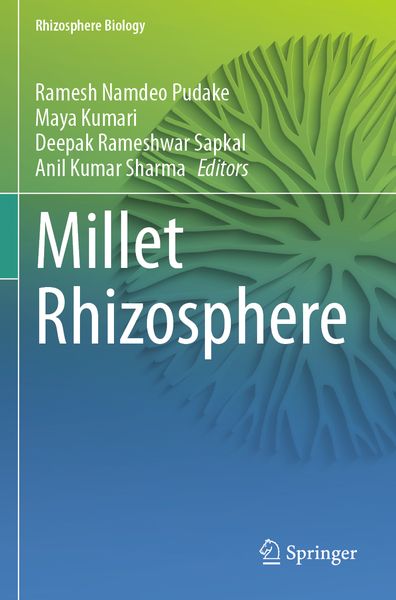
Produktbild: Millet Rhizosphere
- 12%

Millet Rhizosphere

Aus der Reihe Rhizosphere Biology
12% sparen

239,99 € UVP 274,99 €

inkl. gesetzl. MwSt., Versandkostenfrei


Beschreibung

Produktdetails

Einband

Taschenbuch

Erscheinungsdatum

13.09.2024

Herausgeber

Ramesh Namdeo Pudake + weitere

Verlag

Springer Singapore

Seitenzahl

348

Maße (L/B/H)

23,5/15,5/1,9 cm

Gewicht

618 g

Auflage

1. Auflage

Sprache

Englisch

ISBN

978-981-9921-68-3

Beschreibung

Portrait

Dr. Ramesh Namdeo Pudake is Assistant Professor at Amity University Uttar Pradesh, Noida – one of the top-ranked private universities in India. Dr. Pudake is a PhD in Crop Genetics and Breeding from China Agricultural University, Beijing, PRC. After his PhD, he is engaged in research in a range of organisms but with a focus on crop plant genomics. He has also worked in the Department of Agronomy at Iowa State University Ames, IA, USA, on host-pathogen interaction and gene mapping. Currently, he is focusing on research on different application genomics in plant-microbe interaction. Dr. Pudake has published more than 37 research publications, 4 books, and 19 book chapters. He also has one scholarship award from the Chinese Government for pursuing his doctoral studies. He is an expert reviewer and guest editor for several journals of repute. 

2. Dr. Maya Kumari is working as Scientist-E in the Directorate of Life sciences, Defence Research and Development Organization, Govt.of India; and has more than 12 years of research experience in the field of plant molecular biology. Her research work in functional and molecular breeding for the detection of the molecular mechanism of plant biotic stress tolerance is of high scientific and social relevance. Currently, she is coordinating various projects related to biological defense technologies and acting as an interface between the army, industry, and DRDO Labs. She has published more than 40 research papers and 1 book and acted as a reviewer for scientific articles in reputed journals. Besides her published work, Dr. Maya persuaded to achieve many awards including the master’s Gold Medal; Endeavour Research Scholarship, DEST, Australia, to carry out research at CLIMA, UWA, Australia; Young Women Scientist Scholarship, Department of Science and Technology, Junior/Senior Research Fellow of Council of Scientific and Industrial Research, Govt. of India; and Chinese Government Scholarship, China Scholarship Council,PR of China. 

3. Dr. Deepak R. Sapkal is Assistant Professor at Amity University Uttar Pradesh. Dr. Sapkal is a PhD in Genetics and Breeding from Dr. PDKV, Akola. He has eight years of teaching experience in the areas of genetics, plant breeding, and biotechnology. Currently, he is focusing on research on molecular breeding. Dr. Sapkal has published more than 10 research publications.

4. Prof. Anil K. Sharma is Professor at the Department of Biological Sciences, CBSH, and Director of Extension Education, GB of Pant University of Agriculture and Technology in Pantnagar. He completed his postdoctoral studies at the GSU, Louisiana (USA), and has been a visiting scientist at the University of Basel, Switzerland (2003), and the University of Helsinki, Finland (2013). He has extensive research and teaching experience and served as a reviewer for various funding bodies and international research journals. He also holds two patents in plant biology and microbiology, respectively. The recipient of various prestigious grants, he has published more than 90 research articles and 30 review articles, as well as 14 books with prominent publishers.


Produktdetails

Einband

Taschenbuch

Erscheinungsdatum

13.09.2024

Herausgeber

Verlag

Springer Singapore

Seitenzahl

348

Maße (L/B/H)

23,5/15,5/1,9 cm

Gewicht

618 g

Auflage

1. Auflage

Sprache

Englisch

ISBN

978-981-9921-68-3

Herstelleradresse

Springer-Verlag KG
Sachsenplatz 4-6
1201 Wien
AT

Email: ProductSafety@springernature.com

Kundinnen und Kunden meinen

0 Bewertungen

Informationen zu Bewertungen

Zur Abgabe einer Bewertung ist eine Anmeldung im Konto notwendig. Die Authentizität der Bewertungen wird von uns nicht überprüft. Wir behalten uns vor, Bewertungstexte, die unseren Richtlinien widersprechen, entsprechend zu kürzen oder zu löschen.

Die Bewertungen sind nach Format, Anzahl Sterne und Datum sortiert.

Verfassen Sie die erste Bewertung zu diesem Artikel

Helfen Sie anderen Kund*innen durch Ihre Meinung

Kundinnen und Kunden meinen

0 Bewertungen filtern

  • Produktbild: Millet Rhizosphere
  • Chapter 1.- Plant-microbe interactions promoting millets plant growth and health: Perspectives for use of microorganisms in millets production, Chapter 2.- Diversity and function of microbes associated with the rhizosphere of millets, Chapter 3.- Biodiversity of arbuscular mycorrhizal fungi and its impact on millets growth, Chapter 4.- Drought-tolerant plant growth-promoting rhizobacteria associated with millets, Chapter 5.- Identification of novel microbial strain for reduced pesticide use in millets, Chapter 6.- Current insights into the role of rhizosphere bacteria in disease suppression in millets, Chapter 7.- Comparison of rhizospheric functional diversity between chemically fertilized and bioinoculated millet, Chapter 8.- Deciphering the role and diversity of microbes present in millet rhizosphere, Chapter 9.- Role of phosphate solubilizing microbes on phosphorous availability and yield attributes of millet, Chapter 10.- Impact of rhizosphere ecology on nitrogen fixation inmillets, Chapter 11.- Synergistic effects of arbuscular mycorrhizal fungi and PGPR on yield improvements in millets, Chapter 13.- Understanding of belowground biochemical communication in millets through metabolomics, Chapter 14.- Prospects of gene editing techniques in manipulating the rhizosphere microbiome for millets productivity, Chapter 15.- Effect of nano-formulated agrochemicals on rhizospheric communities in millets, Chapter 16.- Potential application of nanotechnology in biofertilizer formulation for millets.