KI-Beratung Beta

Gutscheinbedingungen

**Gültig bis 30.11.2026 auf Spielzeug, Schreibwaren, Filme, Geschenke & Trends, Musik, tolino eReader & Zubehör, Hörbücher und Hörbuch-Downloads, nicht preisgebundene Bücher und Kalender online auf thalia.at und in der Thalia App. Einzelne Artikel können ausgeschlossen sein. Aufgrund der Buchpreisbindung sind deutschsprachige Bücher und eBooks ausgenommen. Zusätzlich ausgenommen sind Abos & Flatrates, Games, Geschenkkarten/-boxen, Shelfies, Software, Zeitschriften sowie einzelne Artikel von tonies®. Pro Einkauf einmal einlösbar. Nur gültig mit im Onlineshop hinterlegter Bonuscard. Click & Collect nur bei Onlinevorabzahlung möglich. Keine Barauszahlung. Nicht kombinierbar mit anderen Aktionen und Gutscheinen. Gutschein wird auf max. 500€ Bestellwert angerechnet. Nicht gültig für Versandkosten und Services.

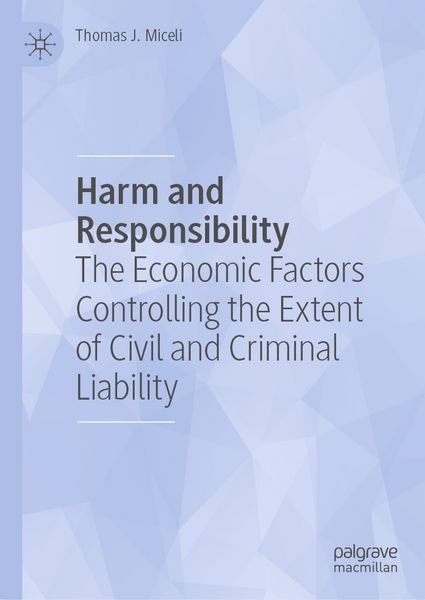
Produktbild: Harm and Responsibility
- 12%

Harm and Responsibility The Economic Factors Controlling the Extent of Civil and Criminal Liability

12% sparen

115,99 € UVP 131,99 €

inkl. gesetzl. MwSt., Versandkostenfrei


Beschreibung

Risk is an ever-present feature of life in a complex world, and it is important for societies to manage it in a just and efficient manner. One way to reduce risk is to assign responsibility for the associated harm. In this book, economist Thomas J. Miceli examines harm and responsibility from an economic...

Beschreibung

Risk is an ever-present feature of life in a complex world, and it is important for societies to manage it in a just and efficient manner. One way to reduce risk is to assign responsibility for the associated harm. In this book, economist Thomas J. Miceli examines harm and responsibility from an economic perspective.


The book focuses on how responsibility affects people’s incentives to refrain from causing unnecessary harm to achieve what economists call optimal deterrence. Secondarily, it is concerned with the quest for justice. Defining this is part of the journey. Does it mean compensating victims for unavoidable losses? Does it involve punishing wrongdoers in proportion to the harm they have caused? Is there a clear answer? The book addresses these questions and more, explaining how, in some cases, these objectives will align with deterrence and in others they will not. The book discusses the ways that the law, tempered by religious and social norms, strikes a balance between these goals.


The principal areas of law that assign legal responsibility are tort law (for accidental harms) and criminal law (for intentional harms). There exist vibrant economic theories of both, and this volume draws on this literature. One theme that emerges is the role of causation in determining responsibility. Attributing responsibility for a given harm to the party that caused it seems both morally just (because it embodies personal responsibility), and economically desirable (because it achieves deterrence in the most direct manner). And yet the law departs from this prescription in any number of ways, both by limiting the responsibility of some who caused harm and by expanding responsibility to some who did not. The book offers readers coherent economic explanations for these departures from a purely causal basis for legal responsibility.


Author Thomas J. Miceli clarifies causation as reciprocal in nature and therefore not a uniquely defined concept. This means that when an action by A causes harm to B, the question is not how to restrain A but rather: whether A has the legal right to take the action in question or whether B has the right to prevent it. There will be a harm either way; the relevant question is which party should bear it. This insight ultimately leads to the fundamental problem of defining harm. In most conflicts this can be straightforward—as when A punches B—but in others it is more challenging. For example, when does free speech become hate speech? Where is the line drawn?


The book concludes by drawing out the implications of this fundamental ambiguity over the meaning of harm, what that means for the law, and what economic theory has to say about it.

Produktdetails

Einband

Gebundene Ausgabe

Erscheinungsdatum

21.12.2024

Abbildungen

XVI, 270 p. 14 illus.

Verlag Springer

Produktdetails

Einband

Gebundene Ausgabe

Erscheinungsdatum

21.12.2024

Abbildungen

XVI, 270 p. 14 illus.

Verlag Springer
Seitenzahl

270

Maße (L/B/H)

21,6/15,3/2,1 cm

Gewicht

449 g

Sprache

Englisch

ISBN

978-3-031-74830-1

Herstelleradresse

Springer-Verlag GmbH
Europaplatz 3
69115 Heidelberg
DE

Email: ProductSafety@springernature.com

Noch keine Bewertungen vorhanden

Verfassen Sie die erste Bewertung zu diesem Artikel

Helfen Sie anderen Kundinnen und Kunden durch Ihre Meinung.

Kundinnen und Kunden meinen

Bewertungen (0)

Weitere Artikel finden Sie in

  • Produktbild: Harm and Responsibility

  • Chapter 1: Introduction.- PART 1. Assigning responsibility: Values and institutions.- Chapter 2: Values.- Chapter 3: Institutions.- Chapter 4: Causation and responsibility.- PART 2. Reasons for limiting responsibility.- Chapter 5: Tort doctrines.- Chapter 6: Criminal doctrines.- PART 3. Reasons for expanding responsibility.- Chapter 7: Tort doctrines.- Chapter 8: Criminal doctrines.- PART 4. Defining harm.- Chapter 9: Reciprocal causation.- Chapter 10: The meaning of harm.