Gutscheinbedingungen

**Gültig nur für Bestellungen an die Wunsch-Poststation bis 10.06.2026 auf Spielzeug, Schreibwaren, Filme, Geschenke & Trends, Musik, tolino eReader & Zubehör, Hörbücher und Hörbuch-Downloads (außer Abo), nicht preisgebundene Bücher und Kalender online auf thalia.at und in der Thalia App. Einzelne Artikel können ausgeschlossen sein. Aufgrund der Buchpreisbindung sind deutschsprachige Bücher und eBooks ausgenommen. Zusätzlich ausgenommen sind preisgebundene Artikel, Abos & Flatrates, eBooks, Games, Geschenkkarten/-boxen, Shelfies, Software, Zeitschriften sowie einzelne Artikel von tonies®. Pro Einkauf einmal einlösbar. Kein Click & Collect möglich. Keine Barauszahlung. Nicht kombinierbar mit anderen Aktionen und Gutscheinen. Gutschein wird auf max. 500€ Bestellwert angerechnet. Nicht gültig für Versandkosten und Services.

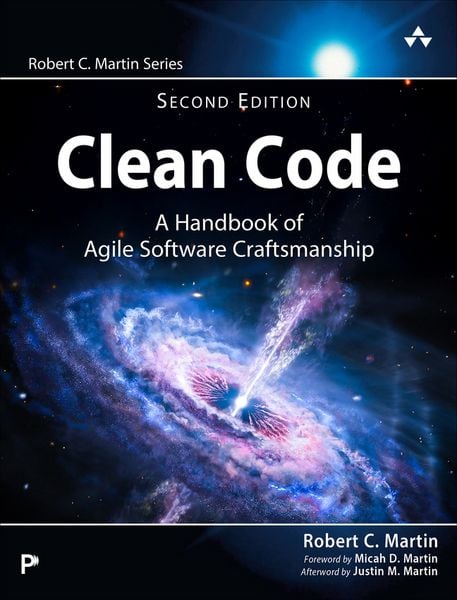
Produktbild: Clean Code: A Handbook of Agile Software Craftsmanship
- 16%

Clean Code: A Handbook of Agile Software Craftsmanship niveau 5 14+

2
16% sparen

48,99 € UVP 58,99 €

inkl. gesetzl. MwSt., Versandkostenfrei


Beschreibung

Produktdetails

Verkaufsrang

25137

Einband

Taschenbuch

Altersempfehlung

ab 14 Jahr(e)

Erscheinungsdatum

08.10.2025

Verlag

Pearson Education Limited

Seitenzahl

672

Maße (L/B/H)

22,8/17,3/3,7 cm

Gewicht

1121 g

Farbe

Schwarz / Graublau

Auflage

2

Sprache

Englisch

ISBN

978-0-13-539857-9

Beschreibung

Produktdetails

Verkaufsrang

25137

Einband

Taschenbuch

Altersempfehlung

ab 14 Jahr(e)

Erscheinungsdatum

08.10.2025

Verlag

Pearson Education Limited

Seitenzahl

672

Maße (L/B/H)

22,8/17,3/3,7 cm

Gewicht

1121 g

Farbe

Schwarz / Graublau

Auflage

2

Sprache

Englisch

ISBN

978-0-13-539857-9

Herstelleradresse

Pearson Benelux B.V.
St.-Martin-Straße 82
81541 München
DE

Email: salesde@pearson.com

Kundinnen und Kunden meinen

2 Bewertungen

Informationen zu Bewertungen

Zur Abgabe einer Bewertung ist eine Anmeldung im Konto notwendig. Die Authentizität der Bewertungen wird von uns nicht überprüft. Wir behalten uns vor, Bewertungstexte, die unseren Richtlinien widersprechen, entsprechend zu kürzen oder zu löschen.

Die Bewertungen sind nach Format, Anzahl Sterne und Datum sortiert.

5 Sterne

(0)

4 Sterne

(1)

3 Sterne

(1)

2 Sterne

(0)

1 Sterne

(0)

Abolut lesenswert

Bewertung aus Chur am 11.02.2021

Bewertungsnummer: 960425

Bewertet: eBook (ePUB)

Neue Impulse die Qualität des Sourcecodes zu bewerten. Für Profis ein Muss.

Abolut lesenswert

Bewertung aus Chur am 11.02.2021
Bewertungsnummer: 960425
Bewertet: eBook (ePUB)

Neue Impulse die Qualität des Sourcecodes zu bewerten. Für Profis ein Muss.

Achtung PDF Druck

Thomas am 17.05.2022

Bewertungsnummer: 1713707

Bewertet: Buch (Taschenbuch)

Sehr lesenswertes Buch, auch für fortgeschritte Entwickler. Leider ist es nicht das Original, sondern nur ein schlechter PDF Druck. Sehr enttäuschend bei dem Preis..

Achtung PDF Druck

Thomas am 17.05.2022
Bewertungsnummer: 1713707
Bewertet: Buch (Taschenbuch)

Sehr lesenswertes Buch, auch für fortgeschritte Entwickler. Leider ist es nicht das Original, sondern nur ein schlechter PDF Druck. Sehr enttäuschend bei dem Preis..

Kundinnen und Kunden meinen

Clean Code

von Robert C. Martin

0 Bewertungen filtern

Die Leseprobe wird geladen.
  • Produktbild: Clean Code: A Handbook of Agile Software Craftsmanship
  • Foreword xix

    Introduction xxv

    Introduction (from Long Ago) xxix

    About the Author xxxi

    Chapter 1: Clean Code 1

    There Will Be Code 2

    Bad Code 3

    The Art of Clean Code 5

    Putting All This Together 9

    We Read More Than We Write 13

    The Boy Scout Rule 14

    Part I: Code 17

    Chapter 2: Clean That Code! 19

    The Cleaning Process 30

    Conclusion 37

    Postscript: Future Bob Playing with Grok3 37

    Postscript Conclusion 40

    Chapter 3: First Principles 41

    Everything Small, Well Named, Organized, and Ordered 42

    A More Significant Example 44

    A Final Thought 68

    Chapter 4: Meaningful Names 71

    Use Intention-Revealing Names 72

    Final Words 87

    Chapter 5: Comments 89

    Compensating for Failure 90

    Good Comments 92

    Bad Comments 97

    Conclusion 115

    Chapter 6: Formatting 117

    The Purpose of Formatting 118

    Vertical Formatting 118

    Horizontal Formatting 127

    Team Rules 132

    Uncle Bob's Formatting Rules 133

    Chapter 7: Clean Functions 137

    Small! 138

    Reading Code from Top to Bottom: The Stepdown Rule 140

    Switch Statements 142

    Clean Functions: A Deeper Look 144

    Conclusion 157

    Chapter 8: Function Heuristics 159

    Function Arguments 159

    Command Query Separation 164

    Prefer Exceptions to Returning Error Codes 165

    DRY: Don't Repeat Yourself 169

    Side Effects 177

    Structured Programming 181

    This Is Too Much to Constantly Keep in Mind 183

    Conclusion 184

    Chapter 9: The Clean Method 185

    Make It Right 186

    Example 188

    Conclusion 210

    Chapter 10: One Thing 211

    Extract Method Refactoring 212

    What Are Large Functions Anyway? 217

    Conclusion 239

    Chapter 11: Be Polite 241

    The Newspaper Metaphor 243

    The Stepdown Rule: Once Again 245

    The Abstraction Roller Coaster 246

    This Is How We Write, but Not How We Want to Read 246

    Chapter 12: Objects and Data Structures 249

    What Is an Object? 250

    Data Abstraction 251

    Data/Object Antisymmetry 252

    The Law of Demeter 255

    Data Transfer Objects 258

    Switch Statements 260

    The OO/Procedural Trade-off 264

    But What About Performance? 265

    Conclusion 265

    Chapter 13: Clean Classes 267

    Classes and Modules versus Files 267

    What Should a Class Contain? 268

    Chapter 14: Testing Disciplines 289

    Discipline 1: Test-Driven Development (TDD) 291

    Discipline 2: Test && Commit || Revert (TCR) 292

    Discipline 3: Small Bundles 293

    Design 293

    Discipline 294

    Keeping Tests Clean 299

    Tests Enable the -ilities 300

    Chapter 15: Clean Tests 303

    Domain-Specific Testing Language 307

    F.I.R.S.T. 310

    Test Design 311

    Conclusion 311

    Chapter 16: Acceptance Testing 313

    The Acceptance Testing Discipline 314

    Conclusion 316

    Chapter 17: AIs, LLMs, and God Knows What 317

    Programming by Prompt 319

    Conclusion 328

    Part II: Design 329

    Chapter 18: Simple Design 331

    YAGNI 333

    Covered by Tests 333

    Maximize Expression 334

    Minimize Duplication 337

    Chapter 19: The SOLID Principles 341

    SRP: The Single Responsibility Principle 343

    OCP: The OpenClosed Principle 347

    LSP: The Liskov Substitution Principle 351

    ISP: The Interface Segregation Principle 354

    DIP: The Dependency Inversion Principle 356

    Chapter 20: Component Principles 363

    Components 364

    A Brief History of Components 364

    Component Cohesion 368

    Component Coupling 373

    Conclusion 387

    Chapter 21: Continuous Design 389

    Continuous Change 390

    Continuous Design 391

    Sailing on the Four Cs of Continuous Design 392

    When Else Do We Design? 420

    Chapter 22: Concurrency 423

    Why Concurrency? 424

    Concurrency Defense Principles 427

    2025 Update and Report from the Field 437

    Conclusion 442

    Part III: Architecture 443

    Chapter 23: The Two Values of Software 445

    Keeping Options Open 446

    Chapter 24: Independence 449

    Use Cases 450

    Operation 450

    Development 451

    Deployment 451

    Leaving Options Open 451

    Chapter 25: Architectural Boundaries 453

    What Lines Do You Draw, and When? 454

    Plug-in Architecture 456

    Case Study: FitNesse 457

    Conclusion 459

    Chapter 26: Clean Boundaries 461

    Third-Party IoT Framework: Lots o' Boundaries 462

    UI/Application Boundary 466

    Clean Boundaries 474

    Chapter 27: The Clean Architecture 475

    The Dependency Rule 476

    Conclusion 481

    Part IV: Craftmanship 483

    "A Great Number" 484

    Eight Decades 484

    The Oath 492

    Chapter 28: Harm 495

    No Harm to Society 496

    Harm to Function 497

    No Harm to Structure 499

    Soft 500

    Tests 501

    Chapter 29: No Defect in Behavior or Structure 503

    Making It Right 504

    Programmers Are Stakeholders 507

    Do Your Best 508

    Chapter 30: Repeatable Proof 511

    Dijkstra 511

    Structured Programming 514

    Functional Decomposition 516

    Test-Driven Development et al. 517

    Chapter 31: Small Cycles 519

    The History of Source Code Control 519

    Continuous Integration 524

    Branches versus Toggles 525

    Continuous Deployment 527

    Continuous Build 528

    Chapter 32: Relentless Improvement 529

    Test Coverage 529

    Mutation Testing 530

    Semantic Stability 530

    Cleaning 531

    Creations 531

    Chapter 33: Maintain High Productivity 533

    Viscosity 533

    Managing Distractions 535

    Time Management 538

    Chapter 34: Work as a Team 539

    Collaborative Programming 539

    Open/Virtual Office 540

    Chapter 35: Estimate Honestly and Fairly 543

    Lies 544

    Honesty, Accuracy, Precision 544

    Lessons from Me 545

    Accuracy and Precision 547

    Aggregation 548

    Honesty 549

    Pressure 550

    Chapter 36: Respect for Fellow Programmers 553

    Chapter 37: Never Stop Learning 555

    Afterword 557

    Appendix: The Clean Code Debate 561

    Introductions 562

    Method Length 563

    Method Length Summary 575

    Comments 576

    Comments Summary 590

    John's Rewrite of PrimeGenerator 591

    A Tale of Two Programmers 596

    Bob's Rewrite of PrimeGenerator2 599

    Test-Driven Development 603

    TDD Summary 612

    Closing Remarks 613

    Bibliography 615

    Index 619