KI-Beratung Beta

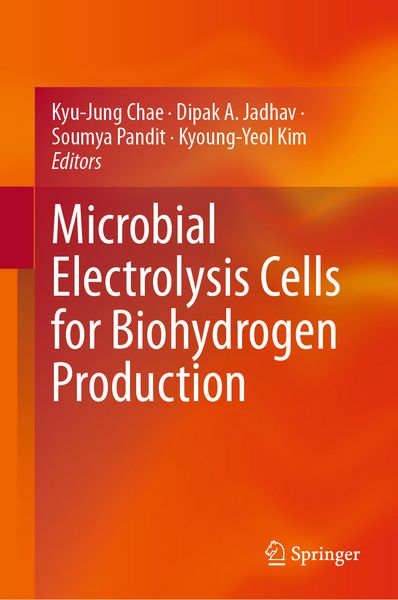
Produktbild: Microbial Electrolysis Cells for Biohydrogen Production
- 12%

Microbial Electrolysis Cells for Biohydrogen Production

12% sparen

163,99 € UVP 186,99 €

inkl. gesetzl. MwSt., Versandkostenfrei


Beschreibung

This book covers microbial electrolysis cells (MEC) for biohydrogen production and explores the basics, challenges, limitations and applications of this technology. The latest advances in electrochemical reactors and microbial electrochemical systems are also presented, accompanied by a discussion on...

Beschreibung

This book covers microbial electrolysis cells (MEC) for biohydrogen production and explores the basics, challenges, limitations and applications of this technology. The latest advances in electrochemical reactors and microbial electrochemical systems are also presented, accompanied by a discussion on the way forward towards practical use of MEC technology.

Divided into 3 parts, the book commences with an introduction to the fundamentals of microbial electrolysis cells and biohydrogen production, followed by an overview of the latest advances in microbial electrolysis cell research, with particular attention given to the performance and operating conditions. The third part of this book is devoted to MEC scaling-up, were readers will find the recent progresses in the field. The possibilities and challenges of integrating conventional wastewater treatment systems with MEC, commercialization challenges of MECs, and life cycle assessment of MEC for biohydrogen production are alsodiscussed in this part of the book. In this book, readers will also find useful case studies detailing pilot-scale applications of MEC for industrial wastewater treatment.

Given its breadth, this book is a valuable resource for scholars in the energy domain, policymakers and researchers actively working with MEC applications. Furthermore, it also appeals to early-stage researchers and scientists interested in the dynamics of microbial electrolysis for wastewater treatment, biohydrogen generation and resource recovery from wastewater.


Portrait

Kyu-Jung Chae is a Professor of Environmental Engineering at Korea Maritime and Ocean University (KMOU), South Korea, and also serves as a Vice-Dean of the College of Ocean Science and Engineering. He received a Ph.D. from Gwangju Institute of Science and Technology, in Environmental Engineering, 2010. As of 2022, renowned for his pioneering research, he has led 30+ research projects as a principal investigator, published 100+ papers, 3 books, and achieved 40 patents. His areas of expertise span a wide range of environmental science and technology, including water-energy nexus technology, bioelectrochemical cells, energy self-sufficient wastewater treatment, microbial fuel cells, advanced wastewater treatment, and marine pollution.

Dipak Ashok Jadhav is an Assistant Professor at JSPM University Pune, Maharashtra, India. Earlier, he was Research Professor at KMOU, Republic of Korea. He holds a MTech and PhD from the Indian Institute of Technology Kharagpur, where he studied the scaling up of microbial fuel cells and development of scaling up microbial fuel cells for sanitation applications. His research focuses on microbial fuel cells, Bioelectrochemical systems, Sanitation, Bioenergy research, Water management, Waste to Energy recovery. He has published 80+ articles and also authored 25 book chapters and 7 books in these topics.

Soumya Pandit is currently working as Senior Assistant Professor at Sharda University, Greater Noida, Delhi NRC, India, where he teaches subjects like Bioprocess Engineering; Industrial Biotechnology; Environmental microbiology and waste management. His research interests are in the areas of environmental biotechnology and bioenergy, with a main focus on microbial electrochemical systems for bioenergy harvesting, biohythane, bacterial biofilm and biofouling study. He has authored 56 articles, 41 book chapters and 3 books. He also published 3 Indian patents (1 granted) so far.

Kyoung-Yeol Kim is an Assistant Professor in the Department of Environmental & Sustainable Engineering at the University at Albany, State University of New York, USA. He received his Ph.D. in Environmental Engineering at Gwangju Institute of Science & Technology (GIST, South Korea) in 2014. Dr. Kim has published 49 articles, contributed to 1 book chapter and 4 patents. Dr. Kim’s research area of expertise is bioelectrochemical systems for energy recovery, especially focused on microbial electrolysis cells (MECs) to produce hydrogen from waste streams. His research group is now conducting multiple research projects including energy and resource recoveries (electricity, hydrogen, nutrients, etc.) from waste streams using (bio)electrochemical systems.

Produktdetails

Einband

Gebundene Ausgabe

Erscheinungsdatum

30.12.2024

Abbildungen

VI, 194 p. 40 illus., 29 illus. in color.

Herausgeber Kyu-Jung Chae + weitere

Produktdetails

Einband

Gebundene Ausgabe

Erscheinungsdatum

30.12.2024

Abbildungen

VI, 194 p. 40 illus., 29 illus. in color.

Herausgeber
Verlag Springer
Seitenzahl

194

Maße (L/B/H)

24,1/16/1,7 cm

Gewicht

419 g

Sprache

Englisch

ISBN

978-3-031-75131-8

Herstelleradresse

Springer-Verlag KG
Sachsenplatz 4-6
1201 Wien
AT

Email: ProductSafety@springernature.com

Noch keine Bewertungen vorhanden

Verfassen Sie die erste Bewertung zu diesem Artikel

Helfen Sie anderen Kundinnen und Kunden durch Ihre Meinung.

Kundinnen und Kunden meinen

Bewertungen (0)

  • Produktbild: Microbial Electrolysis Cells for Biohydrogen Production
  • Microalgae-based biohydrogen production.- Microbial Electrolysis Cells: The Sustainable Waste-water Treatment Technology.- Understanding the Operative Reactions in Microbial Electrolysis Cells.- Microbial Electrolysis Cells: The renewable hydrogen formation technology from wastewater.- Effects of different electrode material and configuration on efficiency of Microbial Electrolysis Cell.- Parameters affecting the performance of Microbial Electrolysis Cells for biohydrogen production.- Cathode Materials and Catalysts in MECs.- Biogas and energy recovery through different bioelectro-assisted integrated routes.- Prospect and Challenges of Biohydrogen Production by Advanced MEC System in Integration with Wastewater Treatment.