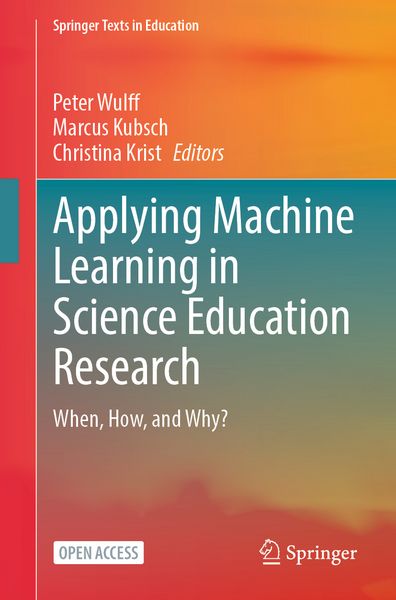
Applying Machine Learning in Science Education Research When, How, and Why?
-
- Englisch ausgewählt
49,99 €
inkl. gesetzl. MwSt.,
Beschreibung
Produktdetails
Einband
Taschenbuch
Erscheinungsdatum
01.03.2025
Abbildungen
XIII, 369 p. 57 illus., 38 illus. in color.
Herausgeber
Peter Wulff + weitereVerlag
SpringerSeitenzahl
369
Maße (L/B/H)
23,5/15,5/2,1 cm
Gewicht
581 g
Sprache
Englisch
ISBN
978-3-031-74226-2
This open access textbook offers science education researchers a hands-on guide for learning, critically examining, and integrating machine learning (ML) methods into their science education research projects. These methods power many artificial intelligence (AI)-based technologies and are widely adopted in science education research. ML can expand the methodological toolkit of science education researchers and provide novel opportunities to gain insights on science-related learning and teaching processes, however, applying ML poses novel challenges and is not suitable for every research context.
The volume first introduces the theoretical underpinnings of ML methods and their connections to methodological commitments in science education research. It then presents exemplar case studies of ML uses in both formal and informal science education settings. These case studies include open-source data, executable programming code, and explanations of the methodological criteria and commitments guiding ML use in each case. The textbook concludes with a discussion of opportunities and potential future directions for ML in science education.
This textbook is a valuable resource for science education lecturers, researchers, under-graduate, graduate and postgraduate students seeking new ways to apply ML in their work.
Noch keine Bewertungen vorhanden
Verfassen Sie die erste Bewertung zu diesem Artikel
Helfen Sie anderen Kundinnen und Kunden durch Ihre Meinung.
Kurze Frage zu unserer Seite
Vielen Dank für Ihr Feedback
Wir nutzen Ihr Feedback, um unsere Produktseiten zu verbessern. Bitte haben Sie Verständnis, dass wir Ihnen keine Rückmeldung geben können. Falls Sie Kontakt mit uns aufnehmen möchten, können Sie sich aber gerne an unseren Kund*innenservice wenden.
zum Kundenservice