Beschreibung
Produktdetails
Format
ePUB
Kopierschutz
Nein
Family Sharing
Nein
Text-to-Speech
Ja
Erscheinungsdatum
23.09.2024
Herausgeber
S. Balasubramaniam + weitereVerlag
De Gruyter MoutonSeitenzahl
289 (Printausgabe)
Dateigröße
3491 KB
Auflage
1. Auflage
Sprache
Englisch
EAN
9783111425511
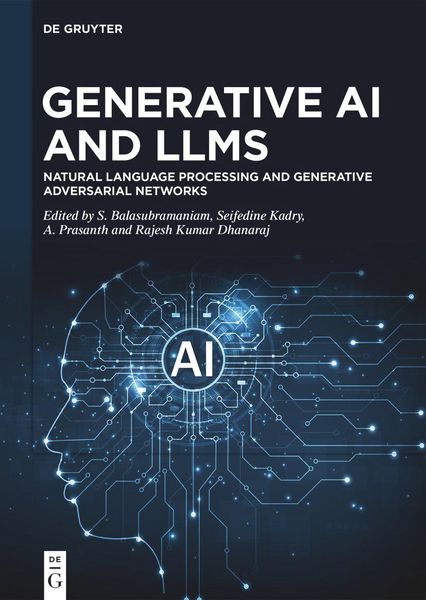
Generative artificial intelligence (GAI) and large language models (LLM) are machine learning algorithms that operate in an unsupervised or semi-supervised manner. These algorithms leverage pre-existing content, such as text, photos, audio, video, and code, to generate novel content. The primary objective is to produce authentic and novel material. In addition, there exists an absence of constraints on the quantity of novel material that they are capable of generating. New material can be generated through the utilization of Application Programming Interfaces (APIs) or natural language interfaces, such as the ChatGPT developed by Open AI and Bard developed by Google.
The field of generative artificial intelligence (AI) stands out due to its unique characteristic of undergoing development and maturation in a highly transparent manner, with its progress being observed by the public at large. The current era of artificial intelligence is being influenced by the imperative to effectively utilise its capabilities in order to enhance corporate operations. Specifically, the use of large language model (LLM) capabilities, which fall under the category of Generative AI, holds the potential to redefine the limits of innovation and productivity. However, as firms strive to include new technologies, there is a potential for compromising data privacy, long-term competitiveness, and environmental sustainability.
This book delves into the exploration of generative artificial intelligence (GAI) and LLM. It examines the historical and evolutionary development of generative AI models, as well as the challenges and issues that have emerged from these models and LLM. This book also discusses the necessity of generative AI-based systems and explores the various training methods that have been developed for generative AI models, including LLM pretraining, LLM fine-tuning, and reinforcement learning from human feedback. Additionally, it explores the potential use cases, applications, and ethical considerations associated with these models. This book concludes by discussing future directions in generative AI and presenting various case studies that highlight the applications of generative AI and LLM.
Noch keine Bewertungen vorhanden
Verfassen Sie die erste Bewertung zu diesem Artikel
Helfen Sie anderen Kundinnen und Kunden durch Ihre Meinung.
Kurze Frage zu unserer Seite
Vielen Dank für Ihr Feedback
Wir nutzen Ihr Feedback, um unsere Produktseiten zu verbessern. Bitte haben Sie Verständnis, dass wir Ihnen keine Rückmeldung geben können. Falls Sie Kontakt mit uns aufnehmen möchten, können Sie sich aber gerne an unseren Kund*innenservice wenden.
zum Kundenservice