KI-Beratung Beta

Gutscheinbedingungen

**Gültig bis 18.11.2026 auf englischsprachige Klassiker (klassiker-32728) online auf thalia.at und in der Thalia App. Einzelne Artikel können ausgeschlossen sein. Ausgenommen sind preisgebundene Artikel & eBooks. Pro Einkauf einmal einlösbar. Click & Collect nur bei Onlinevorabzahlung möglich. Keine Barauszahlung. Nicht kombinierbar mit anderen Aktionen und Gutscheinen. Gutschein wird auf max. 500€ Bestellwert angerechnet. Nicht gültig für Geschenkkarten, Versandkosten und Services.

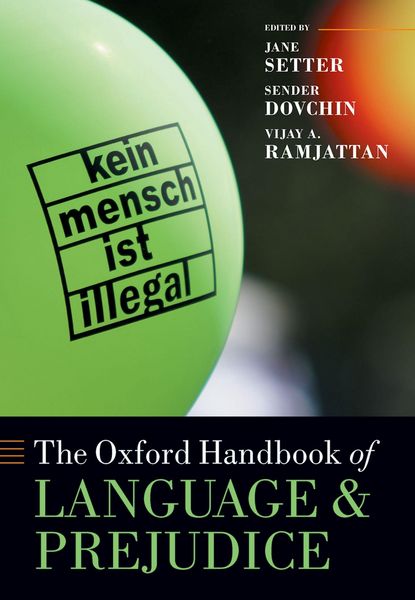
Produktbild: The Oxford Handbook of Language and Prejudice

The Oxford Handbook of Language and Prejudice

259,99 €

inkl. gesetzl. MwSt., Versandkostenfrei


Beschreibung

This volume offers an indepth examination of linguistic prejudice, covering its intersection with racism, sexism, classism, ableism, and various other forms of oppression. It includes perspectives from the Global South and explores initiatives to address prejudice on the basis of language.

Produktdetails

Einband

Gebundene Ausgabe

Erscheinungsdatum

22.12.2025

Herausgeber Jane Setter + weitere
Verlag Oxford Academic

Produktdetails

Einband

Gebundene Ausgabe

Erscheinungsdatum

22.12.2025

Herausgeber
Verlag Oxford Academic
Seitenzahl

960

Maße (L/B/H)

25,2/18/6,2 cm

Gewicht

1833 g

Sprache

Englisch

ISBN

978-0-19-286920-3

Herstelleradresse

Libri GmbH
Europaallee 1
36244 Bad Hersfeld
DE

Email: gpsr@libri.de

Noch keine Bewertungen vorhanden

Verfassen Sie die erste Bewertung zu diesem Artikel

Helfen Sie anderen Kundinnen und Kunden durch Ihre Meinung.

Kundinnen und Kunden meinen

Bewertungen (0)

Die Leseprobe wird geladen.
  • Produktbild: The Oxford Handbook of Language and Prejudice
    • Introduction: Rearticulating Prejudice in Relation to Language
    • Part I. Gender and Sexuality
    • 1: Ting-Fai Yu: Sexism and Sexist Language
    • 2: Jaspal Naveel Singh: Gender and Gendered Language
    • 3: Jordan J. Tudisco: Anti-Trans, Anti-Gender, and Transphobic Language
    • 4: Helen Sauntson: Anti-LGB Language
    • 5: Joe Pearce, Jane Setter, and Amalia Arvaniti: Voice Quality, Pitch, and Gender Discrimination
    • Part II: Ableism
    • 6: George Akanlig-Pare and Mary Edward: Cultural Stigmatization and Linguistic Prejudice in Deaf Education in Ghana
    • 7: Zarana Maheshwari: Language and Discursive Production of Blind Subjects: A Study of Gujarati Small Stories
    • 8: Valéria Aydos, Luiz Henrique Magnani, and Gustavo Henrique Rückert: Linguistic Prejudice and Discrimination against Autistic People
    • 9: Christina Samuelsson, Nicole Müller, and Lars-Christer Hydén: Prejudice and Discrimination against Adults Living with Acquired Cognitive-Communication
    • 10: Rod Hermeston: The Role of Metaphor and Indexicality in the Reinforcement of Social Meanings of Disability
    • Part III: Race and Ethnicity
    • 11: Eldin Milak and Ana Tankosic: 'Racial Blindness' and 'Racial Ignorance' in the Sociolinguistic Arena: The Case of the Balkans and South Korea
    • 12: Federico Faloppa: Xenophobia and Migration
    • 13: Haley De Korne, Judith Purkarthofer, and Maria Obojska: Heritage Languages
    • 14: Yaron Matras: Language Analysis for the Determination of Origin (LADO): A Conflict of Paradigms and its Resolution through New Protocols
    • 15: Laura Smith-Khan: Incredible Language and Refugee Legal Processes: Challenging Asylum Credibility Assessments
    • Part IV: Social Issues
    • 16: Stephanie Dryden, Min Wang, and Sender Dovchin: Accentism
    • 17: Dominic Watt: Dialectism
    • 18: Catherine MacDonald, Christina Peoples, Jenny Inker, and Tracey Gendron: Age, Ageism, and Ageist Language
    • 19: Patrick J. Dillon, Bianca Siegenthaler, and Ambar Basu: Examining Discrimination and Prejudice as Emerging Constructs in Health Communication Scholarship
    • 20: Laura L. Paterson: Poverty and Wealth
    • 21: Gladis Massini-Cagliari: Social Status and Linguistic Prejudice in Brazil
    • 22: Beatha Set, Phillip Mpofu, and Tendai Chari: Language Prejudice and Discrimination on Social Media Platforms in Southern Africa
    • V: Politics and Religion
    • 23: Bridget A. Goodman, Yecid Ortega, and Sandro R. Barros: Politics, Religion, and the Empiring of Languages in Brazil, Colombia, and Ukraine
    • 24: Juan C. Godenzzi: The Symbolic Power of Written Language in the Andes
    • 25: Dariush Izadi: Understanding Linguistic Prejudice through Linguistic Landscapes
    • 26: Shaila Sultana: Language, Religious Determinism, and Prejudices in Digital Spaces: Historical Antecedents of Colonialism
    • Part VI: Educational Perspectives
    • 27: Juldyz Smagulova and Karina Narymbetova: The Representation of Minority People in Kazakhstan School Textbooks: The Invisible 130
    • 28: Vander Tavares and Silvia Melo-Pfeifer: Vulnerability to Raciolinguistic Ideologies within the Language Teaching Profession: From Prejudice to Discrimination
    • 29: Carly Steele, Rhonda Oliver, and Natasha Holzberger: Culturally and Linguistically Diverse Language Learners in the Australian Education System
    • 30: Yidie Xu and Fan Fang: De-Mystifying Linguistic Prejudice and Discrimination in Standard Language Ideology: Towards Decolonizing Language Education
    • 31: Clara Vaz Bauler and Ian Cushing: Language, (De)colonization, and the Curriculum
    • Part VII: Combatting Linguistic Prejudice
    • 32: Beth Malory: Language Guidelines as the Frontier of Anti-Prejudicial Prescriptivism
    • 33: Ruanni Tupas: Combatting Inequalities of Multilingualism Online
    • 34: Rob Drummond and Sadie Ryan: Tackling Linguistic Prejudice through Public Dialogue: The Accentism Project and Accentricity Podcast
    • 35: Vijay A. Ramjattan: Twitter as an Online Counterpedagogy to Linguistic Prejudice
    • 36: Josep Soler and Sergi Morales-Gálvez: Linguistic Prejudice in Academia: The Case of English for Publication Purposes from an Interdisciplinary Angle