Gutscheinbedingungen

**Gültig bis 14.09.2026 auf Spielzeug, Schreibwaren, Filme, Geschenke & Trends, Musik, tolino eReader & Zubehör, Hörbücher, nicht preisgebundene Bücher und Kalender in der Thalia App. Einzelne Artikel können ausgeschlossen sein. Aufgrund der Buchpreisbindung sind deutschsprachige Bücher und eBooks ausgenommen. Zusätzlich ausgenommen sind Abos & Flatrates, Games, Geschenkkarten/-boxen, Shelfies, Software, Zeitschriften sowie einzelne Artikel von tonies®. Pro Einkauf einmal einlösbar. Nur gültig mit im Onlineshop hinterlegter Bonuscard. Click & Collect nur bei Onlinevorabzahlung möglich. Keine Barauszahlung. Nicht kombinierbar mit anderen Aktionen und Gutscheinen. Gutschein wird auf max. 500€ Bestellwert angerechnet. Nicht gültig für Versandkosten und Services.

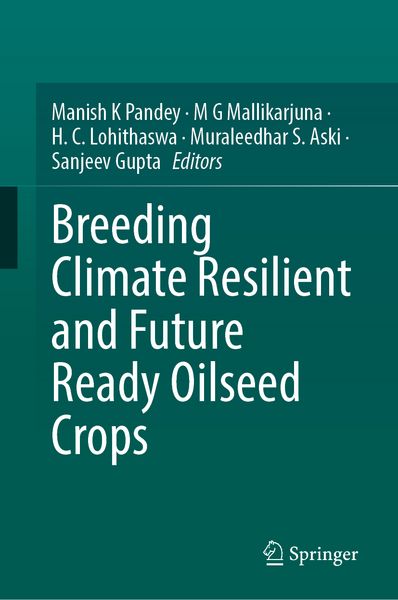
  • Produktbild: Breeding Climate Resilient and Future Ready Oilseed Crops
  • Produktbild: Breeding Climate Resilient and Future Ready Oilseed Crops
- 14%

Breeding Climate Resilient and Future Ready Oilseed Crops

14% sparen

215,99 € UVP 252,99 €

inkl. gesetzl. MwSt., Versandkostenfrei


Beschreibung

Produktdetails

Einband

Gebundene Ausgabe

Erscheinungsdatum

01.02.2025

Abbildungen

XV, 491 p. 21 illus., 20 illus. in color.

Herausgeber

Manish K. Pandey + weitere

Verlag

Springer Singapore

Seitenzahl

491

Maße (L/B/H)

24,1/16/3,3 cm

Gewicht

920 g

Auflage

1. Auflage

Sprache

Englisch

ISBN

978-981-9777-43-3

Beschreibung

Portrait


Manish K. Pandey completed his PhD in Plant Genetics from Osmania University while working at ICAR-Indian Institute of Rice Research (IIRR), Hyderabad, India. He had postdoctoral research experience at the University of Georgia, USA. He currently leads the groundnut and pigeonpea genomics, prebreeding, and bioinformatics research at the International Crops Research Institute for the Semi-Arid Tropics (ICRISAT), Hyderabad, India. He is also an elected fellow of the National Academy of Agricultural Sciences, India, and his contributions are well-cited, with 11,953 Google Scholar citations, an h-index of 60, and an i10-index of 169.


M. G. Mallikarjuna is a Scientist (Genetics and Plant Breeding) at the Division of Genetics, ICAR-Indian Agricultural Research Institute (ICAR-IARI), New Delhi, India. He earned a degree in agricultural sciences from the University of Agricultural Sciences, Dharwad, India. He completed his post-graduation from Acharya NG Ranga Agricultural University, Hyderabad, and earned a doctoral degree from ICAR-IARI, New Delhi, receiving gold medals for his outstanding academic performance. He received several research grants from various national funding agencies. His current research interests include the application of genomics and systems biology to understand the stress responses in crops and model plants, deciphering the evolutionary snapshots of gene families and stress-resilient breeding. To date, he has published 35 research articles in peer-reviewed journals, 10 book chapters, and 3 books. In addition to this, he has been involved in developing 15 hybrid varieties. He is also actively involved in post-graduation teaching and guiding research scholars in their project work.


H. C. Lohithaswa is currently working as a Professor of Genetics and Plant Breeding at the University of Agricultural Sciences (UAS), Bangalore. He holds master’s and doctoral degrees in genetics and plant breeding from UAS, Bangalore, and later served as a postdoctoral researcher at the Plant Genome Mapping Laboratory, University of Georgia, Athens, USA. He has taught many courses to undergraduate and graduate students and received several awards for his scientific contributions. His work on comparative genomics-driven marker discovery helped identify markers that work across both the Poaceae and legume lineage. He has wide experience in QTL mapping, marker-assisted selection, and genomic selection in crops, such as cowpea, pigeonpea, rice, and maize. He has successfully handled several national and international research projects and published over 150 research papers in journals with high impact factors. He was also involved in finger millet and horse gram genome sequencing. Additionally, he has developed and released 20 crop varieties.


Muraleedhar S. Aski is a Senior Scientist specializing in lentil and mungbean breeding at the Division of Genetics, ICAR-Indian Agricultural Research Institute, New Delhi. Previously, he served as a chickpea breeder at ICAR-IIPR, Kanpur. His research focuses on crop improvement using conventional, molecular, and transgenic methods. Dr. Aski earned his bachelor’s degree from UAS, Dharwad, a master’s degree from ANGRAU, Bapatla, and a PhD in genetics from IARI, New Delhi. He has played a key role in developing 15 legume crop varieties, including a highprotein chickpea, IPC 2005-62, and India’s first biofortified lentil, L 4717 (Pusa Agethi). As a faculty member, he teaches and supervises graduate and PhD students. His work on genetic resources, stress evaluations, and nutrient gene mapping earned him the GRISAAS 2019 Young Scientist Award. His research is well-cited, with 994 Google Scholar citations, an H-index of 17, and an i10-index of 30.


Sanjeev Gupta is a distinguished scientist in plant breeding at the Indian Council of Agricultural Research (ICAR), where he currently serves as the Assistant Director General (Oilseed and Pulses) in New Delhi. With over 32 years of expertise in grain legume genetics, he has developed 18 high-yielding cultivars, including the world’s first early-maturing mungbean variety, ‘Virat’, which matures in just 52–55 days. Under his leadership as national coordinator, mungbean and urban production have increased by over 2.5 times in just 8 years, significantly advancing India’s progress towards self-sufficiency in pulses. He has led multiple national and international projects focused on molecular marker-assisted breeding and climate-resilient agriculture. As a distinguished author, he has published nearly 125 research papers and edited 6 books, including popular titles from Springer. He is a Fellow of the National Academy of Agricultural Sciences and has received numerous awards for his contributions to agricultural science.

Produktdetails

Einband

Gebundene Ausgabe

Erscheinungsdatum

01.02.2025

Abbildungen

XV, 491 p. 21 illus., 20 illus. in color.

Herausgeber

Verlag

Springer Singapore

Seitenzahl

491

Maße (L/B/H)

24,1/16/3,3 cm

Gewicht

920 g

Auflage

1. Auflage

Sprache

Englisch

ISBN

978-981-9777-43-3

Herstelleradresse

Springer-Verlag KG
Sachsenplatz 4-6
1201 Wien
AT

Email: ProductSafety@springernature.com

Noch keine Bewertungen vorhanden

Verfassen Sie die erste Bewertung zu diesem Artikel

Helfen Sie anderen Kundinnen und Kunden durch Ihre Meinung.

Kundinnen und Kunden meinen

Bewertungen (0)

  • Produktbild: Breeding Climate Resilient and Future Ready Oilseed Crops
  • Produktbild: Breeding Climate Resilient and Future Ready Oilseed Crops

  • Chapter 1. Introduction: Breeding Climate Resilient and Future Ready Oilseed Crops.- Chapter 2. Genomics, Pan-Genomics and Super Pan-Genomics of Major Oilseed Crops.- Chapter 3. Genetic Enhancement of Abiotic Stress Tolerance in Oilseeds through Contemporary Breeding Approaches.- Chapter 4. Breeding for Insect Pests Resistance in Oilseed Crops through Genomics Assisted Breeding.- Chapter 5. Breeding oil seed crops for resistance to fungal pathogens through genomics-assisted breeding.- Chapter 6. Genomic Approaches for Achieving Higher Nutrient Use Efficiency in Oilseeds.- Chapter 7. Application of Novel Breeding Methods to Achieve Rapid Genetic Gain in Oilseed Crops.- Chapter 8. Advances in Plant Phenotyping for Climate Resilient Oilseeds Breeding.- Chapter 9. Genome Editing: A Novel Breeding Strategy for Enhanced Stress Tolerance and Quality in Oil Seed Crops.- Chapter 10. Breeding Climate-Resilient Groundnut in the Climate Change Era: Current Breeding Strategies and Prospects.- Chapter 11. Breeding climate resilient Rapeseed-Mustard in climate change era: Current breeding strategies and prospects.- Chapter 12. Breeding Climate Resilient Soybean in Climate Change Era: Current Breeding Strategies and Prospects.- Chapter 13. Breeding climate-resilient sunflowers in the climate change era: Current breeding strategies and prospects.- Chapter 14. Adaption of next-generation breeding tools in the improvement of minor oilseed crops: Status and prospects.- Chapter 15. Breeding for high oleate oilseed crops: Opportunities, constraints, and prospects.- Chapter 16. Global Status of Genetic, Genomic and Bioinformatics Resources for Genetic Enhancement of Oilseed Crops.