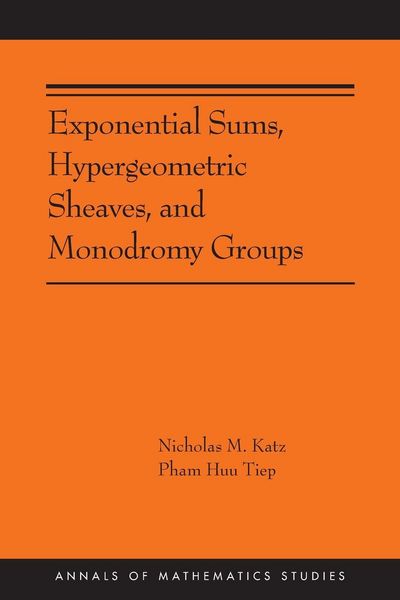
Exponential Sums, Hypergeometric Sheaves, and Monodromy Groups
-
- Hardcover
- Taschenbuch ausgewählt
- eBook
-
Sprache:Englisch
91,99 €
inkl. gesetzl. MwSt.,
Beschreibung
Produktdetails
Einband
Taschenbuch
Erscheinungsdatum
24.06.2025
Verlag
University PressesSeitenzahl
600
Maße (L/B/H)
23,4/15,6/3,2 cm
Gewicht
898 g
Sprache
Englisch
ISBN
978-0-691-27225-2
An examination of some of the remarkable connections between group theory and arithmetic algebraic geometry over finite fields
Exponential sums have been of great interest ever since Gauss, and their importance in analytic number theory goes back a century to Kloosterman. Grothendieck’s creation of the machinery of l-adic cohomology led to the understanding that families of exponential sums give rise to local systems, while Deligne, who gave his general equidistribution theorem after proving the Riemann hypothesis part of the Weil conjectures, established the importance of the monodromy groups of these local systems. Deligne’s theorem shows that the monodromy group of the local system incarnating a given family of exponential sums determines key statistical properties of the family of exponential sums in question. Despite the apparent simplicity of this relation of monodromy groups to statistical properties, the actual determination of the monodromy group in any particular situation is highly nontrivial and leads to many interesting questions.
This book is devoted to the determination of the monodromy groups attached to various explicit families of exponential sums, especially those attached to hypergeometric sheaves, arguably the simplest local systems on G_m, and to some simple (in the sense of simple to write down) one-parameter families of one-variable sums. These last families turn out to have surprising connections to hypergeometric sheaves. One of the main technical advances of this book is to bring to bear a group-theoretic condition (S+), which, when it applies, implies very strong structural constraints on the monodromy group, and to show that (S+) does indeed apply to the monodromy groups of most hypergeometric sheaves.
Noch keine Bewertungen vorhanden
Verfassen Sie die erste Bewertung zu diesem Artikel
Helfen Sie anderen Kundinnen und Kunden durch Ihre Meinung.
Kurze Frage zu unserer Seite
Vielen Dank für Ihr Feedback
Wir nutzen Ihr Feedback, um unsere Produktseiten zu verbessern. Bitte haben Sie Verständnis, dass wir Ihnen keine Rückmeldung geben können. Falls Sie Kontakt mit uns aufnehmen möchten, können Sie sich aber gerne an unseren Kund*innenservice wenden.
zum Kundenservice