KI-Beratung Beta

Gutscheinbedingungen

**Gültig bis 30.11.2026 auf Spielzeug, Schreibwaren, Filme, Geschenke & Trends, Musik, tolino eReader & Zubehör, Hörbücher und Hörbuch-Downloads, nicht preisgebundene Bücher und Kalender online auf thalia.at und in der Thalia App. Einzelne Artikel können ausgeschlossen sein. Aufgrund der Buchpreisbindung sind deutschsprachige Bücher und eBooks ausgenommen. Zusätzlich ausgenommen sind Abos & Flatrates, Games, Geschenkkarten/-boxen, Shelfies, Software, Zeitschriften sowie einzelne Artikel von tonies®. Pro Einkauf einmal einlösbar. Nur gültig mit im Onlineshop hinterlegter Bonuscard. Click & Collect nur bei Onlinevorabzahlung möglich. Keine Barauszahlung. Nicht kombinierbar mit anderen Aktionen und Gutscheinen. Gutschein wird auf max. 500€ Bestellwert angerechnet. Nicht gültig für Versandkosten und Services.

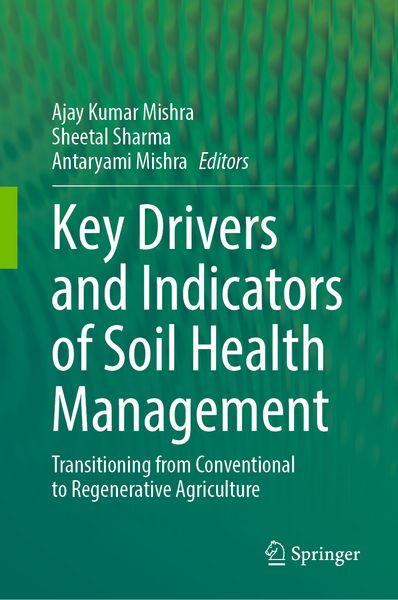
Produktbild: Key Drivers and Indicators of Soil Health Management
- 12%

Key Drivers and Indicators of Soil Health Management Transitioning from Conventional to Regenerative Agriculture

12% sparen

192,99 € UVP 219,99 €

inkl. gesetzl. MwSt., Versandkostenfrei


Beschreibung

This book explores the crucial transition from conventional to regenerative agriculture practices, focusing on the key drivers and indicators of soil health management. It provides knowledge to implement sustainable agricultural systems that prioritize soil health and foster the transition toward regenerative...

Beschreibung

This book explores the crucial transition from conventional to regenerative agriculture practices, focusing on the key drivers and indicators of soil health management. It provides knowledge to implement sustainable agricultural systems that prioritize soil health and foster the transition toward regenerative practices. This book delves into the principles and concepts of soil health, the challenges and limitations of conventional agriculture, the assessment of soil health through various indicators, and the importance of cover crops, crop rotation, conservation tillage, nutrient management, and water conservation practices. It also addresses the role of soil biodiversity, policy frameworks, and scaling up regenerative agriculture, providing practical strategies and case studies.


The target audience for this book ranges from students and researchers to policymakers and large-scale farmers. Farmers will benefit from the practical insights and strategies presented, and policymakers and agricultural organizations can gain valuable knowledge on the drivers and policy frameworks supporting sustainable agriculture and soil health management.

Portrait


Dr. Ajay Kumar Mishra
is currently working as a senior associate scientist at International Rice Research Institute (IRRI). Dr. Mishra's primary research focus is development and implementation of the rice crop manager tool, an ICT-based platform that delivers context-specific rice farming management technologies. His work is particularly targeted towards small-scale farmers in India, where the application of these technologies helps improve profitability and productivity in rice and rice-based agri-food farming. Dr. Mishra is also dedicated to developing low-cost innovative technologies for climate-smart agriculture and ensuring their adoption by the farming community. Mishra's research contributions are significant, as evident from his authorship and co-authorship of over 30 scientific papers in peer-reviewed journals and book chapters.


Dr. Sheetal Sharma
is currently working as a senior scientist in the field of soil science, at International Rice Research Institute (IRRI). With a strong background in agricultural research, Dr. Sharma has made significant contributions to the understanding of soil fertility, nutrient management, and sustainable rice production. Dr. Sharma holds a Ph.D. in Soil Science and has amassed over 15 years of experience in agricultural research and development. Her areas of research interests are soil fertility, nutrient cycling, and the impact of agricultural practices on soil health. She has conducted extensive research on the optimization of nutrient management strategies for rice production, focusing on improving crop productivity while minimizing environmental impacts. She has collaborated with international research organizations, government agencies, and farmer communities to develop and promote sustainable agricultural practices in rice-growing regions. Dr. Sharma's research findings have been published in reputable scientific journals, and she has also contributed to various technical reports and publications.


Dr. Antaryami Mishra
is a renowned expert in the field of soil science, affiliated with the Orissa University of Agriculture and Technology (OUAT) in Bhubaneshwar, India. Dr. Mishra has made significant contributions to the study and understanding of soil health management and sustainable agricultural practices. He holds a Ph.D. in soil science and has established himself as a prominent researcher and academician in the field. He has authored numerous research papers, book chapters, and technical reports that have contributed to the advancement of knowledge in soil fertility, nutrient management, and soil health assessment. He has collaborated with government agencies, NGOs, and farmer communities to promote sustainable agricultural practices and raise awareness about soil conservation, nutrient management, and sustainable land use.

Produktdetails

Einband

Gebundene Ausgabe

Erscheinungsdatum

21.12.2024

Abbildungen

XVI, 195 p. 25 illus., 24 illus. in color.

Herausgeber Ajay Kumar Mishra + weitere

Produktdetails

Einband

Gebundene Ausgabe

Erscheinungsdatum

21.12.2024

Abbildungen

XVI, 195 p. 25 illus., 24 illus. in color.

Herausgeber
Verlag Springer Singapore
Seitenzahl

195

Maße (L/B/H)

24,1/16/1,7 cm

Gewicht

475 g

Auflage

1. Auflage

Sprache

Englisch

ISBN

978-981-9775-63-7

Herstelleradresse

Springer-Verlag KG
Sachsenplatz 4-6
1201 Wien
AT

Email: ProductSafety@springernature.com

Noch keine Bewertungen vorhanden

Verfassen Sie die erste Bewertung zu diesem Artikel

Helfen Sie anderen Kundinnen und Kunden durch Ihre Meinung.

Kundinnen und Kunden meinen

Bewertungen (0)

  • Produktbild: Key Drivers and Indicators of Soil Health Management

  • .- Chapter 1_Regenerative Agriculture: A Multifaceted Approach to One Health and Soil Restoration.


    .- Chapter 2_Optimizing Soils for Regenerative Agriculture: A Case Study in Odisha. 


    .- Chapter 3_Assessing Soil Microbial Communities in Regenerative Agriculture: Methods and Impacts on Soil-Plant Interactions. 


    .- Chapter 4_Framework for Soil Health Assessment under Different Land Uses.


    .- Chapter 5_Regenerative Agriculture: Inclusive Approach for Transforming Conventional Agriculture. 


    .- Chapter 6_Digital Innovations for Agro Advisory Services for Soil and Land Management.


    .- Chapter 7_Nutrient Management and Fertilizer Optimization. 


    .- Chapter 8_Pathways for Assessment and Managing Soil Biodiversity. 


    .- Chapter 9_Efficient Water Management Strategies and Recharge Potential. 


    .- Chapter 10_Adoption and Scaling Regenerative Agriculture: Strategies for Sustainable Resource Management in Rice-Based Systems.