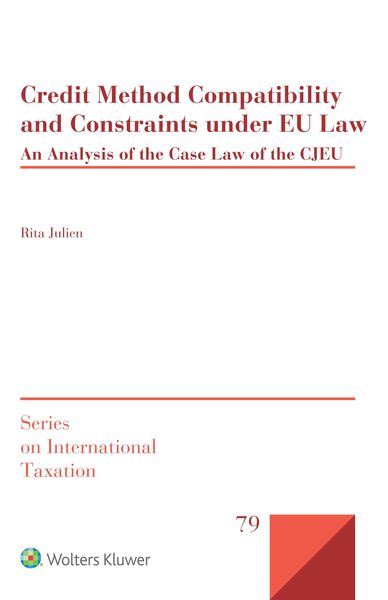
Credit Method Compatibility and Constraints under EU Law An Analysis of the Case Law of the CJEU
-
- Einzelkauf Download ausgewählt
-
Sprache:Englisch
-
eBook Format:ePUB
- PDF 178,90 €
- ePUB 178,90 € ausgewählt
178,90 €
inkl. gesetzl. MwSt.Beschreibung
Produktdetails
Format
ePUB
Kopierschutz
Ja
Family Sharing
Ja
Text-to-Speech
Ja
Erscheinungsdatum
13.01.2022
Verlag
Wolters KluwerSeitenzahl
568 (Printausgabe)
Dateigröße
2989 KB
Sprache
Englisch
EAN
9789403523644
As European Union (EU) Member States seek to counteract base erosion and profit shifting (BEPS) practices while avoiding new obstacles to the EU's internal market such as double taxation, the credit method, also known as the foreign tax credit, is one of the essential tools in this balancing act, yet it is one that has given rise to various EU law challenges and questions. This invaluable book - the first in-depth study of the EU law constraints on designing the credit method - delineates the EU law boundaries within which the Member States must operate when they implement this method of tax relief.
For the first time, the Court of Justice of the European Union (CJEU) cases that may affect, directly or indirectly, the credit method and its main components are systematically identified and analysed in order to extract the legal findings and principles that define the contours within which the Member States can manoeuvre when considering EU-compatible approaches to the credit method. To this end, among others, this book offers:
an extensive study of the historical legal developments of the credit method;
an overview of the key design features of the credit method, considering the optional, variable components, such as the credit limitation (maximum creditable amount), that tailor it to different legal and policy considerations;
an analysis of the legal constraints on the key features of the credit method flowing from CJEU case law on the fundamental freedoms, considering the impact of landmark cases and concepts (e.g., Schumacker, neutralization);
the EU law implications based on the type of credit method (direct, indirect, imputation) and the feature of the credit method (e.g., credit limitation, credit carryforward); and
examples to clearly and concisely illustrate the basic operation of the credit method and some of the main calculation and EU law issues.
The author's doctoral dissertation, on which the book is based, was awarded the Wolfgang Gassner Science Prize 2020 and the European Doctoral Tax Thesis Award 2020.
As a timely, comprehensive and practical study of the relationship between the credit method and EU law, this book will be welcomed by lawyers and other professionals working with taxation matters, as well as by tax policymakers and academics in the fields of international and European tax law.
Noch keine Bewertungen vorhanden
Verfassen Sie die erste Bewertung zu diesem Artikel
Helfen Sie anderen Kundinnen und Kunden durch Ihre Meinung.
Kurze Frage zu unserer Seite
Vielen Dank für Ihr Feedback
Wir nutzen Ihr Feedback, um unsere Produktseiten zu verbessern. Bitte haben Sie Verständnis, dass wir Ihnen keine Rückmeldung geben können. Falls Sie Kontakt mit uns aufnehmen möchten, können Sie sich aber gerne an unseren Kund*innenservice wenden.
zum KundenserviceWeitere Artikel finden Sie in
- eBooks >
- Fachbücher >
- Recht