Gutscheinbedingungen

**Gültig bis 17.08.2026 auf Schreibwaren & Office-Artikel online auf thalia.at, in der Thalia App und in teilnehmenden Thalia Buchhandlungen in Österreich mit Schulsortiment. In den Buchhandlungen nur gültig auf lagernde Ware. Einzelne Artikel können ausgeschlossen sein. Ausgenommen sind preisgebundene Artikel. Pro Einkauf einmal einlösbar. Nur gültig gegen Vorlage oder im Onlineshop hinterlegter Bonuscard. Infos zur Einlösung in der Buchhandlung sind auf der Bonuscard-Vorteilspreisseite zu finden. Click & Collect nur bei Onlinevorabzahlung möglich. Keine Einlösung bei Scan & Go-Bezahlung. Keine Barauszahlung. Nicht kombinierbar mit anderen Aktionen und Gutscheinen. Gutschein wird auf max. 500€ Bestellwert angerechnet. Nicht gültig für Geschenkkarten, Versandkosten und Services.

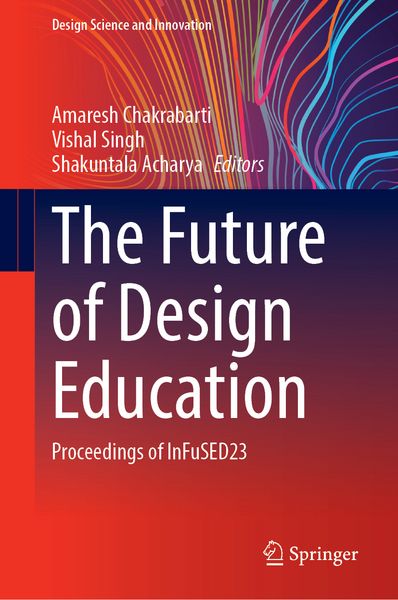
  • Produktbild: The Future of Design Education
  • Produktbild: The Future of Design Education
- 13%

The Future of Design Education Proceedings of InFuSED23

13% sparen

209,99 € UVP 241,99 €

inkl. gesetzl. MwSt., Versandkostenfrei


Beschreibung

Produktdetails

Einband

Gebundene Ausgabe

Erscheinungsdatum

26.03.2025

Herausgeber

Amaresh Chakrabarti + weitere

Verlag

Springer Singapore

Seitenzahl

265

Maße (L/B/H)

24,1/16/2,2 cm

Gewicht

549 g

Auflage

1. Auflage

Sprache

Englisch

ISBN

978-981-9773-62-6

Beschreibung

Portrait

Professor Amaresh Chakrabarti  is a Senior Professor and Chair, Department of Design and Manufacturing, Indian Institute of Science, Bangalore. He published 23 books, 310 articles, 14 patents, and co-authored DRM, a framework for design research. He is the Founding-Chair of ICoRD conferences, an Honorary Fellow of the Institution of Engineering Designers, UK, and a recipient of: Jawaharlal Nehru Fellowship for Cambridge University (India-UK), ORS Award, Lundgren Award, MIAA Commendation Award (UK), and TUM Ambassador Award, Germany. He is the Editor-in-Chief for AI-EDAM Journal (CUP). 

Professor Vishal Singh  is an Associate Professor at the Department of Design and Manufacturing, Indian Institute of Science, Bangalore, where he leads the IMPACT4IMPACT Lab. He researches design, computational, and systems thinking for diverse application domains. He is a co-founder of SpaCyPhy Tech Pvt Ltd., a technology-based start-up. He has previously worked in various academic roles in Finland and Australia. He received his PhD from the University of Sydney, a Master’s from IISc Bangalore, and a Bachelor’s from BIT Mesra.

Dr. Shakuntala Acharya  is an architect and an Assistant Professor at the Department of Design, Indian Institute of Technology, Guwahati. During her doctoral study at Indian Institute of Science (IISc), Bengaluru, she was selected as design scholar for the IUSSTF Joint Center of Excellence for Sustainability and was the recipient of the JASSO Scholarship from Japan Advanced Institute of Science and Technology (JAIST), Japan. Her areas of interest are Design education and pedagogy; Creativity and design methodology, and Sustainability in smart built environment. 

Produktdetails

Einband

Gebundene Ausgabe

Erscheinungsdatum

26.03.2025

Herausgeber

Verlag

Springer Singapore

Seitenzahl

265

Maße (L/B/H)

24,1/16/2,2 cm

Gewicht

549 g

Auflage

1. Auflage

Sprache

Englisch

ISBN

978-981-9773-62-6

Herstelleradresse

Springer-Verlag KG
Sachsenplatz 4-6
1201 Wien
AT

Email: GPSR Kontakt

Noch keine Bewertungen vorhanden

Verfassen Sie die erste Bewertung zu diesem Artikel

Helfen Sie anderen Kundinnen und Kunden durch Ihre Meinung.

Kundinnen und Kunden meinen

Bewertungen (0)

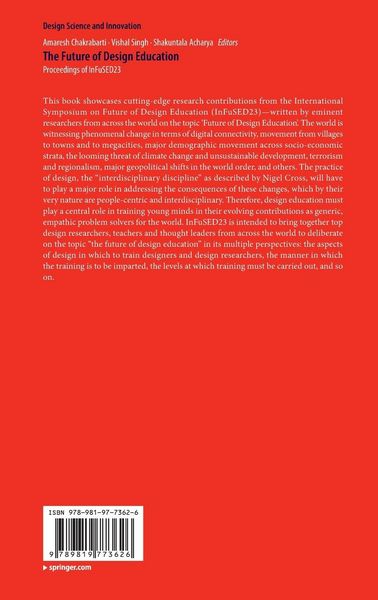
  • Produktbild: The Future of Design Education
  • Produktbild: The Future of Design Education
  • The Future of Design Education – The Real Shift.- Imagine if Gropius was born 100 years later.- Cognitive Diversity as the New Frontier of Design Process.- Interplays between learning theories.- The Interaction Between Design Thinking, Systems Thinking, and Computational Thinking.- Is PhD an Essential Qualification for Permanent Faculty Members in Design at a University.- Competency based Design Education.- The ‘D’ in Design : What drives design students.- Decentralized Autonomous Social Innovation Design and Social Creativity in a Connected Society.- The Stimulus-Based Pedagogy to Understand Target Audience in Design Education.- Design Futures; a new educational framework for design education for the 21st Century.- Future of Design Education: Using the DESINNO Project as the Case Study.- Experiences of Design for Disability in Collaborating with Students and Industries.- Creating online courses: Framework for an effective delivery.- On a Self-Tutoring System for Managing Engineering Design Students’ Learning through Reflection on Doing.- Implementation of “Design Practice” Experience in a Regular Lecture-Based Machine Design Class with a Large Student Population.- Technical training programme for future teachers. Benefits for engineering education.