Forum Internationale: The New German Arbitration Law in International Perspective The New German Arbitration Law in International Perspective
-
- Einzelkauf Download ausgewählt
-
Sprache:Englisch
77,10 €
inkl. gesetzl. MwSt.Beschreibung
Produktdetails
Format
Kopierschutz
Ja
Family Sharing
Ja
Text-to-Speech
Nein
Erscheinungsdatum
01.10.2000
Verlag
Wolters KluwerSeitenzahl
76 (Printausgabe)
Dateigröße
2650 KB
Sprache
Englisch
EAN
9789041174314
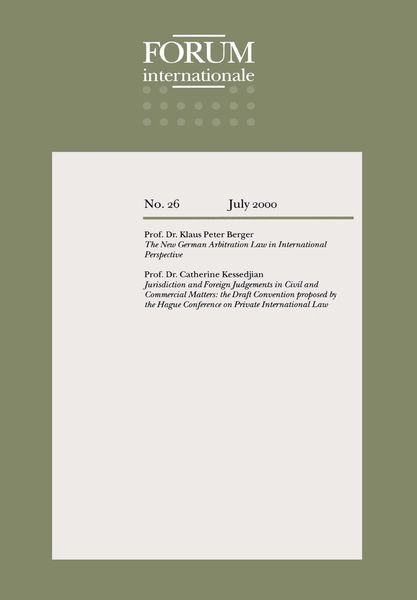
Full Title: The New German Arbitration Law in International Perspective Jurisdiction and Foreign Judgements in Civil And Commercial Matters: The Draft Convention Proposed by the Hague Conference on Private International Law The contents of no. 26 of the `Forum Internationale'' series are related to procedural law. The first lecture has been written by well-known author Klaus Peter Berger and deals with the new German Arbitration Act.
Mr. Berger provides a brief account of the drafting history of the new law, highlights six important areas of international arbitration law and practice, and explains the solutions chosen by the German legislator. He treats, among other topics, arbitrability, arbitral interim relief and conflict of laws. An English translation of the German Arbitration Act can be found at the end of the text.
The second lecture is written by Catherine Kessedjian and has as its topic the future Hague Convention on International Jurisdiction and Recognition and Enforcement. As deputy Secretary-General of the Hague Conference on Private International Law, Mrs. Kessedjian is heavily involved in the activities concerning this convention.
The lecture discusses the need for such a convention and the structure such a convention could adapt (single, double or mixed). Furthermore some grounds for jurisdiction, such as those for disputes relating to contracts and torts, the forum non conveniens and provisional measures, are discussed in more depth, as are the basic requirements for enforcement.
At the end the question is raised which mechanism can be devised to create a forum in which questions of interpretation can be solved in an easy and quick manner and against low costs, and how uniform interpretation can be guaranteed.
Noch keine Bewertungen vorhanden
Verfassen Sie die erste Bewertung zu diesem Artikel
Helfen Sie anderen Kundinnen und Kunden durch Ihre Meinung.
Kurze Frage zu unserer Seite
Vielen Dank für Ihr Feedback
Wir nutzen Ihr Feedback, um unsere Produktseiten zu verbessern. Bitte haben Sie Verständnis, dass wir Ihnen keine Rückmeldung geben können. Falls Sie Kontakt mit uns aufnehmen möchten, können Sie sich aber gerne an unseren Kund*innenservice wenden.
zum Kundenservice