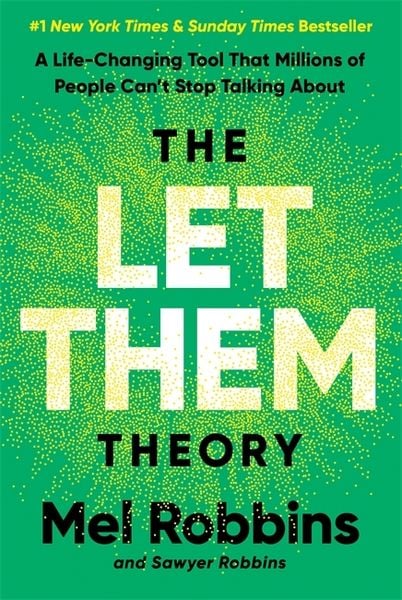
Produktbild: The Let Them Theory

The Let Them Theory A Life-Changing Tool That Millions of People Can't Stop Talking About

7

29,99 €

inkl. gesetzl. MwSt., zzgl. Versandkosten


  • Kostenlose Lieferung ab 30 € Einkaufswert
  • Versandkostenfrei für Bonuscard-Kund*innen

Beschreibung

Produktdetails

Verkaufsrang

154

Einband

Gebundene Ausgabe

Erscheinungsdatum

24.12.2024

Verlag

Hay House UK Ltd

Seitenzahl

336

Maße (L/B/H)

23,2/15,9/3,6 cm

Gewicht

529 g

Sprache

Englisch

ISBN

978-1-78817-618-7

Beschreibung

Produktdetails

Verkaufsrang

154

Einband

Gebundene Ausgabe

Erscheinungsdatum

24.12.2024

Verlag

Hay House UK Ltd

Seitenzahl

336

Maße (L/B/H)

23,2/15,9/3,6 cm

Gewicht

529 g

Sprache

Englisch

ISBN

978-1-78817-618-7

EU-Ansprechpartner

Penguin Random House Ireland
Morrison Chambers, 32 Nassau Street
D02 YH68 Dublin
IE
https://eu-contact.penguin.ie

Herstelleradresse

Hay House Inc
33 Notting Hill Gate
W11 3JQ London
UK
https://hayhouse.zendesk.com/hc/en-us

Kundinnen und Kunden meinen

Informationen zu Bewertungen

Zur Abgabe einer Bewertung ist eine Anmeldung im Konto notwendig. Die Authentizität der Bewertungen wird von uns nicht überprüft. Wir behalten uns vor, Bewertungstexte, die unseren Richtlinien widersprechen, entsprechend zu kürzen oder zu löschen.

Die Bewertungen sind nach Format, Anzahl Sterne und Datum sortiert.

  • Bewertung

    5/5

    09.12.2025

    Buch (Gebundene Ausgabe)

    Powerful and freeing — this book taught me how to let go and find peace.

    Mel Robbins’ The Let Them Theory is a refreshingly direct and emotionally liberating guide to navigating human relationships in a healthier, more grounded way. What makes this book both powerful and surprisingly comforting is its central premise: you cannot control other people—what they do, how they think, or how they behave—so the most freeing response is simply to let them. This idea sounds deceptively simple, but Robbins demonstrates how this mindset shift can dramatically reduce stress, protect emotional energy, and foster inner peace. Robbins frames the “Let Them” approach not as indifference or disengagement, but as an act of emotional intelligenceand boundary-setting. Many of us unconsciously carry the burden of managing others’ expectations, smoothing over conflicts, or anticipating disappointment. Robbins argues that this constant mental and emotional labor is unsustainable. When we try to control what is fundamentally uncontrollable, we trap ourselves in cycles of frustration and anxiety. Letting people be who they are—without trying to reshape their choices—creates space for healthier, more authentic interactions. One of the most practical tools Robbins introduces is the 3-second rule. Whenever something triggers you—a rude comment, someone’s lateness, a negative reaction—you pause for three seconds before responding. This tiny moment interrupts the automatic emotional loop and allows for intentional decision-making. It’s astonishing how such a small pause can change the tone of a conversation, defuse irritation, or help you choose silence over needless conflict. Robbins presents it not as a technique for suppressing emotion, but for reclaiming your power to respond thoughtfully rather than react impulsively. Robbins’ writing is warm, conversational, and infused with her trademark candor. She blends personal anecdotes, reader stories, and everyday scenarios to make the concepts feel immediately relevant. Whether she’s talking about navigating family tensions, managing friendships, or dealing with work dynamics, her tone is empathetic and deeply relatable. She never promises that adopting the Let Them mindset will make life effortless; instead, she acknowledges that acceptance is a repeated, intentional practice—one that builds emotional resilience over time. Critically, some readers may find the book repetitive, especially because the core message—let them do what they’re going to do—appears throughout. But much like meditation or habit-building, this repetition is a feature, not a flaw. Internalizing the Let Them Theory requires hearing it, applying it, and hearing it again. Its power lies in its simplicity and consistency. What sets this book apart from other self-help guides is its emotional realism. Robbins does not sugarcoat the fact that letting go can be uncomfortable, especially for people pleasers or overthinkers. But she makes a compelling case that acceptance is not passive—it is a form of strength. Instead of wasting energy on what you can’t influence, you invest it in what you can: your reactions, your boundaries, your peace. In a world filled with constant comparison, overstimulation, and interpersonal pressure, The Let Them Theory offers a grounding counter-message. It’s short, accessible, and deeply resonant. For anyone exhausted by drama, drained by others’ expectations, or longing for a calmer way of living, this book is both a relief and a revelation.

  • Sayra Akyol

    5/5

    06.12.2025

    Buch (Gebundene Ausgabe)

    Great Book

    I thought this would be just another hyped-up TikTok self-help book, but I actually really enjoyed it and have found myself using the tips Mel Robbins gives in her book. Firstly, I liked how she began the book by sharing a personal story about how she came to embrace the 'Let Them' theory. I like how personal everything feels in general. With self-help books, one might feel as if the author is superior and has everything figured out. But Mel feels like a friend. By always giving examples from her own life or that of her friends, she makes it feel like she is just like everyone else, struggling with the same everyday things. She is very relatable. I love how she goes beyond 'Let Them' and introduces 'Let ME'. Mel writes about how we can't control certain things, but we should take control of the things we can. I think it's helpful to ask myself, when something is bothering me, if there's anything I can really do about it. If the answer is yes, I should do it; if not, I shouldn't worry about it. Nowadays, people often think that if their friends don't text them, it's their friends' fault, or that their friends are jerks if they don't invite them. However, Mel encourages you to also ask yourself why you might not be invited. If I want to be included, I realize that I have to take matters into my own hands. I can write to people who are important to me, even if they don't always reply. She makes it clear that not everything is a personal attack. I could relate to a lot of what she said, such as when she talked about seeing photos of some of her friends gathering and wondering why she wasn't there. I knew exactly how she felt, but with some other themes I couldn’t relate, for example, to a part of the book where she mostly talks about job situations, such as having a boss you don’t like, because I am a student and don't have a job. Some chapters are not as relatable if you don't have the same living situation. I often struggle with emotional reactions from people in my life who don't communicate their problems but instead shut down and ignore me. She helped me to see that this is their issue, not mine. When they are ready, they will talk about it; it is not my responsibility to force an adult to discuss their problems. She also helped me realize that constantly telling someone to do something, such as eating healthily and going to the gym, can have the opposite effect and just pressure them. She helped me realize that in future I want to stop commenting and pressuring them so often as it just builds tension. However, I still find it a bit difficult because some people just need that push, and if no one told them, they would never do it. So I don’t 100% agree with her on that topic but still get what she means by that and that the passive aggressive comments are hurtful and not helping.

  • Chiara G

    5/5

    05.12.2025

    Buch (Gebundene Ausgabe)

    This book is for you and your loved ones, it opens your eyes.

    I very much enjoyed reading the „Let them Theory“ by Mel Robbins. I was already familiar with her podcasts, which I find very interesting, so I was happy to finally read her book. Although I was rather sceptical at first, thinking it would just be another collection of quotes about life lessons and feel good motivators, but I was wrong. Mel Robbins has somehow managed to captivate me like no other similar book ever has. The way she shed light on certain topics made me realise many things about life, opening my eyes to various issues. While reading the book I often found myself in situations similar to those described in the book. For example, chapter 6 is about the family that is not changing. I love my family with all my heart and perhaps I love them so much that I want to help them solve their problems more than they want to solve them themselves. Her quotes: „the only person you can change is you“, „let adults be adults“ and „ acceptance allows you to see the family with compassion“ spoke directly to my heart. I found myself in everyday situations where I realised that I was acting wrong for the right reasons. Mel Robbins gave me the right impulses to try and work on myself to ensure that I am not destroying my relationships but rather try to be a better person and not always try to change people's behaviours. I very much enjoyed her invitations to join in exercises for example: The 5 whys, where you have to ask yourself why something bothers you. I am trying to embed this task into my everyday life. Chapter 10 was also very insightful for me to read. It approaches jealousy with honesty. Jealousy often mirrors our real desires. We envy what we secretly want to pursue. Her example about her interior design friend who was so jealous of this other person being successful, was very powerful. It reminded me of myself, how I personally didn’t dare to pursue my dreams of becoming a musician, but the girl next door did and she became successful which made me envy her so much. This realisation through the book and the fact why I was so jealous prompts me to finally start pursuing my dreams, so thank you. And one more chapter I would like to point out is Chapter 16 which was another valuable life lesson for myself. “The process of getting better often feels worse than staying the same”. This means that changing is uncomfortable and needs a lot of energy because you have to face everything you usual ignore. The book says: “No one gets sober until being drunk is more painful than facing what they’re running from”, this basically brings it to the point, that healing is a choice, everyone has to make for themselves. As a psychology student, I am familiar with various processes of human behaviour, different personalities and how the brain works. I was therefore doubtful that with my existing background knowledge, I would perceive all the life lessons written down in the book as nonsense, but I was clearly proven wrong.

  • Bewertung

    5/5

    24.07.2025

    Buch (Gebundene Ausgabe)

    DAS BESTE BUCH ALLERZEITEN!!!

    Ihr müsst es definitiv alle gelesen haben. Wirklich nur WOW! Es war so mega gut, es war eins der aller besten die ich lesen durfte. In sovielen Aspekten extrem lehrreich. Tut euch einen gefallen und liest es bitte.

  • Tessa

    4/5

    15.02.2025

    Buch (Gebundene Ausgabe)

    Rezension

    Das Buch bietet einen Ansatz, um das eigene Leben zurückzugewinnen, indem man loslässt, was man nicht kontrollieren kann: andere Menschen. Durch vier einfache Worte – “Let them. Let me.” – zeigt Robbins, wie man sich von den Meinungen, Dramen und Erwartungen anderer befreien kann, um den eigenen Frieden und das Wohlbefinden zu schützen. Während das Prinzip des Loslassens nicht völlig neu ist, hat Robbins es auf eine zugängliche und praxisnahe Weise verpackt.

Kundinnen und Kunden meinen

5

5

4

1

3

0

2

0

1

1

Bewertungen (7)

Weitere Artikel finden Sie in

Die Leseprobe wird geladen.
  • Produktbild: The Let Them Theory