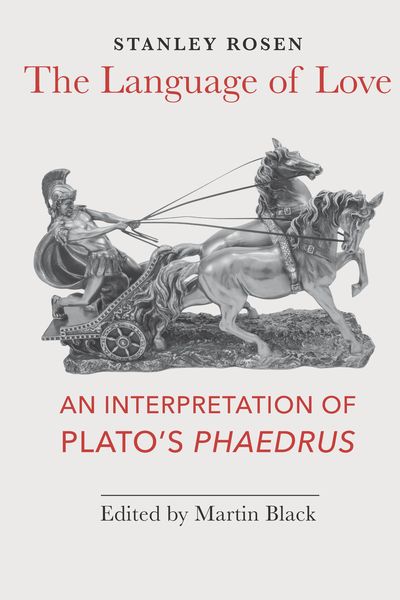
Language of Love An Interpretation of Plato''s Phaedrus
28,30 €
inkl. gesetzl. MwSt.Beschreibung
Produktdetails
Format
ePUB
Kopierschutz
Ja
Family Sharing
Ja
Text-to-Speech
Ja
Erscheinungsdatum
29.10.2021
Herausgeber
Black Martin BlackVerlag
St Augustine's PressSeitenzahl
305 (Printausgabe)
Dateigröße
557 KB
Sprache
Englisch
EAN
9781587314599
Stanley Rosen completed The Language of Love in the early 1970s, but the manuscript was put aside and only rediscovered in 2013, the year before his death. The Language of Love is an interpretation of the Phaedrus that was meant to follow and complete Rosen's Symposium commentary. Only two articles have been previously published. Rosen's frequent references to the central passages and second half of the Phaedrus were more important in pointing up the importance of his absent full interpretation of the dialogue.
Here Rosen's argue for the possibility of philosophy or the retrieval of human self-knowledge on the basis of a renewed argument for the partial intelligibility of ordinary experience or, in other words, for the Platonic Ideas. His book on the Symposium was an important contribution to the subsequent sea change in Plato scholarship that returned attention to the dialogue form and to the poetic side of philosophy even in its quarrel with philosophy. That change allowed us search for understanding in the light of the whole, a whole which is otherwise, as Rosen has shown elsewhere, fragmented by the scientism of analytical philosophy or the historicism of "Continental" philosophy.
The Language of Love represents a missing key to Stanley Rosen's work and, much more significantly, to the rediscovery of philosophy in our time. The title of the book is not merely a play on words. It points to the incommensurability between the constructed or historical nature of language or culture and the pre-discursive apprehension of things that is necessary if speech is to make sense and be understood, as opposed to being mere nonsense.
Among many valuable insights along the way, Rosen unites the dialogue in two parts, treating both eros and rhetoric, showing the linkage between eros and writing, as between myth and analysis. He connects the comic attempt to subject eros to diaeresis in the Phaedrus with the attempt to understand non-being as an eidos in the Sophist. In both cases, the inadequacy of a technical understanding of philosophy returns us to the pre-technical world of ordinary experience.
Rosen's interpretation is an expression of the Socratic claim that we can't speak beautifully without knowing the truth and that whatever truth we speak or write is a reflection of the silent invisibility of beauty as the unity of form. However, "Like every good teacher, it does not simply state that link for us to memorize. Instead, we must recollect it."
Here Rosen's argue for the possibility of philosophy or the retrieval of human self-knowledge on the basis of a renewed argument for the partial intelligibility of ordinary experience or, in other words, for the Platonic Ideas. His book on the Symposium was an important contribution to the subsequent sea change in Plato scholarship that returned attention to the dialogue form and to the poetic side of philosophy even in its quarrel with philosophy. That change allowed us search for understanding in the light of the whole, a whole which is otherwise, as Rosen has shown elsewhere, fragmented by the scientism of analytical philosophy or the historicism of "Continental" philosophy.
The Language of Love represents a missing key to Stanley Rosen's work and, much more significantly, to the rediscovery of philosophy in our time. The title of the book is not merely a play on words. It points to the incommensurability between the constructed or historical nature of language or culture and the pre-discursive apprehension of things that is necessary if speech is to make sense and be understood, as opposed to being mere nonsense.
Among many valuable insights along the way, Rosen unites the dialogue in two parts, treating both eros and rhetoric, showing the linkage between eros and writing, as between myth and analysis. He connects the comic attempt to subject eros to diaeresis in the Phaedrus with the attempt to understand non-being as an eidos in the Sophist. In both cases, the inadequacy of a technical understanding of philosophy returns us to the pre-technical world of ordinary experience.
Rosen's interpretation is an expression of the Socratic claim that we can't speak beautifully without knowing the truth and that whatever truth we speak or write is a reflection of the silent invisibility of beauty as the unity of form. However, "Like every good teacher, it does not simply state that link for us to memorize. Instead, we must recollect it."
Noch keine Bewertungen vorhanden
Verfassen Sie die erste Bewertung zu diesem Artikel
Helfen Sie anderen Kundinnen und Kunden durch Ihre Meinung.
Kurze Frage zu unserer Seite
Vielen Dank für Ihr Feedback
Wir nutzen Ihr Feedback, um unsere Produktseiten zu verbessern. Bitte haben Sie Verständnis, dass wir Ihnen keine Rückmeldung geben können. Falls Sie Kontakt mit uns aufnehmen möchten, können Sie sich aber gerne an unseren Kund*innenservice wenden.
zum Kundenservice