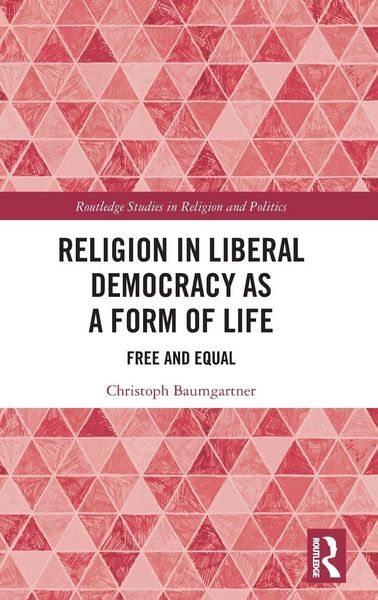

Religion in Liberal Democracy as a Form of Life Free and Equal
-
- Hardcover ausgewählt
- Taschenbuch
- eBook
-
Sprache:Englisch
161,99 €
inkl. gesetzl. MwSt.,
Beschreibung
Produktdetails
Einband
Gebundene Ausgabe
Erscheinungsdatum
03.12.2024
Verlag
Taylor & FrancisSeitenzahl
216
Maße (L/B/H)
24/16,1/1,6 cm
Gewicht
493 g
Sprache
Englisch
ISBN
978-1-03-288042-6
Religion in Liberal Democracy as a Form of Life advances a theory to deal with the challenges connected to the liberal democratic ideal that all people are free to codetermine the future of their society and equally entitled to their religion and beliefs, given the historical bias towards Christianity in politics and culture within many European societies.
Religious diversity and social and political participation are in fact fiercely contested issues. Critical scholars from philosophy and cultural theory contest that liberal political theories of freedom of religion can adequately deal with issues connected to an increasingly diversified and secularized religious field in historically Christian societies. Consequently, they claim that politics based on such theories cannot deliver on the promise to ensure conditions that allow all members of society equal religious freedom and political participation. By outlining historical developments, and by closely examining case studies of recent controversies about religious diversity in Germany and the Netherlands, this book identifies shortcomings of the currently predominant liberal account of freedom of religion or belief. Based on this analysis, the author proposes a more complex theory of liberal democracy as a form of life, with religion and religious freedom as components of it. This takes into account that informal norms, social structures, and predominant notions of belonging can function as powerful obstacles to freedom and equality, even if formal legal and political institutions prohibit discrimination based on religion. Construing liberal democracy as a "form of life"-that is, as a set of social practices, attitudes, and their institutional manifestations and material expressions-shifts the focus of critical analysis from the law to informal structures and components. This provides an understanding of the dynamics of (culturalized) religion in society, which has often been missing in political philosophical theories. The theory proposed in this book provides normative criteria for building liberal democracies that are tolerant with respect to religious differences and solidaric in terms of ensuring conditions that allow all members of society to codetermine, as equals, the future of society, irrespective of their religion or beliefs.
This book will appeal to scholars of political theory, social and political philosophy, religious studies, sociology, and anthropology.
Noch keine Bewertungen vorhanden
Verfassen Sie die erste Bewertung zu diesem Artikel
Helfen Sie anderen Kundinnen und Kunden durch Ihre Meinung.
Kurze Frage zu unserer Seite
Vielen Dank für Ihr Feedback
Wir nutzen Ihr Feedback, um unsere Produktseiten zu verbessern. Bitte haben Sie Verständnis, dass wir Ihnen keine Rückmeldung geben können. Falls Sie Kontakt mit uns aufnehmen möchten, können Sie sich aber gerne an unseren Kund*innenservice wenden.
zum Kundenservice