Gutscheinbedingungen

**Gültig bis 14.09.2026 auf Spielzeug, Schreibwaren, Filme, Geschenke & Trends, Musik, tolino eReader & Zubehör, Hörbücher, nicht preisgebundene Bücher und Kalender in der Thalia App. Einzelne Artikel können ausgeschlossen sein. Aufgrund der Buchpreisbindung sind deutschsprachige Bücher und eBooks ausgenommen. Zusätzlich ausgenommen sind Abos & Flatrates, Games, Geschenkkarten/-boxen, Shelfies, Software, Zeitschriften sowie einzelne Artikel von tonies®. Pro Einkauf einmal einlösbar. Nur gültig mit im Onlineshop hinterlegter Bonuscard. Click & Collect nur bei Onlinevorabzahlung möglich. Keine Barauszahlung. Nicht kombinierbar mit anderen Aktionen und Gutscheinen. Gutschein wird auf max. 500€ Bestellwert angerechnet. Nicht gültig für Versandkosten und Services.

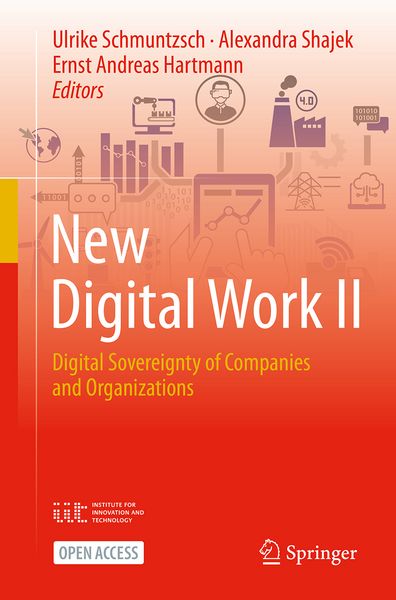
  • Produktbild: New Digital Work II
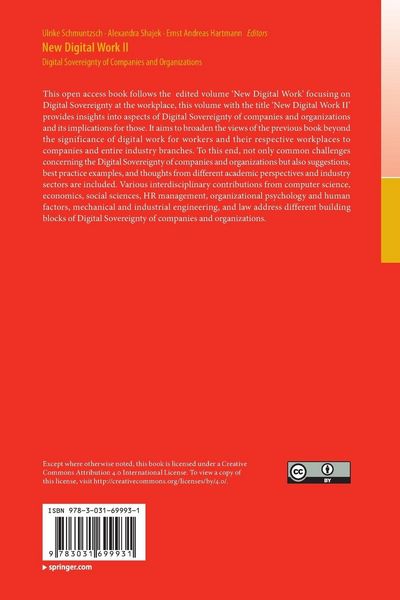
  • Produktbild: New Digital Work II

New Digital Work II Digital Sovereignty of Companies and Organizations

49,99 €

inkl. gesetzl. MwSt., Versandkostenfrei


Beschreibung

Produktdetails

Einband

Taschenbuch

Erscheinungsdatum

29.04.2025

Abbildungen

VIII, 284 p. 49 illus., 48 illus. in color.

Herausgeber

Ulrike Schmuntzsch + weitere

Verlag

Springer

Seitenzahl

284

Maße (L/B/H)

23,5/15,5/1,6 cm

Gewicht

446 g

Sprache

Englisch

ISBN

978-3-031-69993-1

Beschreibung

Portrait


Dr. Ulrike Schmuntzsch 
studied ‘Business Psychology’ at the former University of Applied Science in Lüneburg and ‘Human Factors’ at the Technical University (TU) Berlin. Focusing on Work and Engineering Psychology, she worked as a research associate at the Chair of Human-Machine Systems at the TU Berlin from 2011 until 2022. As part of several application-oriented research projects with various industry partners, she was responsible for human-centred evaluation and design. Her doctoral thesis, which she completed in 2014, focuses on the development and evaluation of a warning glove as a means of user support during maintenance work in industrial applications. Since 2022, she has been a Research Associate at the Institute for Innovation and Technology (iit) and a consultant at VDI/VDE Innovation + Technik GmbH. In this role, she is part of the project team ‘Digital Sovereignty in Business’.


Dr. Alexandra Shajek 
is a Research Associate at the iit and Team Leader of the ‘Education and Work’ group at VDI/VDE Innovation + Technik GmbH. At the iit, she worked on projects such as ‘Case studies on the effects of the COVID-19 pandemic on operational transformation processes in organizations’ among others. Previously, she worked as a visiting researcher at the German Institute for Economic Research (DIW) and, in addition, completed her doctorate in the field of innovation research at Humboldt University of Berlin.


Dr. Ernst Andreas Hartmann 
after studying psychology, is specialising in work and organisational psychology—obtained his doctorate as Dr. rer. nat. at the Faculty of Mechanical Engineering at RWTH Aachen University in 1995. In the 1990s, he worked at the Hochschuldidaktisches Zentrum/Lehrstuhl Informatik im Maschinenbau (University Teaching Centre/Chair of Information Technology in Mechanical Engineering) at RWTH Aachen. In this context, he engaged in projects on academic reform and took part in the development of new forms of academic teaching/learning. Furthermore, he carried out research on the design of man–machine systems and issues of industrial work organisation. In the mid-1990s, he was an internal consultant for organisation and process development at John Deere Werke Mannheim. In 2002, he qualified as lecturer (habilitation) in psychology and received the ‘venia legendi’ for Work and Organisational Psychology; since then, he has been a private lecturer for work systems and process design at RWTH Aachen. From2001 to 2004, he was responsible for the scientific coordination of the programme ‘Lernkultur Kompetenzentwicklung’ (‘competence development and learning cultures’) of the German Federal Ministry of Education and Research at the ‘Arbeitsgemeinschaft Betriebliche Weiterbildungsforschung ABWF e.V.’ (‘Association for Research in Continuing Education’). From 2004 to 2016, Ernst Andreas Hartmann was head of the Socio-economic Department at VDI/VDE Innovation + Technik GmbH in Berlin; since 2016, he has been head of the Education, Science and Humanities Department. Since 2007, he has functioned as one of the directors of the Institute for Innovation and Technology (iit).

Produktdetails

Einband

Taschenbuch

Erscheinungsdatum

29.04.2025

Abbildungen

VIII, 284 p. 49 illus., 48 illus. in color.

Herausgeber

Verlag

Springer

Seitenzahl

284

Maße (L/B/H)

23,5/15,5/1,6 cm

Gewicht

446 g

Sprache

Englisch

ISBN

978-3-031-69993-1

Herstelleradresse

Springer-Verlag GmbH
Tiergartenstr. 17
69121 Heidelberg
DE

Email: ProductSafety@springernature.com

Noch keine Bewertungen vorhanden

Verfassen Sie die erste Bewertung zu diesem Artikel

Helfen Sie anderen Kundinnen und Kunden durch Ihre Meinung.

Kundinnen und Kunden meinen

Bewertungen (0)

  • Produktbild: New Digital Work II
  • Produktbild: New Digital Work II

  • Einbindung von Werker-Wissen in Datengenerierung für ML (Engl. Translation will follow).- Future challenges of data-driven problem solving in producing companies in context of digital sovereignty and lessons learned from electronics industry.- Rechtliche Grundlagen (Bedeutung Data Act für KMUs).- Technical approaches in support of autonomy.- SCB Scenario based Product development.- Model-based predictive maintainance.- Fallstudie VDE (anonymisierte Erkenntnisse auf Unternehmensebene bringen).- Innovation capacity in manufacturing: a question of autonomy.- PERMA Project.- Veränderungsmacher, Change Management.- Technologisierung Gesundheit.- Warum Digitalisierung von KMUs von dominierendne Konzernen betrieben wird--(das Plattformthema/"Netzwerkeffekt"?)/Edge Computing.- katulu.io.- KI basierte Überwachung und Vorhersage von Werkzeugverschleiß.