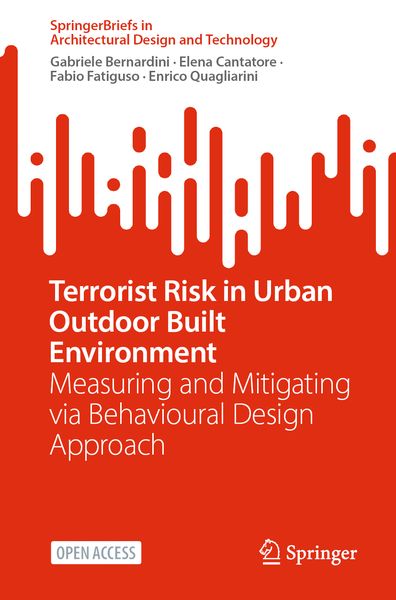

Terrorist Risk in Urban Outdoor Built Environment Measuring and Mitigating via Behavioural Design Approach
-
- Englisch ausgewählt
29,99 €
inkl. gesetzl. MwSt.,
- Kostenlose Lieferung ab 30 € Einkaufswert
- Versandkostenfrei für Bonuscard-Kund*innen
Beschreibung
Produktdetails
Einband
Taschenbuch
Erscheinungsdatum
03.11.2024
Verlag
Springer SingaporeSeitenzahl
126
Maße (L/B/H)
23,5/15,5/0,8 cm
Gewicht
225 g
Auflage
1. Auflage
Sprache
Englisch
ISBN
978-981-9769-64-3
This open access book outlines the latest results in analysing, assessing, and managing terrorist risk in the urban outdoor built environment. In detail, contents refer to the outdoor Open Areas (such as streets, squares, urban parks and other public spaces in our cities) exposed to such violent events considering the physical elements and properties of the built environment and users. PThe built environment features, including layout, use and management, are combined with terrorist threats issues and user behaviours in emergency conditions, to determine a set of complementary tools for the reduction of risk and increase of urban resilience. The contents hence provide different levels of tool analysis, for risk scenario definition, risk assessment, mitigation strategies design and effectiveness evaluation, considering traditional approaches about the issue along with simulation-based approaches relying on understanding and representing user behaviors. This “behavioural design” approach offers the opportunity to manage the level of risk for specific real urban cases over going the normative limitations in Europe that are only referred to few countries and sometimes deal with the prevention of violent acts by intelligence activities as the exclusive way to face this issue. In addition, the focus on the characters of cultural and historic places and their resilience is increasing by means of introduction of mitigation and compatible solutions providing a complementary chapter for the design of resilient cities in all of their peculiarities (peripheries, consolidated, and historical).
In this sense, it is one of the first organized attempts to analyse the main limitations of current solutions in these outdoor Open Areas and, at the same time, to clearly introduce the importance of human behaviours and the various choices in emergency evacuation conditions, thanks to the proposed behavioural-based simulation approach. The attention is focused on a critical aspect for historic spaces, where morphological conditions are fixed values. Thus, this book represents a sort of guidelines about these user-related issues during such violent events and is useful to both professionals and researchers in the areas of security and urban administration.
Noch keine Bewertungen vorhanden
Verfassen Sie die erste Bewertung zu diesem Artikel
Helfen Sie anderen Kundinnen und Kunden durch Ihre Meinung.
Kurze Frage zu unserer Seite
Vielen Dank für Ihr Feedback
Wir nutzen Ihr Feedback, um unsere Produktseiten zu verbessern. Bitte haben Sie Verständnis, dass wir Ihnen keine Rückmeldung geben können. Falls Sie Kontakt mit uns aufnehmen möchten, können Sie sich aber gerne an unseren Kund*innenservice wenden.
zum Kundenservice