KI-Beratung Beta

Produktbild: Patchwork Apartheid

Patchwork Apartheid Private Restriction, Racial Segregation, and Urban Inequality

49,40 €

inkl. gesetzl. MwSt.

Beschreibung

For the first half of the twentieth century, private agreements to impose racial restrictions on who could occupy property decisively shaped the development of American cities and the distribution of people within them. Racial restrictions on the right to buy, sell, or occupy property also effectively...

Beschreibung

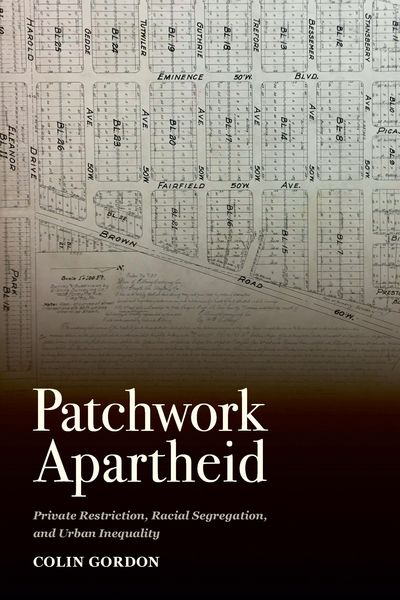
For the first half of the twentieth century, private agreements to impose racial restrictions on who could occupy property decisively shaped the development of American cities and the distribution of people within them. Racial restrictions on the right to buy, sell, or occupy property also effectively truncated the political, social, and economic citizenship of those targeted for exclusion. In Patchwork Apartheid, historian Colin Gordon examines the history of such restrictions and how their consequences reverberate today. Drawing on a unique record of property restrictions excavated from local property records in five Midwestern counties, Gordon documents the prevalence of private property restriction in the era before zoning and building codes were widely employed and before federal redlining sanctioned the segregation of American cities and suburbs. This record of private restriction-documented and mapped to the parcel level in Greater Minneapolis, Greater St. Louis, and two Iowa counties-reveals the racial segregation process both on the ground, in the strategic deployment of restrictions throughout transitional central city neighborhoods and suburbs, and in the broader social and legal construction of racial categories and racial boundaries.
Gordon also explores the role of other policies and practices in sustaining segregation. Enforcement of private racial restrictions was held unconstitutional in 1948, and such agreements were prohibited outright in 1968. But their premises and assumptions, and the segregation they had accomplished, were accommodated by local zoning and federal housing policies. Explicit racial restrictions were replaced by the deceptive business practices of real estate agents and developers, who characterized certain neighborhoods as white and desirable and others as black and undesirable, thereby hiding segregation behind the promotion of sound property investments, safe neighborhoods, and good schools. These practices were in turn replaced by local zoning, which systematically protected white neighborhoods while targeting "blighted" black neighborhoods for commercial and industrial redevelopment, and by a tangle of federal policies that reliably deferred to local and private interests with deep investments in local segregation. Private race restriction was thus a key element in the original segregation of American cities and a source of durable inequalities in housing wealth, housing opportunity, and economic mobility.
Patchwork Apartheid exhaustively documents the history of private restriction in urban settings and demonstrates its crucial role in the ideas and assumptions that have sustained racial segregation in the United States into the twenty-first century.

Produktdetails

Format

PDF

Kopierschutz

Ja

Family Sharing

Ja

Text-to-Speech

Nein

Produktdetails

Format

PDF

Format

eBooks im PDF-Format haben eine festgelegte Seitengröße und eignen sich daher nur bedingt zum Lesen auf einem tolino eReader oder Smartphone. Für den vollen Lesegenuss empfehlen wir Ihnen bei PDF-eBooks die Verwendung eines Tablets oder Computers.

Kopierschutz

Ja

Kopierschutz

Zum Lesen dieses eBooks auf Geräten der tolino Familie sowie auf sonstigen eReadern und am PC benötigen Sie eine Adobe ID. Weitere Hinweise zum Lesen von kopiergeschützten eBooks finden Sie unter Hilfe/Downloads.

Family Sharing

Ja

Family Sharing

Mit Family Sharing können Sie eBooks innerhalb Ihrer Familie (max. sechs Mitglieder im gleichen Haushalt) teilen. Sie entscheiden selbst, welches Buch Sie mit welchem Familienmitglied teilen möchten. Auch das parallele Lesen durch verschiedene Familienmitglieder ist durch Family Sharing möglich. Um eBooks zu teilen oder geteilt zu bekommen, muss jedes Familienmitglied ein Konto bei Thalia oder einem anderen tolino-Buchhändler haben. Weitere Informationen finden Sie unter Hilfe/Family-Sharing.

Text-to-Speech

Nein

Text-to-Speech

Bedeutet Ihnen Stimme mehr als Text? Mit der Funktion Text-to-Speech können Sie sich im tolino webReader und in der aktuellen Thalia – Lesen & Hören App das eBook vorlesen lassen. Weitere Informationen finden Sie unter Hilfe/Text-to-Speech.

Erscheinungsdatum

15.11.2023

Verlag Russell Sage Foundation
Seitenzahl

285 (Printausgabe)

Dateigröße

19956 KB

Sprache

Englisch

EAN

9781610449229

Barrierefreiheit
  • keine Information zur Barrierefreiheit bekannt

Noch keine Bewertungen vorhanden

Verfassen Sie die erste Bewertung zu diesem Artikel

Helfen Sie anderen Kundinnen und Kunden durch Ihre Meinung.

Kundinnen und Kunden meinen

Bewertungen (0)

Weitere Artikel finden Sie in

Die Leseprobe wird geladen.
  • Produktbild: Patchwork Apartheid