KI-Beratung Beta

Gutscheinbedingungen

**Gültig am 25.11.2026 auf fremdsprachige Bücher online auf thalia.at und in der Thalia App. Einzelne Artikel können ausgeschlossen sein. Ausgenommen sind preisgebundene Artikel & eBooks. Pro Einkauf einmal einlösbar. Click & Collect nur bei Onlinevorabzahlung möglich. Keine Barauszahlung. Nicht kombinierbar mit anderen Aktionen und Gutscheinen. Gutschein wird auf max. 500€ Bestellwert angerechnet. Nicht gültig für Geschenkkarten, Versandkosten und Services.

Produktbild: Status of Decline and Conservation of Amphibians of the Middle East
- 16%

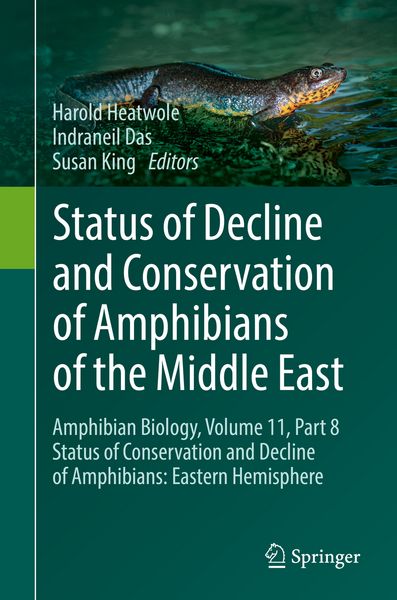
Status of Decline and Conservation of Amphibians of the Middle East Amphibian Biology, Volume 11, Part 8 Status of Conservation and Decline of Amphibians: Eastern Hemisphere

16% sparen

82,99 € UVP 98,99 €

inkl. gesetzl. MwSt., Versandkostenfrei


Beschreibung

Amphibians by virtue of their thin, moist, permeable skins are poorly protected from harsh environments and are especially susceptible to chemical changes, desiccation, and alteration of their habitat. Accordingly, it is not surprising that they manifest exceptionally high rates of extinction and suffer...

Beschreibung

Amphibians by virtue of their thin, moist, permeable skins are poorly protected from harsh environments and are especially susceptible to chemical changes, desiccation, and alteration of their habitat. Accordingly, it is not surprising that they manifest exceptionally high rates of extinction and suffer more severe declines than do most other taxa in an environment undergoing unprecedented anthropogenic change. They are especially important to study as they serve as an early-warning system portending changes that are beginning to engulf more resistant species, including our own.

The current volume covers the 14 countries of the Middle East, each written by a specialist, and is part of the Amphibian Biology series.

Rezension

Structurally, the content adopts a geographically partitioned framework. Each chapter, authored by regional specialists . Status of Decline and Conservation of Amphibians of the Middle East represents a significant consolidation of available regional herpetofaunal knowledge. By integrating faunal inventories with conservation assessments undertaken under challenging sociopolitical conditions, it provides an important reference for herpetologists, conservation biologists, and environmental policymakers concerned with the persistence of amphibian assemblages in the Middle East amid an era of rapid global environmental change. (Lydia Allison Fucsko, The Quarterly Review of Biology, Vol. 101 (3), September, 2026)

Portrait


Harold Heatwole
began his profession with a Ph.D. from the University of Michigan on habitat selection by forest-floor amphibians in Venezuela and Michigan. During his first job (University of Puerto Rico) he studied water balance of amphibians, ecology of reptiles, and conducted faunal surveys of the islands of Puerto Rico and the Virgin Islands. He spent some summers in Panama investigating the herpetofauna of tropical rainforests and others teaching Animal Behaviour at University of Virginia’s Mountain Lake Biological Station.


His second job was at the University of New England (Australia) where he continued research in herpetology. His continued interest in tropical islands led him to the Presidency of the Great Barrier Reef Committee and to Foundation President of the Australian Coral Reef Society, and eventually to a second Ph.D. (Botany) at the University of Queensland on the dynamics of vegetation on islands of the Great Barrier Reef. Trips to the reefs stimulated an interest in sea snakes which became a main focus of his research and led to a third Ph.D (in Earth Science on the role of palaeogeography on the speciation of sea-kraits) from James Cook University.


He served as President of the Australian Society of Herpetologists and as President of the Herpetologists’ League (USA). He also received a fourth doctorate, a D.Sc. from the University of New England for a treatise on ecological herpetology.


Professor Heatwole has a sustained interest in writing and editing with 366 publications to his credit, including editing the series Amphibian Biology of which the present issue constitutes volume 13. He also edited a seven-volume series of books on Ecology in Australia and served a term as one of the editors of the
Australian Journal of Ecology
and was Editor-in Chief of
Integrative and Comparative Biology
from 2010 through 2014.


Currently, he is Professor Emeritus at North Carolina State University and Adjunct Professor at the University of New England.


Indraneil Das
has been a staff of the Institute of Biodiversity and Environmental Conservation, Universiti Malaysia Sarawak since 1998. He received his doctoral degree from the University of Oxford, and was a Fulbright Postdoctoral Fellow at Harvard University. His research covers the areas of ecology and systematics, conservation biology and the history of natural history. He served as Chair of the IUCN / SSC South and Southeast Asian Reptile and Amphibian Specialist Group between 1994-2005, was Founding Co-Chair of the IUCN/SSC Indian Subcontinent Reptile and Amphibian Specialist Group and is currently member of the IUCN Amphibian Specialist Group and Skink Specialist Group. Das has taken part in numerous IUCN Red Listing workshops, in China, India, Malaysia, Singapore, Sri Lanka, Thailand and the United States as resource persons, and is editorial staff of a number of scientific periodicals, including
Biodiversity and Conservation
,
Herpetological Review
and
Hamadryad
.


Sue King 
began her professional career with a B.S. in Sports Medicine from Marietta College, working as an athletic trainer and physical therapy assistant briefly, she soon left that area of interest and began her work with animals, first in a local shelter, and then as a veterinary technician. She was eventually able to combine these two interests and incorporate canine rehabilitation into her work as a veterinary technician. Sue also spent time learning about wildlife rehabilitation and she volunteered and then worked at a carnivore sanctuary, caring for captive felids, primarily. Returning to school, Sue earned a B.S. in Fisheries, Wildlife, and Conservation Biology from North Carolina State University. She then earned an M.S. in Biology from Eastern Kentucky University, studying the nesting habitat of Four-toed Salamanders (
Hemidactylium scutatum
) in a system of natural and constructed wetlands. With research questions that she could not answer without more education, Sue once again returned to North Carolina State University, this time earning a Master of Geospatial Information Science and Technology. She has since moved to Australia with her husband, Hal Heatwole, with whom she has collaborated and assisted with his publications. 
Produktdetails

Einband

Gebundene Ausgabe

Erscheinungsdatum

23.01.2025

Abbildungen

XII, 301 p. 157 illus., 142 illus. in color.

Herausgeber Harold Heatwole + weitere

Produktdetails

Einband

Gebundene Ausgabe

Erscheinungsdatum

23.01.2025

Abbildungen

XII, 301 p. 157 illus., 142 illus. in color.

Herausgeber
Verlag Springer
Seitenzahl

301

Maße (L/B/H)

24,1/16/2,2 cm

Gewicht

646 g

Sprache

Englisch

ISBN

978-3-031-68984-0

Herstelleradresse

Springer-Verlag KG
Sachsenplatz 4-6
1201 Wien
AT

Email: ProductSafety@springernature.com

Noch keine Bewertungen vorhanden

Verfassen Sie die erste Bewertung zu diesem Artikel

Helfen Sie anderen Kundinnen und Kunden durch Ihre Meinung.

Kundinnen und Kunden meinen

Bewertungen (0)

  • Produktbild: Status of Decline and Conservation of Amphibians of the Middle East

  • Chapter 1. The Species Composition, Distribution, and Endangerment of the Amphibian Fauna in Syria.- Chapter 2. Status of Studies of Amphibians and their Conservation in Lebanon.- Chapter 3. Status and Decline of the Amphibians of Israel.- Chapter 4. Status and Decline of Amphibians of the West Bank and the Gaza Strip.- Chapter 5. Amphibians of Jordan: Conservation Status, Distribution, and Threats.- Chapter 6. The Amphibian Fauna of Iraq and the Threats it Faces.- Chapter 7. Amphibia Fauna of Kuwait.- Chapter 8. The Amphibian Fauna of Iran and its Conservation.- Chapter 9. Amphibians’ Status, Threats, and Conservation in Saudi Arabia.- Chapter 10. Amphibia Fauna of Bahrain.- Chapter 11. The Amphibians of Qatar.- Chapter 12. Conservation Status of Amphibians in the United Arab Emirates.- Chapter 13. Amphibians of Yemen.- Chapter 14. Amphibians of Oman.