Gutscheinbedingungen

**Gültig am 28.06.2026 auf Spielzeug, Schreibwaren, Filme, Geschenke & Trends, Musik, tolino eReader & Zubehör, Hörbücher und Hörbuch-Downloads (außer Abo), nicht preisgebundene Bücher und Kalender online auf thalia.at und in der Thalia App. Einzelne Artikel können ausgeschlossen sein. Aufgrund der Buchpreisbindung sind deutschsprachige Bücher und eBooks ausgenommen. Zusätzlich ausgenommen sind preisgebundene Artikel, Abos & Flatrates, eBooks, Games, Geschenkkarten/-boxen, Shelfies, Software, Zeitschriften sowie einzelne Artikel von tonies®. Pro Einkauf einmal einlösbar. Click & Collect nur bei Onlinevorabzahlung möglich. Keine Barauszahlung. Nicht kombinierbar mit anderen Aktionen und Gutscheinen. Gutschein wird auf max. 500€ Bestellwert angerechnet. Nicht gültig für Versandkosten und Services.

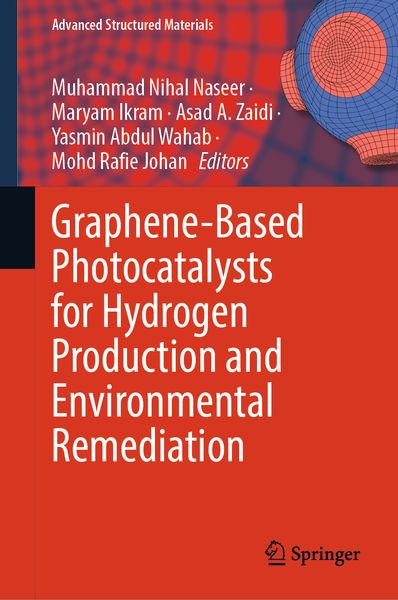
Produktbild: Graphene-Based Photocatalysts for Hydrogen Production and Environmental Remediation
Band 219 - 12%

Graphene-Based Photocatalysts for Hydrogen Production and Environmental Remediation

12% sparen

221,99 € UVP 252,99 €

inkl. gesetzl. MwSt., Versandkostenfrei


Beschreibung

Produktdetails

Einband

Gebundene Ausgabe

Erscheinungsdatum

28.09.2024

Herausgeber

Muhammad Nihal Naseer + weitere

Verlag

Springer

Seitenzahl

619

Maße (L/B/H)

24,1/16/4 cm

Gewicht

1115 g

Sprache

Englisch

ISBN

978-3-031-68463-0

Beschreibung

Portrait

Muhammad Nihal Naseer is an Erasmus Mundus scholar pursuing a Joint Master Degree in Materials for Energy Storage and Conversion (MESC+) which is an Erasmus Mundus Joint Master’s Degree Program. He completed his bachelor's degree in mechanical engineering at the National University of Sciences and Technology (NUST) Pakistan in 2021 and focused on thermodynamic modeling of energy conversion technologies. He has published his research findings in prestigious journals and has co-edited three books with reputable publishers. He has expertise in thermodynamic modeling, energy analysis, and materials engineering, and has received multiple awards for his academic and research performance.

Maryam Ikram  is a chemical engineer who recently graduated from the University of Engineering and Technology Lahore in Pakistan (2021). She is currently pursuing her Master's degree in Materials for Energy Storage and Conversion (MESC+), an Erasmus Mundus Joint Master’s Degree Program. Her research interests lie in the field of developing materials and tuning their properties for hydrogen production. She aspires to contribute to the field of sustainable energy through her research work.

Dr. Asad Ali Zaidi  is an associate professor at Department of Mechanical Engineering, Faculty of Engineering, Islamic University of Madinah, Kingdom of Saudi Arabia. He has also served as the head of the undergraduate program, assistant professor of thermal sciences, and research supervisor at the National University of Sciences and Technology-Pakistan. He is skilled in materials, renewable energy, and low-cost waste utilization technologies. He is an author or co-author of more than 65 papers in international refereed journals and conferences. He has also given several invited/plenary talks at international conferences.

Dr. Yasmin Abdul Wahab is an assistant professor at Nanotechnology and Catalysis Research Center (NANOCAT) in Universiti Malaya. She has also served as the Head of Business Development Unit, oversees NANOCAT's technical service teams responsible for testing and development of technology for multiple sciences and engineering domains. She led research/troubleshooting on various cost and cycle time reduction and productivity improvement projects. Her research interest includes semiconductors (materials, processes, and device fabrication technology), flexible electronics and energy technologies. She is an author of more than 160 papers in international refereed journals and conferences.

Professor Dr. Mohd Rafie Johan is the director of the Nanotechnology and Catalysis Research Center (NANOCAT), at the University of Malaya. Previously, he was a professor of Materials Engineering in the Department of Mechanical Engineering of the University of Malaya. He received his Ph.D. in 2005 from the Department of Physics, University of Malaya. He is the author of 372 peer-reviewed (ISI) papers with H-index 41. He is internationally recognized in the field of photocatalysis and nanotechnology and has been elected in Evaluation Panels for different national and international grants applications. Further, he has delivered invited speeches at multiple international conferences and hosted special issues in various journals. Currently, he leads Nanomaterials Engineering Research Group of 20 Ph.D. and 24 Master students. These supervised students span over a quite broad scientific area going from science (chemistry, physics, material science, biology) to engineering (chemical, material).

Produktdetails

Einband

Gebundene Ausgabe

Erscheinungsdatum

28.09.2024

Herausgeber

Verlag

Springer

Seitenzahl

619

Maße (L/B/H)

24,1/16/4 cm

Gewicht

1115 g

Sprache

Englisch

ISBN

978-3-031-68463-0

Herstelleradresse

Springer-Verlag GmbH
Tiergartenstr. 17
69121 Heidelberg
DE

Email: ProductSafety@springernature.com

Kundinnen und Kunden meinen

0 Bewertungen

Informationen zu Bewertungen

Zur Abgabe einer Bewertung ist eine Anmeldung im Konto notwendig. Die Authentizität der Bewertungen wird von uns nicht überprüft. Wir behalten uns vor, Bewertungstexte, die unseren Richtlinien widersprechen, entsprechend zu kürzen oder zu löschen.

Die Bewertungen sind nach Format, Anzahl Sterne und Datum sortiert.

Verfassen Sie die erste Bewertung zu diesem Artikel

Helfen Sie anderen Kund*innen durch Ihre Meinung

Kundinnen und Kunden meinen

0 Bewertungen filtern

  • Produktbild: Graphene-Based Photocatalysts for Hydrogen Production and Environmental Remediation
  • 1. Graphene - The Material of the Era.- 2. Photocatalytic materials, design concepts and functional mechanistic pathways.- 3. Graphene-Based Composites as Highly-Efficient and Robust Photocatalytic Systems.- 4. Graphene synthesis and characterization techniques for photocatalytic applicants.- 5. Understanding Photocatalytic Mechanism through Spectroscopy Techniques.