Gutscheinbedingungen

**Gültig bis 24.09.2026 ab einem Mindestbestellwert von 30€ auf Spielzeug, Schreibwaren, Filme, Geschenke & Trends, Musik, tolino eReader & Zubehör, Hörbücher und Hörbuch-Downloads, nicht preisgebundene Bücher und Kalender online auf thalia.at und in der Thalia App. Einzelne Artikel können ausgeschlossen sein. Aufgrund der Buchpreisbindung sind deutschsprachige Bücher und eBooks ausgenommen. Zusätzlich ausgenommen sind Abos & Flatrates, Games, Geschenkkarten/-boxen, Shelfies, Software, Zeitschriften sowie einzelne Artikel von tonies®. Pro Einkauf einmal einlösbar. Click & Collect nur bei Onlinevorabzahlung möglich. Keine Barauszahlung. Nicht kombinierbar mit anderen Aktionen und Gutscheinen. Gutschein wird auf max. 500€ Bestellwert angerechnet. Nicht gültig für Versandkosten und Services. Preisgebundene Artikel sind vom Mindestbestellwert ausgeschlossen.

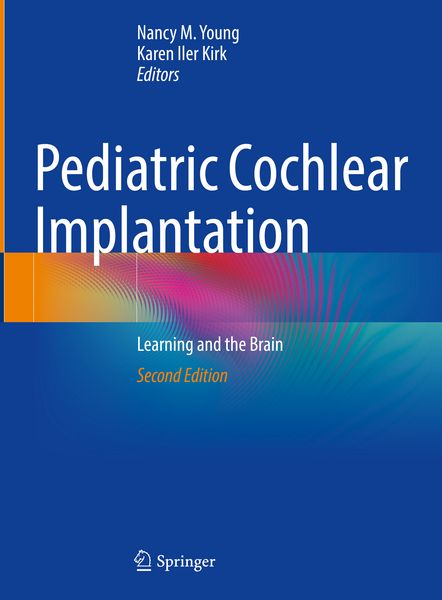
Produktbild: Pediatric Cochlear Implantation
- 12%

Pediatric Cochlear Implantation Learning and the Brain

12% sparen

239,99 € UVP 274,99 €

inkl. gesetzl. MwSt., Versandkostenfrei


Beschreibung

Produktdetails

Einband

Gebundene Ausgabe

Erscheinungsdatum

28.12.2024

Abbildungen

XXIII, 543 p. 144 illus., 102 illus. in color.

Herausgeber

Nancy M. Young + weitere

Verlag

Springer

Seitenzahl

543

Maße (L/B/H)

28,5/21,5/3,5 cm

Gewicht

1795 g

Auflage

Second Edition 2024

Sprache

Englisch

ISBN

978-3-031-67187-6

Beschreibung

Portrait


Nancy M Young, MD
 is the Lillian S. Wells Professor of Pediatric Otolaryngology at the Northwestern University Feinberg School of Medicine. She is a surgeon and Head of the Section of Otology and Neurotology in the Division of Otolaryngology at the Ann & Robert H. Lurie Children’s Hospital of Chicago. She is also a Fellow of the Knowles Hearing Center of the Northwestern University School of Communication. Dr. Young is founder and Medical Director of the Lurie Children’s Pediatric Cochlear Implant Program, one of the largest in the United States. She is Principal Investigator of NIH funded research using brain scans and AI-analytics to predict language after cochlear implantation on the individual-child level. The goal of this research is to develop custom brain-based therapy to improve language outcomes.


Karen Iler Kirk, PhD
 is Professor Emerita in the Department of Speech and Hearing Science at the University of Illinois at Urbana-Champaign, where she served as the Shahid and Ann Carlson Khan Professor and Head. She has authored more than 100 publications. Her research investigating factors influencing spoken word recognition and speech perception in adult and pediatric cochlear implant users was continuously funded by NIH for two decades.  She has developed tests of spoken word recognition that are used widely to assess performance in pediatric cochlear implant candidates and recipients. Her tests have been adapted for use in other languages, including Mandarin and Cantonese. She is a Fellow of the American Speech-Language-Hearing Association and received Honors of the Association in 2017. The Honors of the Association recognizes members for their distinguished contributions to the discipline of communication sciences and disorders and is the highest honor the Association bestows.

Produktdetails

Einband

Gebundene Ausgabe

Erscheinungsdatum

28.12.2024

Abbildungen

XXIII, 543 p. 144 illus., 102 illus. in color.

Herausgeber

Verlag

Springer

Seitenzahl

543

Maße (L/B/H)

28,5/21,5/3,5 cm

Gewicht

1795 g

Auflage

Second Edition 2024

Sprache

Englisch

ISBN

978-3-031-67187-6

Herstelleradresse

Springer-Verlag KG
Sachsenplatz 4-6
1201 Wien
AT

Email: ProductSafety@springernature.com

Noch keine Bewertungen vorhanden

Verfassen Sie die erste Bewertung zu diesem Artikel

Helfen Sie anderen Kundinnen und Kunden durch Ihre Meinung.

Kundinnen und Kunden meinen

Bewertungen (0)

  • Produktbild: Pediatric Cochlear Implantation

  • Part I: Introduction
    .- 1. Design and best uses of cochlear implants.-
    Part II: Clinical Management
    .- 2. Cochlear Implant Candidacy in Children: Audiological Considerations.- 3. Hearing Configurations Involving More Than a Unilateral Cochlear Implant.- 4. Achieving Early Implantation: Australian Delivery of Comprehensive Cochlear Implant Care.- 5. Bilingual Families.- 6. Cochlear Implantation for Single Sided Deafness in Children.- 7. Vaccines and the Cochlear Implant Patient.- 8. Medical and Radiological Issue in Pediatric CI.- 9. Surgical Considerations.- 10. Cochlear Implant programming for Children.- 11. Present audiological practices and paths toward better measures and precision medicine approaches.- 12. Diagnosis and management of Cochlear Implant Malfunction.- 13. Role of Electrophysiological Testing in Patients.- 14. Vestibular System Considerations.-
    Part III: Cochlear Implant Outcomes in Children
    .- 15. Speech Perception and Spoken Word Recognition.- 16. Bilateral and Spatial Hearing in Implanted Children.- 17. Language and Literacy skills in Children with CI: Present and Past findings.- 18. Family Dynamics Impact on Cochlear Implant Outcomes.-
    Part IV: Cochlear Implant Outcomes in Special Populations
    .- 19. Cochlear Implant for Children with Additional Disabilities.- 20. Cochlear Implantation of Children with Cochlear Nerve Deficiency.- 21. Neuroscience of the Pediatric Auditory Brainstem Implant.-
    Part V: Maximizing CI outcomes Learning
    .- 22. Elementary Cognitive Processes Underlying Verbal Working Memory in Pre-lingually Deaf Children with Cochlear Implants.- 23. Working Memory Training in Deaf Children with Cochlear Implants.- 24. Integrated Language Intervention for Children with Hearing Loss.- 25. Auditory training: Optimal training paradigms.- 26. Parent-implemented communication intervention of young implanted children.- 27. Music as Communication and Training for Children with Cochlear Implants.- 28. Prediction cochlear implant outcomes in children with congenital hearing loss: brain-based prediction to improve language.-
    Part VI: Educational Management, Interprofessional Education, Global Barriers to Access
    .- 29. Early Intervention Programs: Therapy Needs of Children Ages 0–3 Years Pre- and Post-cochlear Implantation.- 30. Supporting educational needs of children, including those with additional disabilities, in mainstream and special education programs.- 31. Interprofessional Training of Professionals to Serve Children who use Cochlear Implants.- 32. Addressing Global Barriers to Cochlear Implantation for Children.