KI-Beratung Beta

Produktbild: Inclusion and Social Justice in Teacher Education
- 16%

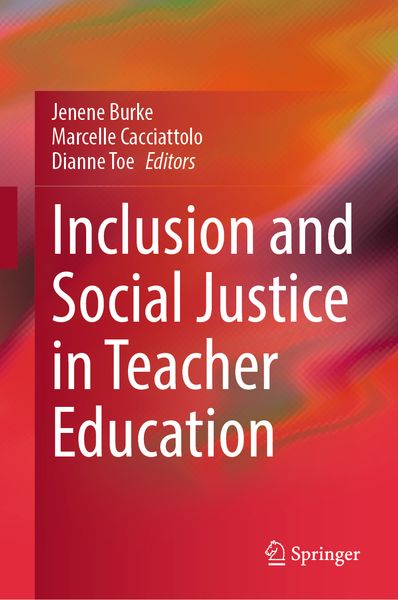
Inclusion and Social Justice in Teacher Education

16% sparen

164,99 € UVP 197,99 €

inkl. gesetzl. MwSt., Versandkostenfrei


Beschreibung

Produktdetails

Einband

Gebundene Ausgabe

Erscheinungsdatum

07.11.2024

Abbildungen

XX, 434 p. 13 illus., 8 illus. in color.

Herausgeber

Jenene Burke + weitere

Verlag

Springer

Seitenzahl

434

Maße (L/B/H)

24,1/16/2,9 cm

Gewicht

927 g

Sprache

Englisch

ISBN

978-3-031-67611-6

Beschreibung

Portrait


Professor Jenene Burke, PhD, is the Director of Academic Operations in the Institute of Education, Arts and Community at Federation University Australia. She is the Past-President of the World Federation of Associations for Teacher Education (WFATE) and represents Australia on the WFATE Board. She is co-convenor of the WFATE research development group 
Inclusion and Social Justice in Teacher Education in Global Contexts
 and established the 
Social Justice, Inclusion and Diversity in Education
 research focus area in the Institute of Education, Arts and Community at Federation.


Associate Professor Marcelle Cacciattolo is the Associate Director (Research Training) in the Institute of Sustainable Industries and Liveable Cities (ISLIC) at Victoria University, Australia. She received her PhD from Monash University, Australia in 2002. Over the last twenty years her research has been cross-disciplinary involving health sciences and education-based research. Marcelle works closely with preservice teachers and schools to examine how trauma-aware pedagogies can support students and families who are the least advantaged. Marcelle is an Honorary Adjunct Professor in the Research Institute for Languages and Cultures of Asia (RILCA) at Mahidol University, Thailand.


Professor Toe is an Honorary Professor of Education at Deakin University, Australia, after holding several leadership positions in the Deakin School of Education. Dianne has a background in Psychology, Audiology, Deaf Education and Teacher Education and has published in the fields of inclusive education, cultural diversity, and social justice in teacher education.  Dianne’s research, teaching and leadership aims to support teachers to build a strong social justice orientation and develop the key skills they need to improve educational outcomes for all learners.

Produktdetails

Einband

Gebundene Ausgabe

Erscheinungsdatum

07.11.2024

Abbildungen

XX, 434 p. 13 illus., 8 illus. in color.

Herausgeber

Verlag

Springer

Seitenzahl

434

Maße (L/B/H)

24,1/16/2,9 cm

Gewicht

927 g

Sprache

Englisch

ISBN

978-3-031-67611-6

Herstelleradresse

Springer-Verlag KG
Sachsenplatz 4-6
1201 Wien
AT

Email: ProductSafety@springernature.com

Noch keine Bewertungen vorhanden

Verfassen Sie die erste Bewertung zu diesem Artikel

Helfen Sie anderen Kundinnen und Kunden durch Ihre Meinung.

Kundinnen und Kunden meinen

Bewertungen (0)

  • Produktbild: Inclusion and Social Justice in Teacher Education

  • Chapter 1: Fostering social justice and inclusion in teacher education.- Chapter 2: Empowering children to become critical thinkers of social justice and diversity education; Paula Hamilton and Chandrika Devarakonda.- Chapter 3: Strategies for facilitating culturally safer learning environments; Kim Willis and Sara Weuffen.- Chapter 4: Adversity, social justice and agency in preservice music teaching; Greg Aronson and Marcelle Cacciattolo.- Chapter 5: Seeking academic voice: An autoethnographic study of casualisation in teacher education; Reshmi Lahiri-Roy.- Chapter 6: Exceptional graduate teachers trying to make a difference: School leadership, school climate and its impact on the experiences of new teachers; Lynette Longaretti, and Dianne Toe.- Chapter 7: Social justice standpoints for anti-colonial education: Safety and agency for people, land and species; Jillian K Marsh, Robyn Ober, John Guenther and Sandra Wooltorton.- Chapter 8: Critical perspectives of diversity, equity, and inclusion in teacher education: Investigating Australia, New Zealand, Sri Lanka, and India; Daya Weerasinghe, Rachel Daniel, Sujeewa Polgampala, and Jayani Gurunada.- Chapter 9: Diversity, equity and belonging: Taking a risk at learning; Mary-Rose McLaren, Shiona Long, Scott Welsh, Anthony Balla, and Fergus McLaren.- Chapter 10: Examining strategies to support teacher self-efficacy when working with diverse student groups: A scoping literature review; Ana Larsen and Ondine Bradbury.- Chapter 11: Reframing early childhood teacher education: An innovation supporting equity and access; Mandy Cooke, Naomi David, Rosemarie Garner, Natalie Robertson and Elizabeth Rouse.- Chapter 12: Teachers with impairments: Including and supporting a ‘vastly marginalised population’; Jenene Burke and Gerard Skene.- Chapter 13: Leading Short Term International Study Experiences in Teacher Education: Enablers, barriers, and insights from four case studies.- Mellita Jones, Marcelle Cacciattolo, Graham Parr, Angela Fitzgerald.- Chapter 14: Preparing preservice teachers for the complexities of working with vulnerable and marginalised young mothers; Karen Felstead.- Chapter 15: The influence of extended family on immigrant pre-service teachers’ career choice; Gillian Kidman, Hazel Tan, Tshewang Rabgay, Ann Gervasoni, and Colleen Vale.- Chapter 16: Women’s education in Afghanistan; Parwaiz Najibi, and Claire McLachlan.- Chapter 17: Striving to develop equity-oriented teacher education pedagogy.- Chapter 18: Waiting for a hero: The challenge of social justice in vulnerable schools; Matthew Krehl Edward Thomas, Lynette Longaretti, Julie Arnold and Dianne Toe.- Chapter 19: The creative arts in early childhood teacher education as a site of resistance to neoliberalism; Jessica Grimes and Patrick Gordon.- Chapter 20: The role of adult perceptions when interpreting and facilitating play-based learning for children with impairments; Amy Claughton.- Chapter 21: Remote teaching practicum in low SES Schools: NETDS preservice teacher perceptions; Marcelle Cacciattolo, Jeanne Carroll, Amanda Muscat, Ligia Pelosi, and Melissah Thomas.- Chapter 22: Metacognition as an enabler for high standards of academic writing in teacher education; Violetta Carter.- Chapter 23: Preservice teacher perspectives on their cultural identity and its impact on classroom practice; Sarah Tartakover.- Chapter 24: Repositioning the teaching and learning of literacy in CALD communities: Beyond the virtual classroom; Mark Vicars, Amanda Muscat and Janine Arantes.- Chapter 25: Concluding chapter by editors; Jenene Burke, Marcelle Cacciattolo and Dianne Toe.