KI-Beratung Beta

  • Produktbild: Transition to Advanced Mathematics
  • Produktbild: Transition to Advanced Mathematics

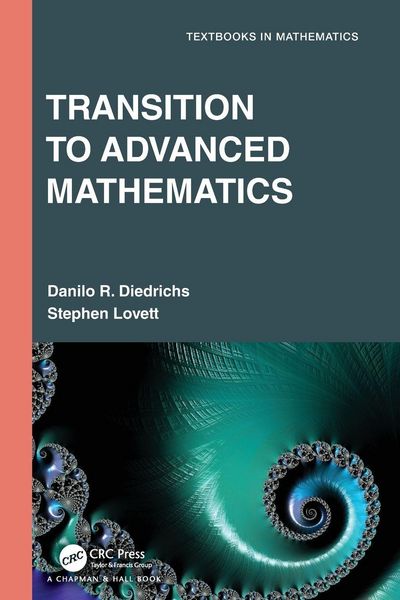
Transition to Advanced Mathematics

Aus der Reihe Textbooks in Mathematics

83,60 €

inkl. gesetzl. MwSt., Versandkostenfrei


Beschreibung

This unique and contemporary text not only offers an introduction to proofs with a view towards algebra and analysis, a standard fare for a transition course, but also presents practical skills for upper-level mathematics coursework and exposes undergraduate students to the context and culture of contemporary...

Beschreibung

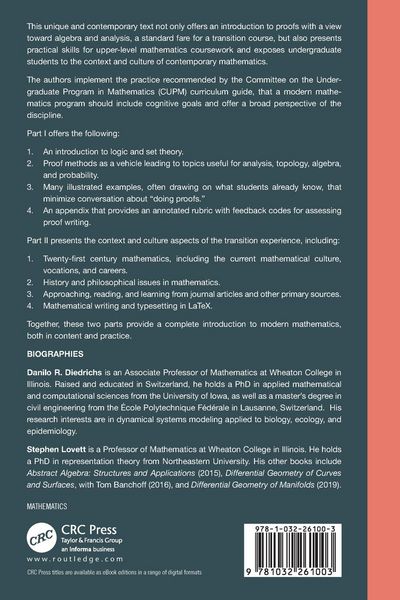
This unique and contemporary text not only offers an introduction to proofs with a view towards algebra and analysis, a standard fare for a transition course, but also presents practical skills for upper-level mathematics coursework and exposes undergraduate students to the context and culture of contemporary mathematics.

The authors implement the practice recommended by the Committee on the Undergraduate Program in Mathematics (CUPM) curriculum guide, that a modern mathematics program should include cognitive goals and offer a broad perspective of the discipline.

Part I offers:

  1. An introduction to logic and set theory.
  2. Proof methods as a vehicle leading to topics useful for analysis, topology, algebra, and probability.
  3. Many illustrated examples, often drawing on what students already know, that minimize conversation about "doing proofs."
  4. An appendix that provides an annotated rubric with feedback codes for assessing proof writing.

Part II presents the context and culture aspects of the transition experience, including:

  1. 21st century mathematics, including the current mathematical culture, vocations, and careers.
  2. History and philosophical issues in mathematics.
  3. Approaching, reading, and learning from journal articles and other primary sources.
  4. Mathematical writing and typesetting in LaTeX.

Together, these Parts provide a complete introduction to modern mathematics, both in content and practice.

Table of Contents

          Part I - Introduction to Proofs

  1. Logic and Sets
  2. Arguments and Proofs
  3. Functions
  4. Properties of the Integers
  5. Counting and Combinatorial Arguments
  6. Relations
    Part II - Culture, History, Reading, and Writing

  7. Mathematical Culture, Vocation, and Careers
  8. History and Philosophy of Mathematics
  9. Reading and Researching Mathematics
  10. Writing and Presenting Mathematics

Appendix A. Rubric for Assessing Proofs

Appendix B. Index of Theorems and Definitions from Calculus and Linear Algebra

Bibliography

Index

Biographies

Danilo R. Diedrichs is an Associate Professor of Mathematics at Wheaton College in Illinois. Raised and educated in Switzerland, he holds a PhD in applied mathematical and computational sciences from the University of Iowa, as well as a master's degree in civil engineering from the Ecole Polytechnique Fédérale in Lausanne, Switzerland. His research interests are in dynamical systems modeling applied to biology, ecology, and epidemiology.

Stephen Lovett is a Professor of Mathematics at Wheaton College in Illinois. He holds a PhD in representation theory from Northeastern University. His other books include Abstract Algebra: Structures and Applications (2015), Differential Geometry of Curves and Surfaces, with Tom Banchoff (2016), and Differential Geometry of Manifolds (2019).
 

Produktdetails

Einband

Taschenbuch

Erscheinungsdatum

26.08.2024

Abbildungen

27 SW-Abb., 27 SW-Zeichn., 8 Tabellen

Verlag Taylor & Francis

Produktdetails

Einband

Taschenbuch

Erscheinungsdatum

26.08.2024

Abbildungen

27 SW-Abb., 27 SW-Zeichn., 8 Tabellen

Verlag Taylor & Francis
Seitenzahl

552

Maße (L/B/H)

23,4/15,6/2,9 cm

Gewicht

828 g

Sprache

Englisch

ISBN

978-1-03-226100-3

EU-Ansprechpartner

Taylor & Francis Verlag GmbH
Kaufingerstraße 24
80331 München
DE
GPSR@taylorandfrancis.com

Herstelleradresse

Taylor & Francis Group
5 Howick Place
SW1P 1WG London
UK
GPSR@taylorandfrancis.com

Noch keine Bewertungen vorhanden

Verfassen Sie die erste Bewertung zu diesem Artikel

Helfen Sie anderen Kundinnen und Kunden durch Ihre Meinung.

Kundinnen und Kunden meinen

Bewertungen (0)

Die Leseprobe wird geladen.
  • Produktbild: Transition to Advanced Mathematics
  • Produktbild: Transition to Advanced Mathematics
  • Part I - Introduction to Proofs. 1. Logic and Sets. 1.1. Logic and Propositions. 1.2. Sets. 1.3. Logical Equivalences. 1.4. Operations on Sets. 1.5. Predicates and Quantifiers. 2. Arguments and Proofs. 2.1. Constructing Valid Arguments. 2.2. First Proof Strategies. 2.3. Proof Strategies. 3. Functions. 3.1. Functions. 3.2. Properties of Functions. 3.3. Choice Functions and the Axiom of Choice. 4. Properties of the Integers. 4.1. A Definition of the Integers. 4.2. Divisibility. 4.3. Greatest Common Divisor; Least Common Multiple. 4.4. Prime Numbers. 4.5. Induction. 4.6. Modular Arithmetic. 5. Counting and Combinatorial Arguments. 5.1. Counting Techniques. 5.2. Concept of a Combinatorial Proof. 5.3. Pigeonhole Principle. 5.4. Countability and Cardinality. 6. Relations. 6.1. Relations. 6.2. Partial Orders. 6.3. Equivalence Relations. 6.4. Quotient Sets. Part II - Culture, History, Reading, and Writing. 7. Mathematical Culture, Vocation, and Careers. 7.1. 21st Century Mathematics. 7.2. Collaboration, Associations, Conferences. 7.3. Studying Upper-Level Mathematics. 7.4. Mathematical Vocations. 8. History and Philosophy of Mathematics. 8.1. History of Mathematics before the Scientific Revolution. 8.2. Mathematics and Science. 8.3. The Axiomatic Method. 8.4. History of Modern Mathematics. 8.5. Philosophical Issues in Mathematics. 9. Reading and Researching Mathematics. 9.1. Journals. 9.2. Original Research Articles. 9.3. Reading and Expositing Original Research Articles. 9.4. Researching Primary and Secondary Sources. 10. Writing and Presenting Mathematics. 10.1. Mathematical Writing. 10.2. Project Reports. 10.3. Mathematical Typesetting. 10.4. Advanced Typesetting. 10.5. Oral Presentations. Appendix A. Rubric for Assessing Proofs. A.1. Logic. A.2. Understanding / Terminology. A.3. Creativity. A.4. Communication. Appendix B. Index of Theorems and Definitions from Calculus and Linear Algebra. B.1. Calculus. B.2. Linear Algebra. Bibliography. Index.