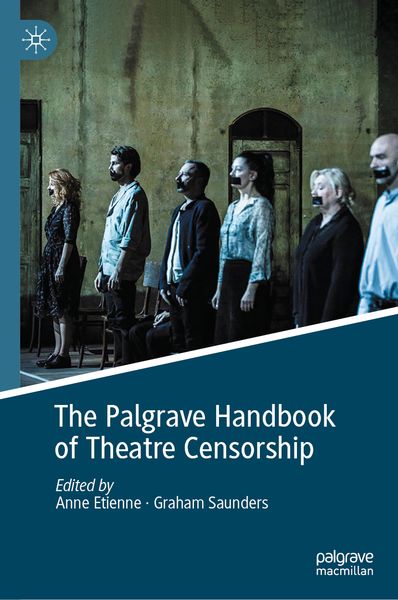
The Palgrave Handbook of Theatre Censorship
-
- Hardcover ausgewählt
- Taschenbuch
- eBook
-
Sprache:Englisch
314,99 €
UVP
362,99 €
inkl. gesetzl. MwSt.,
Beschreibung
Produktdetails
Einband
Gebundene Ausgabe
Erscheinungsdatum
29.11.2024
Abbildungen
XV, 4 illus., 1 illus. in color., farbige Illustrationen, schwarz-weiss Illustrationen
Herausgeber
Anne Etienne + weitereVerlag
SpringerSeitenzahl
670
Maße (L/B/H)
24,1/16/4,3 cm
Gewicht
1183 g
Sprache
Englisch
ISBN
978-3-031-67298-9
This book incorporates a wide theoretical, cultural, literary and historical engagement in exploring the tension between dramatic productions and the forms of censorship they encounter from creation to reception. The Palgrave Handbook of Theatre Censorship offers global new insights into censorship practices, examining attempts at repression motivated either by fears that audiences gathering together to watch live dramatic events will lead to sedition and mass uprisings, or by moral or religious squeamishness requiring the establishment of institutional systems of censorship to curb or suppress the stage. As such, the Handbook aims to initiate redefinitions of what we understand or experience as censorship.
Who knew theatre could (still) carry so many threats, or be so widely provocative and dangerous? This is an extraordinary and often eye-opening set of thirty-six individually insightful, wide-ranging and oftentimes disturbing essays, each of which offers unique insights into theatre censorship practices and their impact within a specific political and moral culture. There is a particular emphasis on the recent and current, and the authors speak with first-hand knowledge and from direct experience not only about the restrictions but also how artists sometimes negotiate and evade these. What makes the book so especially fascinating and illuminating is seeing so many examples juxtaposed together. This enables the reader to hear the essays and the cultures talking to and alongside each other. The collection repeatedly breaks fresh ground, and the editors deserve enormous credit for gathering and effectively curating so many reports from the front-line.
- Steve Nicholson, Emeritus Professor, University of Sheffield, UK
Anne Etienne and Graham Saunders’s book is a wide-ranging, incisive and compelling collection of reflections and case studies on the theatre industry’s relationship to censorship and self-censorship from a historical and contemporaneous perspective. An impressive array of authors have been assembled for this volume representing, among them, views on the subject from Spain, Denmark, Norway, Zimbabwe, South Africa, Germany, Italy, Indonesia, Iran, Portugal, Turkey, Brazil, Japan, Ireland, Australia, Russia, England and more. The book is by turns surprising in its curatorial and narrative design and wonderfully effective at delineating the complex and thorny paths that create socio-political cultures where the censorship and self-censorship of theatre artists thrives and/or is efficaciously contested and rebelled against. Of note is a through line of argument in the book around less overt modes of surveillance that police artists’ imaginations and thereby the work they create and produce. At a time in the world where many governments are increasingly seeking to limit artistic expression, this book is a necessary reminder of the many freedoms that have been fought for in theatres around the globe, and how the power of being unsilenced must never be taken for granted.
– Caridad Svich. Playwright & Translator
This is a truly excellent collection of incisive studies. It is wide-ranging, impressively global in scope, with an illuminating balance of the historical and the contemporary. In its impressive and well-realised ambition, demonstrated by the well-focused intelligence and academic flair of its many contributors, this collection is both magisterial and vital. It is an essential contribution to censorship studies, fascinating and inspiring, a must-read for anyone interested in the subject.
– Aleks Sierz. Theatre critic and author of Rewriting the Nation: British Theatre Today (2011) & Good Nights Out: A History of British Theatre Since the Second World War (2021)
Noch keine Bewertungen vorhanden
Verfassen Sie die erste Bewertung zu diesem Artikel
Helfen Sie anderen Kundinnen und Kunden durch Ihre Meinung.
Kurze Frage zu unserer Seite
Vielen Dank für Ihr Feedback
Wir nutzen Ihr Feedback, um unsere Produktseiten zu verbessern. Bitte haben Sie Verständnis, dass wir Ihnen keine Rückmeldung geben können. Falls Sie Kontakt mit uns aufnehmen möchten, können Sie sich aber gerne an unseren Kund*innenservice wenden.
zum Kundenservice