Gutscheinbedingungen

**Gültig bis 06.07.2026 auf fremdsprachige Bücher online auf thalia.at, in der Thalia App ab einem Mindestbestellwert von 30€ und in allen Thalia Buchhandlungen in Österreich. In den Buchhandlungen nur gültig auf lagernde Ware. Einzelne Artikel können ausgeschlossen sein. Ausgenommen sind preisgebundene Artikel & eBooks. Pro Einkauf einmal einlösbar. Nur gültig gegen Vorlage oder im Onlineshop hinterlegter Bonuscard. Infos zur Einlösung in der Buchhandlung sind auf der Bonuscard-Vorteilspreisseite zu finden. Click & Collect nur bei Onlinevorabzahlung möglich. Keine Einlösung bei Scan & Go-Bezahlung. Keine Barauszahlung. Nicht kombinierbar mit anderen Aktionen und Gutscheinen. Gutschein wird auf max. 500€ Bestellwert angerechnet. Nicht gültig für Versandkosten und Services.

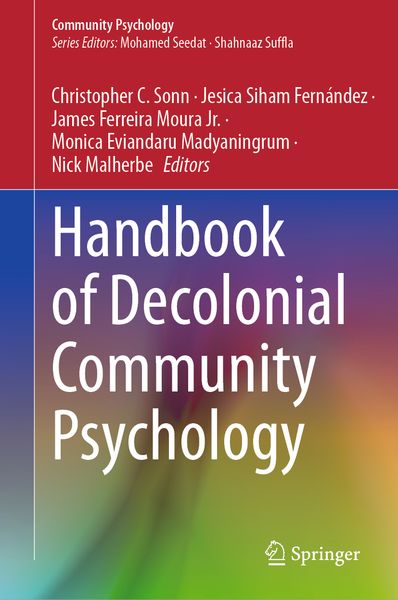
Produktbild: Handbook of Decolonial Community Psychology
- 13%

Handbook of Decolonial Community Psychology

Aus der Reihe Community Psychology
13% sparen

314,99 € UVP 362,99 €

inkl. gesetzl. MwSt., Versandkostenfrei


Beschreibung

Produktdetails

Einband

Gebundene Ausgabe

Erscheinungsdatum

22.10.2024

Abbildungen

XXIX, 15 illus. in color., farbige Illustrationen

Herausgeber

Christopher C. Sonn + weitere

Verlag

Springer

Seitenzahl

546

Maße (L/B/H)

24,1/16/3,7 cm

Gewicht

965 g

Sprache

Englisch

ISBN

978-3-031-67034-3

Beschreibung

Portrait

Christopher C. Sonn , PhD is a Professor at Victoria University, Melbourne, Australia on the land of the Wurundjeri of the Kulin nation. He is a fellow of and Deputy Director (Research Training) the Institute of Health and Sport. His research is concerned with understanding and changing dynamics of oppression and resistance, examining structural violence such as racism, and its effects on social identities, intergroup relations and belonging. He holds a Visiting Professorship at the University of the Witwatersrand, South Africa. He is co-editor of Creating Inclusive Knowledges and Decoloniality and Epistemic Justice in Contemporary Community Psychology, and co-author of Social Psychology and Everyday Life, and Associate Editor of the American Journal of Community Psychology and Community Psychology in Global Perspective.

Jesica Siham Fernández is an Assistant Professor in the Ethnic Studies Department at Santa Clara University, and the author of the book "Growing Up Latinx: Coming of Age in a Time of Contested Citizenship" (NYU Press, 2021). She received her PhD in Social Psychology and Latin American & Latinx Studies from the University of California, Santa Cruz. Grounded in a decolonial feminist praxis, she engages critical PAR paradigms and approaches to support Latinx communities, youth, and communities of color in actualizing collective sociopolitical wellbeing, and transformative justice. As a teacher-scholar-activist, Jesica’s praxis is rooted in a commitment to racial justice and anti-oppression toward decolonial liberation.

James Ferreira Moura Jr. is an Adjunct Professor at the Institute of Humanities and Letters of the University of International Integration of Afro-Brazilian Lusophony. Professor of the Psychology Doctoral Program at the Federal University of Ceará. PhD in Psychology at the Federal University of Rio Grande do Sul (UFRGS). Fulbright Visiting Professor at Boston College, United States(US). He is co-editor of the book Psychosocial of Implications of Poverty (2019). He coordinates the Network of Studies and Confrontations of Poverty, Discrimination and Resistance (reaPODERE), which develops activities of critical teaching, research, and collaborative extension. He conducts research mainly on the following themes: Community Psychology, Public Policy, Poverty, Shame/Humiliation, Interseccionalty and Decolonial Studies.

Monica Eviandaru Madyaningrum is an assistant professor at the Faculty of Psychology, Sanata Dharma University, Indonesia. She holds a PhD degree in community psychology from the School of Health and Biomedicine, Victoria University, Australia, where she also did her master program. Her research and publications are in the areas of community psychology, community empowerment, participatory methodologies and disability studies. In addition to her academic position, she has been involved in developing a support group for families of children with multiple disabilities in Yogyakarta Province, Indonesia.

Nick Malherbe is a researcher at Institute for Social and Health Sciences, University of South Africa and South African Medical Research Council-University of South Africa Masculinity and Health Research Unit. His research interests include culture, psychological praxis, and visual methods.

Produktdetails

Einband

Gebundene Ausgabe

Erscheinungsdatum

22.10.2024

Abbildungen

XXIX, 15 illus. in color., farbige Illustrationen

Herausgeber

Verlag

Springer

Seitenzahl

546

Maße (L/B/H)

24,1/16/3,7 cm

Gewicht

965 g

Sprache

Englisch

ISBN

978-3-031-67034-3

Herstelleradresse

Springer-Verlag KG
Sachsenplatz 4-6
1201 Wien
AT

Email: GPSR Kontakt

Noch keine Bewertungen vorhanden

Verfassen Sie die erste Bewertung zu diesem Artikel

Helfen Sie anderen Kundinnen und Kunden durch Ihre Meinung.

Kundinnen und Kunden meinen

Bewertungen (0)

  • Produktbild: Handbook of Decolonial Community Psychology
  • Decolonisation in and beyond community psychologies: A transnational plurilogue.-Revisiting Maritza Montero's work from a decolonial perspective.-The Psychological, A Critique From Decolonial Community Psychology.-Emotion and Affect in Social and Political Life: Community Psychology’s Contributions and Erasures.-Reproducing Coloniality: Language, Gender, and Neoliberal Discourses of Selfhood.-Teaching community psychology from an entanglement framework.-Decolonizing community-based research and practice in the Indonesian context: Refuting superiority, foregrounding solidarity.-Sacred Cenote Spaces Nurturing Heart-Centered Collective Transformation.-Community Psychology and life on the streets: problematizations of the concept of community.-Decolonial Attitude And Community Psychology In Social Policy.-Reflections on Decoloniality, Liberation and Community Psychology.-Towards a decolonising psychology: Reflexivity with mothers and adolescents from the Maya Region of Yucatan.-Aula en la Montaña: Deconstructing coloniality in childhood through community action.-Challenging Borders and Border Violence: A Decolonial Community Psychology Perspective.-Everyday Solidarities and Epistemic Justice: Nourishing Ecologies of Wellbeing.-Refusing Necropolitics in St. John and in Palestine: Unearthing Stories of Land Dispossession, Desire and the Will to Live.-Reimaging a Decolonial and Post-Sectarian Lebanon: A Reflection on the October 17 Uprising.-Colonial constructions of friendship and land dispossession: implications for contemporary land and environmental defending.-“A march is beginning, a march for freedom”: Miya poetry as decolonial praxis toward justice and liberation.-Scars of Resistance: Battling Through the Pain, Bearing the Bruises.-From collective reflexivity to personal responsibility: Making sense of community critiques about ‘Kurdish Power’ research.-Anthropocentric limits of community: Relation as a black and indigenous ethic.-Illegible Fugitivity and Subversive Resistances: black decolonial roots of decoloniality.-Contributions of Afro-Pindoramic thought to the decolonial turn in community psychology.-Decolonial Community Psychology from Abya Yala.-Weaving Pathways Towards Decoloniality Through Indigenous Community-Based Research and Cosmopraxes.-Decolonial Practices from a Community Psychology.-Contributions and contradictions in decolonizing community psychology: Accompanying Mayan and Andean Women through feminist PAR.-The Indigenous Foundations of the Decolonial Community Psycholog.