KI-Beratung Beta

Gutscheinbedingungen

**Gültig bis 18.11.2026 auf englischsprachige Klassiker (klassiker-32728) online auf thalia.at und in der Thalia App. Einzelne Artikel können ausgeschlossen sein. Ausgenommen sind preisgebundene Artikel & eBooks. Pro Einkauf einmal einlösbar. Click & Collect nur bei Onlinevorabzahlung möglich. Keine Barauszahlung. Nicht kombinierbar mit anderen Aktionen und Gutscheinen. Gutschein wird auf max. 500€ Bestellwert angerechnet. Nicht gültig für Geschenkkarten, Versandkosten und Services.

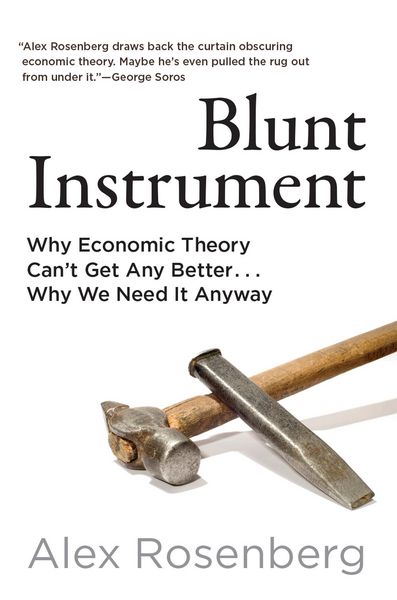
Produktbild: Blunt Instrument

Blunt Instrument Why Economic Theory Can't Get Any Better...Why We Need It Anyway

29,99 €

inkl. gesetzl. MwSt., zzgl. Versandkosten


  • Kostenlose Lieferung ab 30 € Einkaufswert
  • Versandkostenfrei für Bonuscard-Kund*innen

Beschreibung

Why economic theory—with no track-record of predictive success—is still an indispensable tool for protecting civilized life. Economic theory has never gotten any better at prediction. Its explanations are always after the fact. The mathematical models economists have devoted themselves to for more than...

Beschreibung

Why economic theory—with no track-record of predictive success—is still an indispensable tool for protecting civilized life.
Economic theory has never gotten any better at prediction. Its explanations are always after the fact. The mathematical models economists have devoted themselves to for more than a century can’t be improved to enhance their empirical relevance. But from this research program that never paid off, a very useful tool has emerged—game theory. It’s just what civilized society needs to protect itself from the rapaciousness that condemns all markets to fail. In Blunt Instrument, Alex Rosenberg helps explain to outsiders exactly what they need to make sense of economic theory, and why despite its failures, it’s still indispensable.
Economic theory is something we all should understand because the economy affects us all, and it is economic theorists who shape that economy for good or ill. No less an economist than John Maynard Keynes expressed the point in a memorable quotation: “Practical men, who believe themselves to be quite exempt from any intellectual influence, are usually the slaves of some defunct economist.” This book draws back the curtain from the math and the graphs that deliver microeconomic and macroeconomic models. It demystifies the formidable-looking equations, explaining the reasoning behind the math so that outsiders can decide on the theory’s importance to their own thinking about the economy. Finally, it shows how game theory—the study of strategic choice—emerged from the outlandish idealizations of economic theory. Most importantly, it illuminates how game theory both mitigates the failures of real-world economies and improves the design of important human institutions.

Produktdetails

Einband

Gebundene Ausgabe

Erscheinungsdatum

18.03.2025

Abbildungen

21 BLACK AND WHITE ILLUS.

Verlag Mit Press

Produktdetails

Einband

Gebundene Ausgabe

Erscheinungsdatum

18.03.2025

Abbildungen

21 BLACK AND WHITE ILLUS.

Verlag Mit Press
Seitenzahl

256

Maße (L/B/H)

23,3/15,8/2,9 cm

Gewicht

488 g

Sprache

Englisch

ISBN

978-0-262-04965-8

Herstelleradresse

Libri GmbH
Europaallee 1
36244 Bad Hersfeld
DE

Email: gpsr@libri.de

Noch keine Bewertungen vorhanden

Verfassen Sie die erste Bewertung zu diesem Artikel

Helfen Sie anderen Kundinnen und Kunden durch Ihre Meinung.

Kundinnen und Kunden meinen

Bewertungen (0)

Die Leseprobe wird geladen.
  • Produktbild: Blunt Instrument
  • Chapter One: Why We Need to Understand Economic Theory
    Chapter Two: Economics Won’t Budge, Can’t Budge, from Rational Choice Theory
    Chapter Three: Adam Smith is Still Setting the Agenda For Economic Theory
    Chapter Four: Who Invited Calculus?
    Chapter Five: Who Needs Money? Not Economic Theory!
    Chapter Six: Back to the Future with The New Classical Macroeconomics
    Chapter Seven: Economic Theory’s War against Profit
    Chapter Eight: It’s All Game Theory Now
    Chapter Nine: Financial Markets are the most important markets. So why are they fated always to fail the most?
    Chapter Ten: Why Economics is Indispensable Anyway