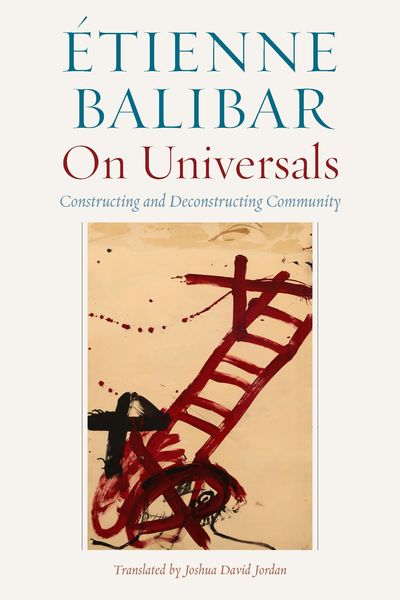
On Universals Constructing and Deconstructing Community
-
- Einzelkauf Download ausgewählt
-
Sprache:Englisch
34,50 €
inkl. gesetzl. MwSt.Beschreibung
Produktdetails
Format
Kopierschutz
Ja
Family Sharing
Ja
Text-to-Speech
Nein
Erscheinungsdatum
04.08.2020
Verlag
Fordham University PressSeitenzahl
(Printausgabe)
Dateigröße
1452 KB
Übersetzt von
Joshua David Jordan
Sprache
Englisch
EAN
9780823288588
Many on the Left have looked upon "universal" as a dirty word, one that signals liberalism's failure to recognize the masculinist and Eurocentric assumptions from which it proceeds. In rejecting universalism, we have learned to reorient politics around particulars, positionalities, identities, immanence, and multiple modernities. In this book, one of our most important political philosophers builds on these critiques of the tacit exclusions of Enlightenment thought, while at the same time working to rescue and reinvent what universal claims can offer for a revolutionary politics answerable to the common. In the contemporary quarrel of universals, Balibar shows, the stakes are no less than the future of our democracies. In dialogue with such philosophers as Alain Badiou, Judith Butler, and Jacques Rancière, he meticulously investigates the paradoxical processes by which the universal is constructed and deconstructed, instituted and challenged, in modern society. With critical rigor and keen historical insight, Balibar shows that every statement and institution of the universal-such as declarations of human rights-carry an exclusionary, particularizing principle within themselves and that every universalism immediately falls prey to countervailing universalisms. Always equivocal and plural, the universal is thus a persistent site of conflict within societies and within subjects themselves. And yet, Balibar suggests, the very conflict of the universal-constituted as an ever-unfolding performative contradiction-also provides the emancipatory force needed to reinvigorate and reimagine contemporary politics and philosophy. In conversation with a range of thinkers from Marx, Freud, and Benjamin through Foucault, Derrida, and Scott, Balibar shows the power that resides not in the adoption of a single universalism but in harnessing the energies made available by claims to universality in order to establish a common answerable to difference.
Noch keine Bewertungen vorhanden
Verfassen Sie die erste Bewertung zu diesem Artikel
Helfen Sie anderen Kundinnen und Kunden durch Ihre Meinung.
Kurze Frage zu unserer Seite
Vielen Dank für Ihr Feedback
Wir nutzen Ihr Feedback, um unsere Produktseiten zu verbessern. Bitte haben Sie Verständnis, dass wir Ihnen keine Rückmeldung geben können. Falls Sie Kontakt mit uns aufnehmen möchten, können Sie sich aber gerne an unseren Kund*innenservice wenden.
zum Kundenservice