KI-Beratung Beta

Produktbild: Strengthening European Energy Policy

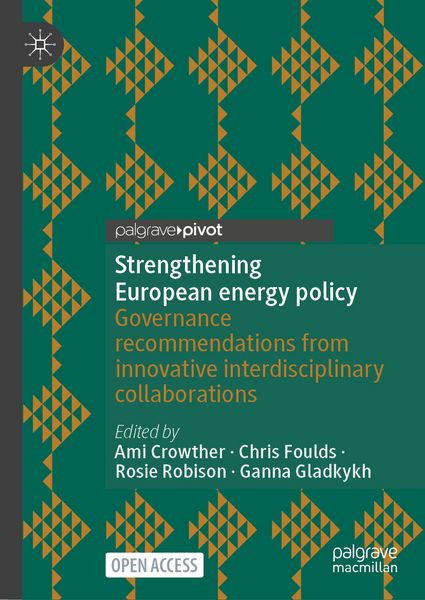
Strengthening European Energy Policy Governance Recommendations From Innovative Interdisciplinary Collaborations

29,99 €

inkl. gesetzl. MwSt., zzgl. Versandkosten


  • Kostenlose Lieferung ab 30 € Einkaufswert
  • Versandkostenfrei für Bonuscard-Kund*innen

Beschreibung

This open access book foregrounds novel collaborations between the Social Sciences and Humanities (SSH), and Science, Technology, Engineering and Mathematics (STEM) disciplines, for the benefit of European energy policy. Each chapter has been led by a team spanning social and technical disciplines. The...

Beschreibung

This open access book foregrounds novel collaborations between the Social Sciences and Humanities (SSH), and Science, Technology, Engineering and Mathematics (STEM) disciplines, for the benefit of European energy policy. Each chapter has been led by a team spanning social and technical disciplines. The book proposes 10 policy recommendations to: Simplify the uptake of community energy; Prioritise societal engagement in geothermal; Create co-learning for energy communities; Facilitate energy literacy; Support place-based strategies for retrofit; Promote integrated policy design for agrivoltaics; Increase social acceptability of low-carbon technologies; Protect digital energy infrastructure; Understand stakeholder perceptions of energy-efficiency measures; and Rethink energy system models to support the just transition. It will be of interest to anyone developing, implementing or critiquing energy policy (locally, nationally or internationally) as well as those looking to expand the use of interdisciplinary research to achieve sustainability goals. 


Part of a three-volume collection covering climate, energy, and mobility policy.

Portrait


Ami Crowther
is a Postdoctoral Research Fellow at Anglia Ruskin University’s Global Sustainability Institute, and lead editor of this book. 


Chris Foulds
is Professor of Sustainability & Society, at Anglia Ruskin University’s Global Sustainability Institute, and co-leads the SSH CENTRE.


Rosie Robison
is Professor of Social Sustainability, at Anglia Ruskin University’s Global Sustainability Institute, and co-leads the SSH CENTRE.


Ganna Gladkykh
is a Policy Fellow at the Stockholm Environment Institute. She edited this book whilst a Clean Energy Transition Expert at the European Energy Research Alliance.

Produktdetails

Einband

Gebundene Ausgabe

Erscheinungsdatum

29.09.2024

Abbildungen

XXIX, 191 p. 2 illus., 1 illus. in color.

Herausgeber Ami Crowther + weitere

Produktdetails

Einband

Gebundene Ausgabe

Erscheinungsdatum

29.09.2024

Abbildungen

XXIX, 191 p. 2 illus., 1 illus. in color.

Herausgeber
Verlag Springer
Seitenzahl

191

Maße (L/B/H)

21,6/15,3/1,7 cm

Gewicht

374 g

Auflage

2024

Sprache

Englisch

ISBN

978-3-031-66480-9

Herstelleradresse

Springer-Verlag GmbH
Europaplatz 3
69115 Heidelberg
DE

Email: ProductSafety@springernature.com

Noch keine Bewertungen vorhanden

Verfassen Sie die erste Bewertung zu diesem Artikel

Helfen Sie anderen Kundinnen und Kunden durch Ihre Meinung.

Kundinnen und Kunden meinen

Bewertungen (0)

  • Produktbild: Strengthening European Energy Policy

  • Chapter 1: Introduction.- Chapter 2: Building pathways to an inclusive skilled labour force to decarbonise existing UK homes: Shared insights from across Britain and leading EU Member States.- Chapter 3: Resilient Infrastructure for Smart Cities: a Participatory Stakeholder Approach to Multi-Criteria Policy Design.- Chapter 4: EU – Africa cooperation for energy access: the case of geothermal energy communities.- Chapter 5: Safeguarding EU Energy Systems: An Interdisciplinary Framework for Resilience in the Digital Era.- Chapter 6: Rethinking energy system models: inclusive pathways to climate neutrality.- Chapter 7: Clean energy for all at risk: the need for community participation in the fast-tracked energy transition.- Chapter 8: From Silicon to Perovskite: A Comprehensive Transdisciplinary Approach to Unveil Economic, Environmental and Societal Barriers and Potential of Established and Emerging PV technologies.- Chapter 9: Public and social acceptability of contentious low-carbon energy technologies in the last decade: nuclear fusion, agrivoltaics and offshore wind turbines.- Chapter 10: A chapter on challenging energy literacy.- Chapter 11: Unknown, uncertainties and risks: social and geoscience implications for public engagement in geothermal energy developments in Europe.- Chapter 12: Conclusion.