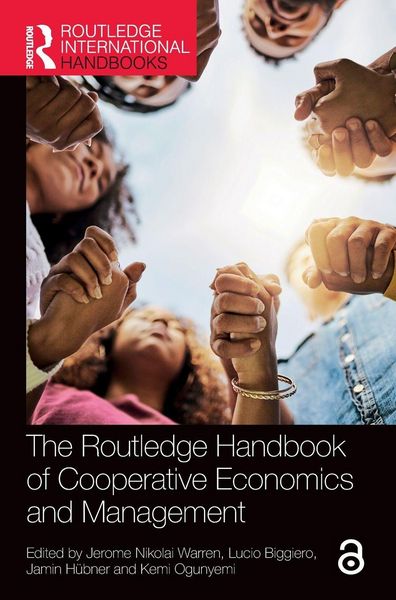
The Routledge Handbook of Cooperative Economics and Management
-
- Hardcover ausgewählt
- Taschenbuch
- eBook
-
Sprache:Englisch
256,99 €
inkl. gesetzl. MwSt.,
Beschreibung
Produktdetails
Einband
Gebundene Ausgabe
Erscheinungsdatum
23.12.2024
Abbildungen
40 SW-Abb., 40 SW-Zeichn., 16 Tabellen
Herausgeber
Jerome Nikolai Warren + weitereVerlag
Taylor & FrancisSeitenzahl
558
Maße (L/B/H)
25/17,5/3,4 cm
Gewicht
1130 g
Sprache
Englisch
ISBN
978-1-03-258385-3
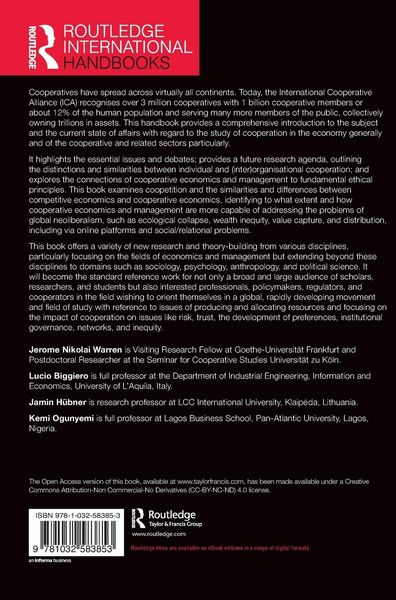
Cooperatives have spread across virtually all continents. Today, the International Cooperative Alliance (ICA) recognises over 3 million cooperatives with 1 billion cooperative members or about 12% of the human population and serving many more members of the public, collectively owning trillions in assets. This handbook provides a comprehensive introduction to the subject and the current state of affairs with regard to the study of cooperation in the economy generally and of the cooperative and related sectors particularly.
It highlights the essential issues and debates; provides a future research agenda, outlining the distinctions and similarities between individual and (inter)organisational cooperation; and explores the connections of cooperative economics and management to fundamental ethical principles. This book examines coopetition and the similarities and differences between competitive economics and cooperative economics, identifying to what extent and how cooperative economics and management are more capable of addressing the problems of global neoliberalism, such as ecological collapse, wealth inequity, value capture, and distribution, including via online platforms and social/relational problems.
This book offers a variety of new research and theory building from various disciplines, particularly focusing on the fields of economics and management but extending beyond these disciplines to domains such as sociology, psychology, anthropology, and political science. It will become the standard reference work for not only a broad and large audience of scholars, researchers, and students but also interested professionals, policymakers, regulators, and cooperators in the field wishing to orient themselves in a global, rapidly developing movement and field of study with reference to issues of producing and allocating resources and focusing on the impact of cooperation on issues like risk, trust, the development of preferences, institutional governance, networks, and inequity.
The handbook has received an Honorable Mention for the Joyce Rothschild book prize.
Noch keine Bewertungen vorhanden
Verfassen Sie die erste Bewertung zu diesem Artikel
Helfen Sie anderen Kundinnen und Kunden durch Ihre Meinung.
Kurze Frage zu unserer Seite
Vielen Dank für Ihr Feedback
Wir nutzen Ihr Feedback, um unsere Produktseiten zu verbessern. Bitte haben Sie Verständnis, dass wir Ihnen keine Rückmeldung geben können. Falls Sie Kontakt mit uns aufnehmen möchten, können Sie sich aber gerne an unseren Kund*innenservice wenden.
zum Kundenservice