• Produktbild: Bioinformatics Research and Applications
  • Produktbild: Bioinformatics Research and Applications
Band 14954 - 21%

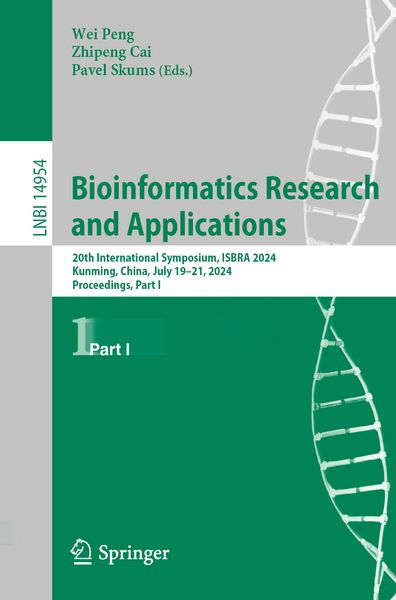
Bioinformatics Research and Applications 20th International Symposium, ISBRA 2024, Kunming, China, July 19–21, 2024, Proceedings, Part I

21% sparen

85,99 € UVP 109,99 €

inkl. gesetzl. MwSt., Versandkostenfrei


Beschreibung

Produktdetails

Einband

Taschenbuch

Erscheinungsdatum

12.07.2024

Herausgeber

Wei Peng + weitere

Verlag

Springer Singapore

Seitenzahl

511

Maße (L/B/H)

23,5/15,5/2,9 cm

Auflage

1. Auflage

Sprache

Englisch

ISBN

978-981-9751-27-3

Beschreibung

Produktdetails

Einband

Taschenbuch

Erscheinungsdatum

12.07.2024

Herausgeber

Verlag

Springer Singapore

Seitenzahl

511

Maße (L/B/H)

23,5/15,5/2,9 cm

Auflage

1. Auflage

Sprache

Englisch

ISBN

978-981-9751-27-3

Herstelleradresse

Springer-Verlag KG
Sachsenplatz 4-6
1201 Wien
AT

Email: ProductSafety@springernature.com

Kundinnen und Kunden meinen

0 Bewertungen

Informationen zu Bewertungen

Zur Abgabe einer Bewertung ist eine Anmeldung im Konto notwendig. Die Authentizität der Bewertungen wird von uns nicht überprüft. Wir behalten uns vor, Bewertungstexte, die unseren Richtlinien widersprechen, entsprechend zu kürzen oder zu löschen.

Die Bewertungen sind nach Format, Anzahl Sterne und Datum sortiert.

Verfassen Sie die erste Bewertung zu diesem Artikel

Helfen Sie anderen Kund*innen durch Ihre Meinung

Kundinnen und Kunden meinen

0 Bewertungen filtern

  • Produktbild: Bioinformatics Research and Applications
  • Produktbild: Bioinformatics Research and Applications
  • .- Predicting Drug-Target Affinity Using Protein Pocket and Graph Convolution Network.

    .- MSMK: Multiscale module kernel for identifying disease-related genes.

    .- Flat and Nested Protein Name Recognition Based on BioBERT and Biaffine Decoder.

    .- RFIR: A Lightweight Network for Retinal Fundus Image Restoration.

    .- Gaussian Beltrami-Klein Model for Protein Sequence Classification: A Hyperbolic Approach.

    .- stEnTrans: Transformer-based deep learning for spatial transcriptomics enhancement.

    .- Contrastive Masked Graph Autoencoders for Spatial Transcriptomics Data Analysis.

    .- Spatial gene expression prediction from histology images with STco.

    .- Exploration and Visualization Methods for Chromatin Interaction Data.

    .- A Geometric Algorithm for Blood Vessel Reconstruction from Skeletal Representation.

    .- UFGOT: unbalanced filter graph alignment with optimal transport for cancer subtyping based on multi-omics data.

    .- Dendritic SE-ResNet Learning for Bioinformatic Classification.

    .- GSDRP: Fusing Drug Sequence Features with Graph Features to Predict Drug Response.

    .- CircMAN: Multi-channel Attention Networks Based on Feature Fusion for CircRNA-binding Site Prediction.

    .- Machine Learning-Driven Discovery of Quadruple-Negative Breast Cancer Subtypes from Gene Expression Data.

    .- A novel Combined Embedding Model based on Heterogeneous Network for Inferring Microbe-Metabolite Interactions.

    .- Central Feature Network Enables Accurate Detection of Both Small and Large Particles in Cryo-Electron Tomography.

    .- LncRNA-disease association prediction based on integrated application of matrix decomposition and graph contrastive learning.

    .- Predictive Score-Guided Mixup for Medical Text Classification.

    .- CHASOS: A novel deep learning approach for chromatin loop predictions.

    .- A deep metric learning based method for predicting miRNA-disease associations.

    .- Learning an adaptive self-expressive fusion model for multi-omics cancer subtype prediction.

    .- IFNet: An Image-Enhanced Cross-Modal Fusion  Network for Radiology Report Generation.

    .- Hybrid Attention Knowledge Fusion Network for Automated Medical Code Assignment.

    .- Variable-length Promoter Strength Prediction based on Graph Convolution.

    .- scMOGAE: A Graph Convolutional Autoencoder-Based Multi-omics Data Integration Framework for Single-Cell Clustering.

    .- VM-UNET-V2: Rethinking Vision Mamba UNet for Medical Image Segmentation.

    .- Fighting Fire with Fire: Medical AI Models Defend Against Backdoor Attacks via Self-Learning.

    .- An In-depth Assessment of Sequence Clustering softares in Bioinformatics.

    .- Novel Fine-tuning Strategy on Pre-trained Protein Model Enhances ACP functional Type Classfication.

    .- Enhancing Privacy and Preserving Accuracy in Medical Image Classification with Limited Labeled Samples.

    .- gaBERT: an Interpretable Pretrained Deep Learning  Framework for Cancer Gene Marker Discovery.

    .- Hybrid CNN and Low-Complexity Transformer Network with Attention-based Feature Fusion for Predicting Lung Cancer Tumor after Neoadjuvant Chemoimmunotherapy.

    .- Deep Hyper-Laplacian Regularized Self-Representation Learning based Structured Association Analysis for Brain Imaging Genetics.

    .- IntroGRN: Gene Regulatory Network Inference from single-cell RNA Data Based on Introspective VAE.

    .- Identification of Potential SARS-CoV-2 Main Protease Inhibitors Using Drug Repurposing and Molecular Modeling.

    .- An Ensemble Learning Model for Predicting Unseen TCR-Epitope Interactions.

    .- Deep Learning Approach to Identify Protein's Secondary Structure Elements.

    .- Modeling single-cell ATAC- seq data based on contrastive learning.

    .- Continuous Identification of Sepsis-Associated Acute Heart Failure Patients: An Integrated LSTM-Based Algorithm.

    .- A novel approach for subtype identification via multi-omics data using adversarial autoencoder.