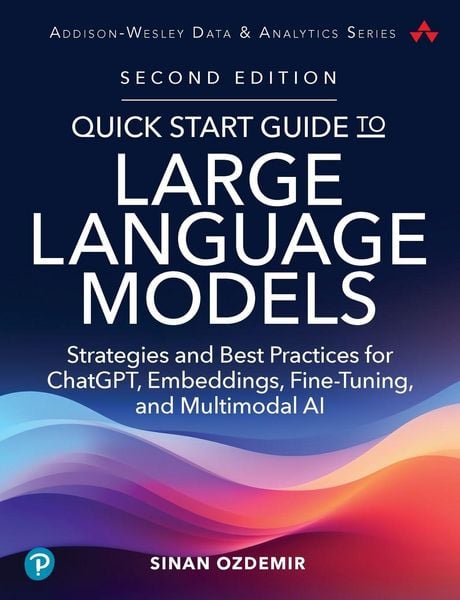
Quick Start Guide to Large Language Models Strategies and Best Practices for Chatgpt, Embeddings, Fine-Tuning, and Multimodal AI
-
- Taschenbuch ausgewählt
- eBook
-
Sprache:Englisch
-
Verlag:Pearson Academic
- Pearson 42,99 €
- Pearson Academic 56,99 € ausgewählt
56,99 €
inkl. gesetzl. MwSt.,
Beschreibung
Produktdetails
Einband
Taschenbuch
Erscheinungsdatum
13.10.2024
Verlag
Pearson AcademicSeitenzahl
384
Maße (L/B/H)
23/17,6/2,1 cm
Gewicht
642 g
Auflage
2nd edition
Sprache
Englisch
ISBN
978-0-13-534656-3
The Practical, Step-by-Step Guide to Using LLMs at Scale in Projects and Products
Large Language Models (LLMs) like Llama 3, Claude 3, and the GPT family are demonstrating breathtaking capabilities, but their size and complexity have deterred many practitioners from applying them. In Quick Start Guide to Large Language Models, Second Edition, pioneering data scientist and AI entrepreneur Sinan Ozdemir clears away those obstacles and provides a guide to working with, integrating, and deploying LLMs to solve practical problems.
Ozdemir brings together all you need to get started, even if you have no direct experience with LLMs: step-by-step instructions, best practices, real-world case studies, and hands-on exercises. Along the way, he shares insights into LLMs' inner workings to help you optimize model choice, data formats, prompting, fine-tuning, performance, and much more. The resources on the companion website include sample datasets and up-to-date code for working with open- and closed-source LLMs such as those from OpenAI (GPT-4 and GPT-3.5), Google (BERT, T5, and Gemini), X (Grok), Anthropic (the Claude family), Cohere (the Command family), and Meta (BART and the LLaMA family).
- Learn key concepts: pre-training, transfer learning, fine-tuning, attention, embeddings, tokenization, and more
- Use APIs and Python to fine-tune and customize LLMs for your requirements
- Build a complete neural/semantic information retrieval system and attach to conversational LLMs for building retrieval-augmented generation (RAG) chatbots and AI Agents
- Master advanced prompt engineering techniques like output structuring, chain-of-thought prompting, and semantic few-shot prompting
- Customize LLM embeddings to build a complete recommendation engine from scratch with user data that outperforms out-of-the-box embeddings from OpenAI
- Construct and fine-tune multimodal Transformer architectures from scratch using open-source LLMs and large visual datasets
- Align LLMs using Reinforcement Learning from Human and AI Feedback (RLHF/RLAIF) to build conversational agents from open models like Llama 3 and FLAN-T5
- Deploy prompts and custom fine-tuned LLMs to the cloud with scalability and evaluation pipelines in mind
- Diagnose and optimize LLMs for speed, memory, and performance with quantization, probing, benchmarking, and evaluation frameworks
"A refreshing and inspiring resource. Jam-packed with practical guidance and clear explanations that leave you smarter about this incredible new field."
--Pete Huang, author of The Neuron
Register your book for convenient access to downloads, updates, and/or corrections as they become available. See inside book for details.
Noch keine Bewertungen vorhanden
Verfassen Sie die erste Bewertung zu diesem Artikel
Helfen Sie anderen Kundinnen und Kunden durch Ihre Meinung.
Kurze Frage zu unserer Seite
Vielen Dank für Ihr Feedback
Wir nutzen Ihr Feedback, um unsere Produktseiten zu verbessern. Bitte haben Sie Verständnis, dass wir Ihnen keine Rückmeldung geben können. Falls Sie Kontakt mit uns aufnehmen möchten, können Sie sich aber gerne an unseren Kund*innenservice wenden.
zum Kundenservice