KI-Beratung Beta

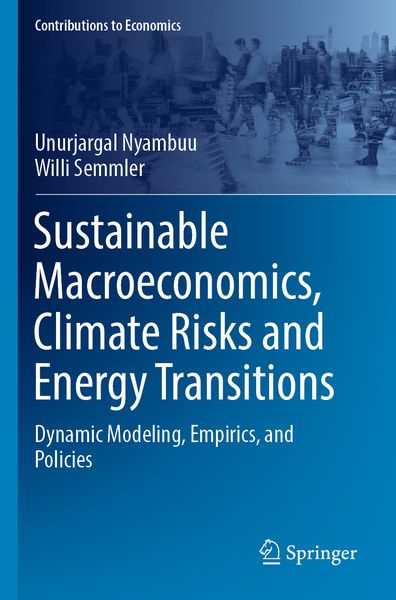
Produktbild: Sustainable Macroeconomics, Climate Risks and Energy Transitions

Sustainable Macroeconomics, Climate Risks and Energy Transitions Dynamic Modeling, Empirics, and Policies

49,99 €

inkl. gesetzl. MwSt., Versandkostenfrei


Beschreibung

Given the industrialized world’s historical dependence on fossil fuel-based energy resources and the now-realized perils of moving beyond the earth’s carbon budget, this book explores the myriad challenges of climate change and in reaching a low-carbon economy. Reconciling the medium-term competing,...

Beschreibung

Given the industrialized world’s historical dependence on fossil fuel-based energy resources and the now-realized perils of moving beyond the earth’s carbon budget, this book explores the myriad challenges of climate change and in reaching a low-carbon economy. Reconciling the medium-term competing, yet frequently complementary, needs for transition policies, the book provides guidelines for complex and often conflicting climate policy tasks.
The book presents empirical trends in the use of carbon-emitting resources and evaluates market-driven short-termism and its adverse impact on resource use and the environment; it emphasizes a medium-term macroeconomic perspective for the transition.  The authors attempt a paradigm shift towards a framework of sustainable macroeconomics. They survey relevant historical models, conduct empirical and numerical analyses ofthe climate change-relevant dynamic models, provide empirical illustrations, and evaluate diverse policy options and implementations together with their historical evolution.  New analytical issues are also  considered, e.g., strategic behavior in the energy and resource sectors, energy competition and the dynamics of market shares in new energy  technology, and supporting policies for dealing with the tipping points encountered in climate change.  The authors suggest a multitude of market-based strategies and public fiscal, monetary, and financial policies, and longer-run planning for resource extraction -all suitable for driving sustainable growth and a transformation of the energy sector.  The book also examines the multiple delaying forces slowing the transition to a low-carbon economy; these typically arise from short-termism, lock-ins, irreversibility, leakages, non-cooperative games, and other political strategies. Thus, they explain the snail’s pace evolution of current national and global climate policies.    The book will appeal to scholars and students of economics and environmental science. It is also relevant for policymakers and practitioners in multilateral institutions, research institutions as well as governments and ministries of countries interested in alternative energy sources, climate economists, and those who study the implementation of sustainable and low carbon-based policies. 

Produktdetails

Einband

Taschenbuch

Erscheinungsdatum

31.05.2024

Abbildungen

XVII, 195 p. 71 illus., 60 illus. in color.

Verlag Springer

Produktdetails

Einband

Taschenbuch

Erscheinungsdatum

31.05.2024

Abbildungen

XVII, 195 p. 71 illus., 60 illus. in color.

Verlag Springer
Seitenzahl

195

Maße (L/B/H)

23,5/15,5/1,2 cm

Gewicht

335 g

Sprache

Englisch

ISBN

978-3-031-27984-3

Herstelleradresse

Springer-Verlag KG
Sachsenplatz 4-6
1201 Wien
AT

Email: ProductSafety@springernature.com

Noch keine Bewertungen vorhanden

Verfassen Sie die erste Bewertung zu diesem Artikel

Helfen Sie anderen Kundinnen und Kunden durch Ihre Meinung.

Kundinnen und Kunden meinen

Bewertungen (0)

  • Produktbild: Sustainable Macroeconomics, Climate Risks and Energy Transitions
  • Chapter 1 – Introduction.- Chapter 2 -Sustainable Growth, Welfare and Short-termism.- Chapter 3 - Non-Sustainable Growth, Resource Extraction, and Boom-Bust Cycles.- Chapter 4 - Fossil Fuel Resources, Environment and Climate Change.- Chapter 5 - Limits on the Extraction of Fossil Fuels,- Chapter 6 - Fossil Fuel Resource Depletion, Backstop Technology, and Renewable Energy.- Chapter 7 - Transition to a Low Carbon Energy System.- Chapter 8 - The Private Sector – Energy Transitions and Financial Market.- Chapter 9 - The Public Sector – Energy Transition and Fiscal and Monetary Policies.- Chapter 10 - Delaying Forces and Climate Negotiation – Games, Lock-ins, Leakages, and Tipping Points.- Chapter 11 - Climate Risks, Sustainable Finance, and Climate Policy.- Chapter 12 - Concluding Remarks.