Gutscheinbedingungen

**Gültig bis 06.07.2026 auf fremdsprachige Bücher online auf thalia.at, in der Thalia App ab einem Mindestbestellwert von 30€ und in allen Thalia Buchhandlungen in Österreich. In den Buchhandlungen nur gültig auf lagernde Ware. Einzelne Artikel können ausgeschlossen sein. Ausgenommen sind preisgebundene Artikel & eBooks. Pro Einkauf einmal einlösbar. Nur gültig gegen Vorlage oder im Onlineshop hinterlegter Bonuscard. Infos zur Einlösung in der Buchhandlung sind auf der Bonuscard-Vorteilspreisseite zu finden. Click & Collect nur bei Onlinevorabzahlung möglich. Keine Einlösung bei Scan & Go-Bezahlung. Keine Barauszahlung. Nicht kombinierbar mit anderen Aktionen und Gutscheinen. Gutschein wird auf max. 500€ Bestellwert angerechnet. Nicht gültig für Versandkosten und Services.

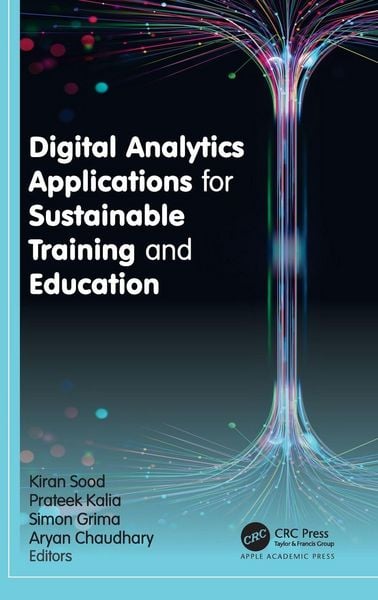
  • Produktbild: Digital Analytics Applications for Sustainable Training and Education
  • Produktbild: Digital Analytics Applications for Sustainable Training and Education

Digital Analytics Applications for Sustainable Training and Education

313,99 €

inkl. gesetzl. MwSt., Versandkostenfrei


Beschreibung

Produktdetails

Einband

Gebundene Ausgabe

Erscheinungsdatum

01.11.2024

Abbildungen

farbige, schwarzweisse Abbildungen

Herausgeber

Kiran Sood + weitere

Verlag

Taylor and Francis

Seitenzahl

496

Maße (L/B/H)

24/16,1/3,2 cm

Gewicht

1120 g

Auflage

1. Auflage

Sprache

Englisch

ISBN

978-1-77491-594-3

Beschreibung

Portrait

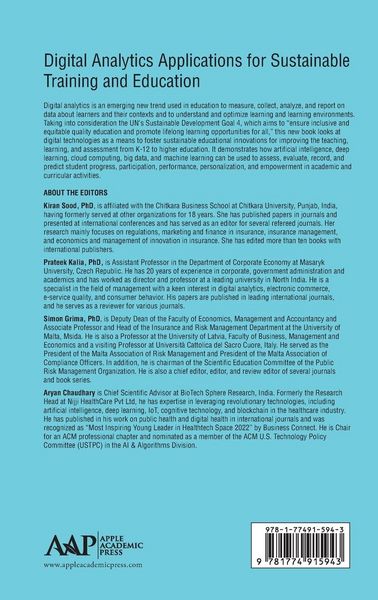
Kiran Sood, PhD, is affiliated with the Chitkara Business School at Chitkara University, Punjab, India, having formerly served at other organizations for 18 years. She has published papers in journals and presented at international conferences and has served as an editor for several refereed journals. Her research mainly focuses on regulations, marketing and finance in insurance, insurance management, and economics and management of innovation in insurance. She has edited more than ten books with international publishers.

Prateek Kalia, PhD, is Assistant Professor in the Department of Corporate Economy at Masaryk University, Czech Republic. He has 20 years of experience in corporate, government administration and academics and has worked as director and professor at a leading university in North India. He is a specialist in the field of management with a keen interest in digital analytics, electronic commerce, e-service quality, and consumer behavior. His papers are published in leading international journals, and he serves as a reviewer for various journals.

Simon Grima, PhD, is Deputy Dean of the Faculty of Economics, Management and Accountancy and Associate Professor and Head of the Insurance and Risk Management Department at the University of Malta, Msida. He is also a Professor at the University of Latvia, Faculty of Business, Management and Economics and a visiting Professor at Università Cattolica del Sacro Cuore, Italy. He served as the President of the Malta Association of Risk Management and President of the Malta Association of Compliance Officers. In addition, he is chairman of the Scientific Education Committee of the Public Risk Management Organization. He is also a chief editor, editor, and review editor of several journals and book series.

Aryan Chaudhary is Chief Scientific Advisor at BioTech Sphere Research, India. Formerly the Research Head at Nijji HealthCare Pvt Ltd, he has expertise in leveraging revolutionary technologies, including artificial intelligence, deep learning, IoT, cognitive technology, and blockchain in the healthcare industry. He has published in his work on public health and digital health in international journals and was recognized as "Most Inspiring Young Leader in Healthtech Space 2022" by Business Connect. He is Chair for an ACM professional chapter and nominated as a member of the ACM U.S. Technology Policy Committee (USTPC) in the AI & Algorithms Division.
Produktdetails

Einband

Gebundene Ausgabe

Erscheinungsdatum

01.11.2024

Abbildungen

farbige, schwarzweisse Abbildungen

Herausgeber

Verlag

Taylor and Francis

Seitenzahl

496

Maße (L/B/H)

24/16,1/3,2 cm

Gewicht

1120 g

Auflage

1. Auflage

Sprache

Englisch

ISBN

978-1-77491-594-3

Herstelleradresse

Libri GmbH
Europaallee 1
36244 Bad Hersfeld
DE

Email: gpsr@libri.de

Noch keine Bewertungen vorhanden

Verfassen Sie die erste Bewertung zu diesem Artikel

Helfen Sie anderen Kundinnen und Kunden durch Ihre Meinung.

Kundinnen und Kunden meinen

Bewertungen (0)

Weitere Artikel finden Sie in

Die Leseprobe wird geladen.
  • Produktbild: Digital Analytics Applications for Sustainable Training and Education
  • Produktbild: Digital Analytics Applications for Sustainable Training and Education
  • Foreword by SECTION I: DIGITALIZATION MEETS SUSTAINABILITY: OPPORTUNITIES AND CHALLENGES 1. Digitalization as a Driver for Sustainability in Training and Education 2. Digitization of Education: Growth Signs for the Edtech Ecosystem 3. Digitalization as a Driver for Sustainability? What Digitalization in Universities Means for Sustainable Development of Education: A Romanian Experience 4. Student Engagement in the Digital Learning Milieu 5. Digital Transformation: A Path Towards Sustainability in Higher Education SECTION II: SOCIAL NETWORK ANALYSIS IN DEVELOPING TRAINING GOALS AND HOLISTIC DEVELOPMENT OF STUDENTS 6. Social Media and the Digital Educational Revolution: Assessing the Bright and Dark Sides 7. A Bibliometric Study of Organizational Commitment and Job Satisfaction in the Education Sector 8. Digital Analytics for Maximizing Effectiveness of Research, Training, and Development 9. Social Network Analysis of Students SECTION III: DATA ALIGNMENT FOR THE UNITED NATION’S SUSTAINABLE DEVELOPMENT GOAL 4 (SDG 4): QUALITY EDUCATION FOR LEARNING OUTCOMES 10. Is Sustainable Education the Key for Economic Growth? The Case of Europe 11. Re-Engineering Education and Training: Fostering Digitalization for Sustainability 12. A Study on the Role of Digital Education in Developing Students’ Competencies for Sustainability 13. Digital Analytics Applications for Sustainable Training and Education 14. The Use of Innovative Pedagogies in Attaining United Nations’ Sustainable Development Goal Four (4): Quality Education for Learning Outcomes in Emerging Markets SECTION IV: DIGITAL TOOL USE AND SELF-REGULATED STRATEGIES IN BILINGUAL ONLINE LEARNING ENVIRONMENTS 15. A Learning Conceptual Framework for E-STEM Education in the Digital Era 16. Can Artificial Intelligence Replace Teachers? 17. Exploring the Initiatives Introduced by the Government of India in Creating an Inclusive Environment for E-Mentorship 18. The Impact of the Student-Centered Learning Approach for Dentistry Students’ Oral Academic Presentations 19. Analysis and Prediction of the Usage of Screen Time to Surmount COVID-19 Using Deep Learning SECTION V: DIGITALIZATION AS A DRIVER FOR SUSTAINABILITY 20. Integrating Digital Citizenship Education in the Contemporary Educational Ecosystem 21. Advancement in Physical Education Teaching and Assessment Based on Human-Computer Interaction with Deep Learning 22. Contribution of the MSMEs (Micro-, Small- and Medium-Sized Enterprises) Sector Towards Social Responsibility and Sustainability: A Study of the Sports Goods Industry 23. Deepening Knowledge of Digitalization and Sustainability of Education: An Overview of Challenges and Solutions 24. Educational Development in Nigeria: Does External Financing Matter? 25. The Challenges of Digital Transformation in Education: The Emerging Market Perspective 26. Practical Guide to Downloading Academic Research Papers for Beginners