Gutscheinbedingungen

**Gültig bis 25.08.2026 ab einem Mindestbestellwert von 30€ auf Spielzeug, Schreibwaren, Filme, Geschenke & Trends, Musik, tolino eReader & Zubehör, Hörbücher und Hörbuch-Downloads (außer Abo), nicht preisgebundene Bücher und Kalender online auf thalia.at und in der Thalia App. Einzelne Artikel können ausgeschlossen sein. Aufgrund der Buchpreisbindung sind deutschsprachige Bücher und eBooks ausgenommen. Zusätzlich ausgenommen sind preisgebundene Artikel, Abos & Flatrates, eBooks, Games, Geschenkkarten/-boxen, Shelfies, Software, Zeitschriften sowie einzelne Artikel von tonies®. Pro Einkauf einmal einlösbar. Click & Collect nur bei Onlinevorabzahlung möglich. Keine Barauszahlung. Nicht kombinierbar mit anderen Aktionen und Gutscheinen. Gutschein wird auf max. 500€ Bestellwert angerechnet. Nicht gültig für Versandkosten und Services. Preisgebundene Artikel sind vom Mindestbestellwert ausgeschlossen.

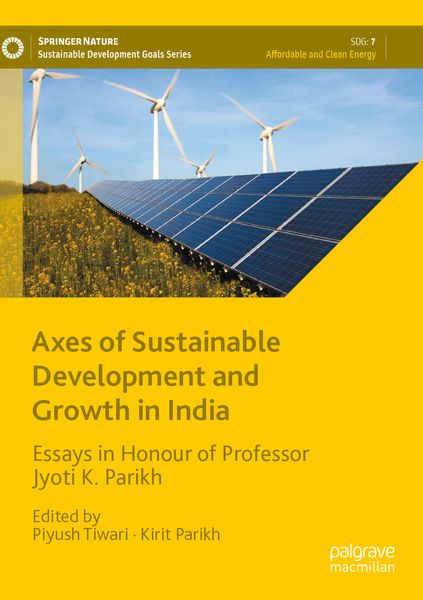
Produktbild: Axes of Sustainable Development and Growth in India
- 13%

Axes of Sustainable Development and Growth in India Essays in Honour of Professor Jyoti K. Parikh

13% sparen

142,99 € UVP 164,99 €

inkl. gesetzl. MwSt., Versandkostenfrei


Beschreibung

Produktdetails

Einband

Taschenbuch

Erscheinungsdatum

12.05.2024

Abbildungen

XXXII, 388 p. 58 illus., 49 illus. in color.

Herausgeber

Piyush Tiwari + weitere

Verlag

Springer Singapore

Seitenzahl

388

Maße (L/B/H)

21/14,8/2,3 cm

Gewicht

541 g

Auflage

2023

Sprache

Englisch

ISBN

978-981-19-9758-7

Beschreibung

Portrait


Dr Piyush Tiwari is Professor of Property at University of Melbourne, Australia. Prior to his current position he was Director Policy at Infrastructure Development Finance Company (IDFC), India. He has held positions at the University of Aberdeen, UK, HDFC, India and the University of Tsukuba, Japan. His research interests include housing economics and mortgages, commercial real estate investment and valuation, land economics and financing infrastructure in developing countries. He is Member, International Land Measurement Standards Committee which is engaged in writing standards for land measurement.

Professor Kirit Parikh
 is currently the Chairman of Integrated Research and Action for Development, New Delhi. He was formerly Member, Planning Commission, Government of India Chairman, and Founder-Director (Vice Chancellor), Indira Gandhi Institute of Development Research (IGIDR), Mumbai – An Advanced Research Institute. He was honoured with Padma Bushan by the President of India in March 2009. He was also the Chairman of the Integrated Energy Policy Committee, Planning Commission, and a Member of the Economic Advisory Council (EAC) of the Prime Ministers of India, Atal Behari Vajpayee, P.V. Narasimha Rao, Chandra Shekhar, V.P.Singh and Rajiv Gandhi. In the past he had also been a member of the National Committee for Environmental Planning & Co-ordination, the National Committee on Science and Technology, and the Fuel Policy Committee.


Produktdetails

Einband

Taschenbuch

Erscheinungsdatum

12.05.2024

Abbildungen

XXXII, 388 p. 58 illus., 49 illus. in color.

Herausgeber

Verlag

Springer Singapore

Seitenzahl

388

Maße (L/B/H)

21/14,8/2,3 cm

Gewicht

541 g

Auflage

2023

Sprache

Englisch

ISBN

978-981-19-9758-7

Herstelleradresse

Springer-Verlag GmbH
Tiergartenstr. 17
69121 Heidelberg
DE

Email: ProductSafety@springernature.com

Noch keine Bewertungen vorhanden

Verfassen Sie die erste Bewertung zu diesem Artikel

Helfen Sie anderen Kundinnen und Kunden durch Ihre Meinung.

Kundinnen und Kunden meinen

Bewertungen (0)

  • Produktbild: Axes of Sustainable Development and Growth in India

  • Part 1-
    Energy Transition and Security.- Chapter 
    1.      Indian energy transition: need for a more balanced and market-oriented approach.- Chapter 2.    Projection of water demand in india in a macroeconomic consistency framework incorporating the food, water and energy nexus.- Chapter 3.      Greener future through Regional cooperation.- Chapter 4.      Regional Energy Trade in BIMSTEC Region: Facilitating clean energy Transition and sustainability.- Chapter 5.      India’s Energy Security: The case of oil.- Part 2-
    Climate Change- Some Mitigation Measures.- Chapter 
    6. Importance of Pumped Hydro Energy Storage (PHES) System towards RE integration and as an enabler towards Zero-emission concept.- Part 3-
    Energy Access and Women Empowerment.- Chapter 
    7. Women's Land Ownership And Household Decisions: Implications For Child Health In Rural India.- Chapter 8. Gender Aspects of Transition to Clean Cooking Energy: Evidence from two states of India.- Part 4-Efficiency of firms.- Chapter 9. Structural Efficiency of the Indian Petroleum Industry: Restructuring Options for Indian National Oil Companies.- Part 5- 
    Sustainable Urban Development.- Chapter 
    10. Benchmarking Urban Sustainability: An Indicator-based assessment of selected Indian and Megacities.- Chapter 11.  Are PPP arrangements different in green infrastructure sectors? An exploratory analysis of Indian PPP projects.- Part 6- 
    Quality of Growth, Human Development and Raising Resources.- Chapter 
    12.  What drives the quality of growth? An Empirical Analysis.- Chapter 13.  Human Development of India: Why Does It Always Look Challenged?.- 12.  Auctions in Kautilya’s Arthasastra.