KI-Beratung Beta

Gutscheinbedingungen

**Gültig am 27.11.2026 auf Spielzeug, Schreibwaren, Filme, Geschenke & Trends, Musik, tolino eReader & Zubehör, Hörbücher und Hörbuch-Downloads, nicht preisgebundene Bücher und Kalender online auf thalia.at und in der Thalia App. Einzelne Artikel können ausgeschlossen sein. Aufgrund der Buchpreisbindung sind deutschsprachige Bücher und eBooks ausgenommen. Zusätzlich ausgenommen sind Abos & Flatrates, Games, Geschenkkarten/-boxen, Shelfies, Software, Zeitschriften sowie einzelne Artikel von tonies®. Pro Einkauf einmal einlösbar. Click & Collect nur bei Onlinevorabzahlung möglich. Keine Barauszahlung. Nicht kombinierbar mit anderen Aktionen und Gutscheinen. Gutschein wird auf max. 500€ Bestellwert angerechnet. Nicht gültig für Versandkosten und Services.

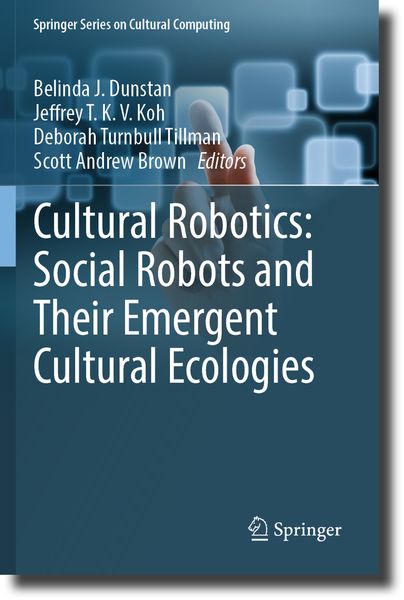
Produktbild: Cultural Robotics: Social Robots and Their Emergent Cultural Ecologies
- 20%

Cultural Robotics: Social Robots and Their Emergent Cultural Ecologies

20% sparen

175,99 € UVP 219,99 €

inkl. gesetzl. MwSt., Versandkostenfrei


Beschreibung

This edited collection approaches the field of social robotics from the perspective of a cultural ecology, fostering a deeper examination of the reach of robotic technology into the lived experience of diverse human populations, as well as the impact of human cultures on the development and design of...

Beschreibung

This edited collection approaches the field of social robotics from the perspective of a cultural ecology, fostering a deeper examination of the reach of robotic technology into the lived experience of diverse human populations, as well as the impact of human cultures on the development and design of these social agents.


To address the broad topic of Cultural Robotics, the book is sectioned into three focus areas: Human Futures, Assistive Technologies, and Creative Platforms and their Communities. The Human Futures section includes chapters on the histories and future of social robot morphology design, sensory and sonic interaction with robots, technology ethics, material explorations of embodiment, and robotic performed sentience. The Assistive Technologies section presents chapters from community-led teams, and researchers working to adopt a strengths-based approach to designing assistive technologies for those with disability or neurodivergence. Importantly, this section contains work written by authors belonging to those communities. Creative Platforms and their Communities looks to the creative cross-disciplinary researchers adopting robotics within their art practices, those contributing creatively to more traditional robotics research, and the testing of robotics in non-traditional platforms such as museum and gallery spaces.


Cultural Robotics: Social Robots and their Emergent Cultural Ecologies
makes a case for the development of social robotics to be increasingly informed by community-led transdisciplinary research, to be decentralised and democratised, shaped by teams with a diversity of backgrounds, informed by both experts and non-experts, and tested in both traditional and non-traditional platforms. In this way, the field of cultural robotics as an ecological approach to encompassing the widest possible spectrum of human experience in the development of social robotics can be advanced.


Portrait


Dr. Belinda J. Dunstan


Dr. Belinda J. Dunstan is an academic in the Faculty of Arts, Design and Architecture at UNSW, and the Human Futures Lead for the UNSW Creative Robotics Lab. Belinda’s research is in the fields of Social Robotics and Human-Robot Interaction, with focus on appearance design, movement planning and technology ethics. She is an author and is a co-editor of Cultural Robotics (Springer, 2016), and designer of the first undergraduate social robotics course in the southern hemisphere, for UNSW. Belinda lectures in Human-Machine Interaction and Interior Architecture.


Dr. Jeffrey T.K.V. Koh


Dr. Jeffrey T.K.V. Koh is a Partner and the Director of Transformation at Chemistry, a B Corp-certified, planet-centric design consultancy in Singapore and Amsterdam. He helps clients and partners transform their organisations to thrive in an uncertain future via regenerative design, future thinking and systems thinking. Jeffrey is also an Associate Professor of Circular Design at the Singapore Institute of Technology and sits on the Advisory Board on Design and the Built Environment for Ngee Ann Polytechnic. He has patents in the US, Singapore and Japan for his inventions, and he helped to pioneer the field of Cultural Robotics. 


Dr Deborah Turnbull Tillman


Deborah Turnbull Tillman is an editor, author and curator, and teaches at UNSW School of Art & Design as a lecturer in Media Arts and Curatorial. She is the Culture and Technology Lead at the UNSW Creative Robotics Lab. Deborah’s curatorial practice specialises in design, technology and new media. Her most recent exhibition, co-curated with A/Profs Lian Loke and Dagmar Reinhardt, was SHErobots: Tool, Toy, Companion at Tin Sheds Gallery, University of Sydney, in 2022. Deborah's PhD, “New Media Curation: a novel methodology and preliminary criteria for exhibiting new media and interactive art,” was awarded in September 2018 and examines disruption and experiential learning regarding curatorial process.


Dr. Scott Andrew Brown


Scott Andrew Brown is a Lecturer at UNSW School of Art & Design, and the lead for the Assistive Technologies Stream in the UNSW Creative Robotics Lab. His expertise is in designing social experiences with neurodivergent people, deploying UX (user experience) and interaction design methods to co-create novel opportunities for engagement with groups that are often marginalised or otherwise not given a voice in the development of interactive products and services. Scott’s current work is on haptic and audio technologies for use by a range of neurodiverse people and researching the effectiveness of ‘quiet rooms’ for autistic children and their families at large sporting events.


Produktdetails

Einband

Taschenbuch

Erscheinungsdatum

12.05.2024

Abbildungen

XVI, 277 p. 66 illus., 56 illus. in color.

Herausgeber Belinda J. Dunstan + weitere

Produktdetails

Einband

Taschenbuch

Erscheinungsdatum

12.05.2024

Abbildungen

XVI, 277 p. 66 illus., 56 illus. in color.

Herausgeber
Verlag Springer
Seitenzahl

277

Maße (L/B/H)

23,5/15,5/1,7 cm

Gewicht

452 g

Auflage

2023

Sprache

Englisch

ISBN

978-3-031-28140-2

Herstelleradresse

Springer-Verlag KG
Sachsenplatz 4-6
1201 Wien
AT

Email: ProductSafety@springernature.com

Noch keine Bewertungen vorhanden

Verfassen Sie die erste Bewertung zu diesem Artikel

Helfen Sie anderen Kundinnen und Kunden durch Ihre Meinung.

Kundinnen und Kunden meinen

Bewertungen (0)

  • Produktbild: Cultural Robotics: Social Robots and Their Emergent Cultural Ecologies
  • 1 Introduction:Emergent Cultural Ecologies in Social Robotics.- Part I: Human Futures.- 2 Social Robot Morphology: Cultural Histories of Robot Design.- 3 The Robot Soundscape.- 4 Reimagining Robots.- 5 Data, Site, Materials: Robotics and Digital Fabrication within Installation Art.- 6 The Future of Non-Fungible Tokens: pNFTs as a Medium for Programmatic Art Enabling a Fully Realized AI-Driven Art Ecosystem.- Part II: Assistive Technology.- 7 From Assistive to Adaptive: Can We Bring a Strengths-Based Approach to Designing Disability Technology?.- 8 The Intersection of Social Impact, Technology and Design: A Catalyst for Cultural Change.- 9 Culture in Social Robots for Education.- 10 Towards an Autistic User Experience (aUX) Design for Assistive Technologies.- 11 Drone Swarms to Support Search and Rescue Operations: Opportunities and Challenges.- Part III: Creative Platforms and their Communities.- 12 Culture and Technology: Curating New Media in Collaborative Ways.-13 Soft Robotics Workshops: Supporting Experiential Learning about Design, Movement, and Sustainability.- 14 Sonic Robotics: Musical Genres as Platforms for Understanding Robotic Performance as Cultural Events.- 15 Rouge and Robot: The Disruptive Feminine.- 16 On Display: Robots as Culture.