KI-Beratung Beta

Gutscheinbedingungen

**Gültig bis 30.11.2026 auf Spielzeug, Schreibwaren, Filme, Geschenke & Trends, Musik, tolino eReader & Zubehör, Hörbücher und Hörbuch-Downloads, nicht preisgebundene Bücher und Kalender online auf thalia.at und in der Thalia App. Einzelne Artikel können ausgeschlossen sein. Aufgrund der Buchpreisbindung sind deutschsprachige Bücher und eBooks ausgenommen. Zusätzlich ausgenommen sind Abos & Flatrates, Games, Geschenkkarten/-boxen, Shelfies, Software, Zeitschriften sowie einzelne Artikel von tonies®. Pro Einkauf einmal einlösbar. Nur gültig mit im Onlineshop hinterlegter Bonuscard. Click & Collect nur bei Onlinevorabzahlung möglich. Keine Barauszahlung. Nicht kombinierbar mit anderen Aktionen und Gutscheinen. Gutschein wird auf max. 500€ Bestellwert angerechnet. Nicht gültig für Versandkosten und Services.

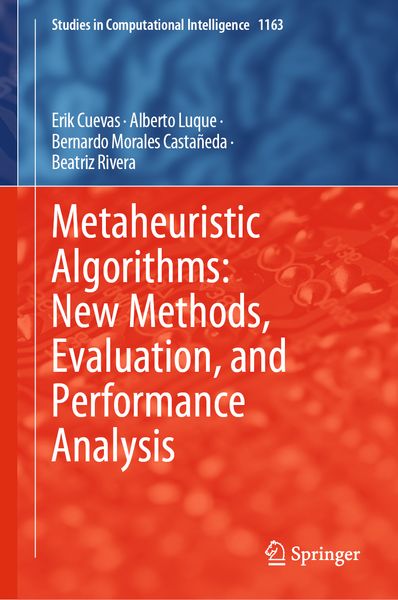
  • Produktbild: Metaheuristic Algorithms: New Methods, Evaluation, and Performance Analysis
  • Produktbild: Metaheuristic Algorithms: New Methods, Evaluation, and Performance Analysis
Band 1163 - 15%

Metaheuristic Algorithms: New Methods, Evaluation, and Performance Analysis

15% sparen

166,99 € UVP 197,99 €

inkl. gesetzl. MwSt., Versandkostenfrei


Beschreibung

This book encompasses three distinct yet interconnected objectives. Firstly, it aims to present and elucidate novel metaheuristic algorithms that feature innovative search mechanisms, setting them apart from conventional metaheuristic methods. Secondly, this book endeavors to systematically assess the...

Beschreibung

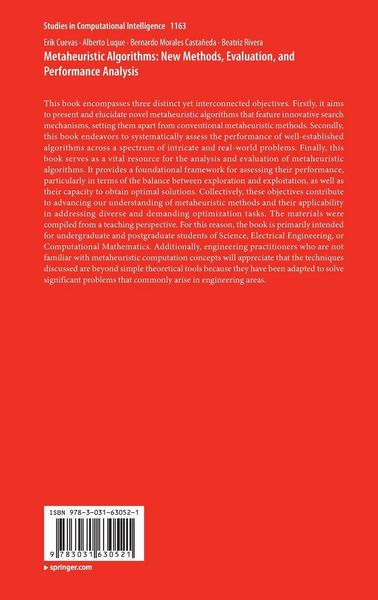
This book encompasses three distinct yet interconnected objectives. Firstly, it aims to present and elucidate novel metaheuristic algorithms that feature innovative search mechanisms, setting them apart from conventional metaheuristic methods. Secondly, this book endeavors to systematically assess the performance of well-established algorithms across a spectrum of intricate and real-world problems. Finally, this book serves as a vital resource for the analysis and evaluation of metaheuristic algorithms. It provides a foundational framework for assessing their performance, particularly in terms of the balance between exploration and exploitation, as well as their capacity to obtain optimal solutions. Collectively, these objectives contribute to advancing our understanding of metaheuristic methods and their applicability in addressing diverse and demanding optimization tasks. The materials were compiled from a teaching perspective. For this reason, the book is primarily intended for undergraduate and postgraduate students of Science, Electrical Engineering, or Computational Mathematics. Additionally, engineering practitioners who are not familiar with metaheuristic computation concepts will appreciate that the techniques discussed are beyond simple theoretical tools because they have been adapted to solve significant problems that commonly arise in engineering areas.

Produktdetails

Einband

Gebundene Ausgabe

Erscheinungsdatum

27.06.2024

Abbildungen

XV, 297 p. 83 illus., 39 illus. in color.

Verlag Springer

Produktdetails

Einband

Gebundene Ausgabe

Erscheinungsdatum

27.06.2024

Abbildungen

XV, 297 p. 83 illus., 39 illus. in color.

Verlag Springer
Seitenzahl

297

Maße (L/B/H)

24,1/16/2,3 cm

Gewicht

589 g

Auflage

2024

Sprache

Englisch

ISBN

978-3-031-63052-1

Herstelleradresse

Springer-Verlag KG
Sachsenplatz 4-6
1201 Wien
AT

Email: ProductSafety@springernature.com

Noch keine Bewertungen vorhanden

Verfassen Sie die erste Bewertung zu diesem Artikel

Helfen Sie anderen Kundinnen und Kunden durch Ihre Meinung.

Kundinnen und Kunden meinen

Bewertungen (0)

  • Produktbild: Metaheuristic Algorithms: New Methods, Evaluation, and Performance Analysis
  • Produktbild: Metaheuristic Algorithms: New Methods, Evaluation, and Performance Analysis

  • .- 1. Introduction to Metaheuristic methods.


    .- 2. A novel method for initializing populations using the Metropolis-Hastings (MH) technique.


    .- 3. A measure of diversity for metaheuristic algorithms employing population-based approaches.


    .- 4. Population Control in Metaheuristic Algorithms: Can Fewer Be Better?.


    .- 5. Exploration Paths Derived from Trajectories Extracted from Second-Order System Responses.


    .- 6. Utilizing the Moth Swarm Algorithm to Improve Image Contrast.


    .- 7. Enhancing Anisotropic Diffusion Filtering via Multi-Objective Optimization.


    .- 8. Fractional Fuzzy Controller Calibration Using metaheuristic Techniques.


    .- 9. Striving for Optimal Equilibrium in Metaheuristic Algorithms: Is It Attainable?.