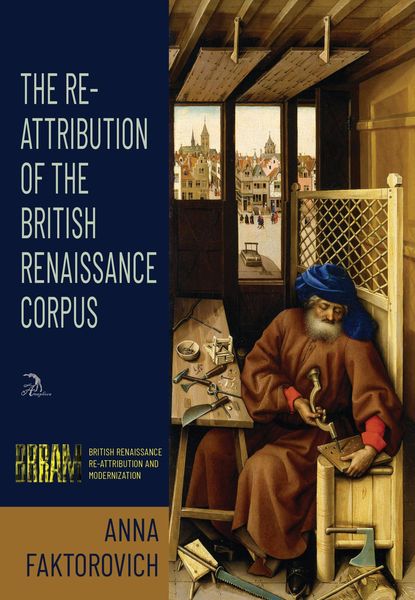
The Re-Attribution of the British Renaissance Corpus (British Renaissance Re-Attribution and Modernization, #1)
-
- Einzelkauf Download ausgewählt
-
Sprache:Englisch
9,49 €
inkl. gesetzl. MwSt.Beschreibung
Produktdetails
Format
ePUB
Kopierschutz
Ja
Family Sharing
Ja
Text-to-Speech
Ja
Erscheinungsdatum
02.05.2023
Verlag
Anna FaktorovichSeitenzahl
(Printausgabe)
Dateigröße
4623 KB
Sprache
Englisch
EAN
9781681145587
The first accurate quantitative re-attribution of all central texts of the British Renaissance. Covers 303 texts with 8,106,059 words, 123 authorial bylines, a range of genres, and a timespan between 1510 and 1662. Includes helpful diagrams that visually show the quantitative-matches and the identical most-frequent phrases between the texts in each linguistic-signature-group. Detailed chronologies for each of the six ghostwriters and the bylines they wrote under, including their dates of birth, death, publications, and other biographical markers that explain why each of them was the only logical attribution. All of the raw and processed data, not only in summary-tables inside of the book, but also in-full on a publicly-accessible GitHub website. One table includes all of the data from the first-edition title-pages (byline, printer, bookseller, date, proverbs), and the first-performance (date, troupe). A table on structural elements across all "Shakespeare"-bylined texts summarizes their plot-movements, character-types, settings, slang-usage, primary sources, and poetic design (percentage of rhyme and hendiadys). To explain why these are the first truly accurate re-attributions, numerous reasons for discrediting previous attribution claims are provided throughout. Re-Attribution of the British Renaissance Corpus describes a newly invented for this study computational-linguistics authorial-attribution method and applies it and several other approaches to the central texts of the British Renaissance. All of the attribution steps are described precisely to give readers replicable instructions on how they can apply them to any text from any period that they are interested in determining an attribution for. This method can be applied to solving criminal linguistic mysteries such as who wrote the Unabomber Manifesto, or theological mysteries such as if any of the Dead Sea Scrolls might have been forged by a modern author. This method is uniquely accurate because it uses 27 different quantitative tests that measure a text's dimensions and its similarity or divergence to other texts automatically, without the statisticians being able to skew the outcome by altering the experiment's analytical design. Re-Attribution guides researchers not only on how to perform the basic calculations, but also how to perform the biographical and documentary research to derive who among the potential bylines in a single signature-group is the ghostwriter, while the others are merely ghostwriter-contractors or pseudonyms. Reliable accuracy is achieved by also performing other types of attribution tests to check if these alternative approaches validate or contradict the 27-tests' findings. Non-quantitative tests discussed include deciphering the hidden implications of contemporary pufferies, as well as comparing structural elements such as characters, plot, and element borrowings. Part II presents a revised version of the history of the birth of the theater in Britain by reviewing forensic accounting evidence in Philip Henslowe's Diary, and the documented history of homicidal lending practices and government corruption connected with troupes and theaters. Parts III-VIII explain precisely how this series derived that the British Renaissance was ghostwritten by only six linguistic-signatures: Richard Verstegan, Josuah Sylvester, Gabriel Harvey, Benjamin Jonson, William Byrd and William Percy. The parts on each of these ghostwriters, not only explain how their biographies fit with the timelines of the texts being attributed to them, but also provide various types of evidence that explains their motives for ghostwriting. And Part IX returns for an intricate analysis of a few pseudonyms or ghostwriting-contractors who were uniquely difficult to exclude as potential ghostwriters; in parallel, these chapters question the reasons these individuals would have needed to purchase ghostwriting services.
Noch keine Bewertungen vorhanden
Verfassen Sie die erste Bewertung zu diesem Artikel
Helfen Sie anderen Kundinnen und Kunden durch Ihre Meinung.
Kurze Frage zu unserer Seite
Vielen Dank für Ihr Feedback
Wir nutzen Ihr Feedback, um unsere Produktseiten zu verbessern. Bitte haben Sie Verständnis, dass wir Ihnen keine Rückmeldung geben können. Falls Sie Kontakt mit uns aufnehmen möchten, können Sie sich aber gerne an unseren Kund*innenservice wenden.
zum Kundenservice