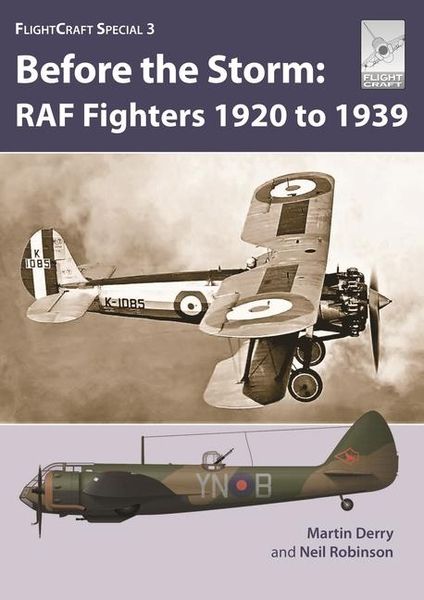
Flight Craft Special 3: RAF Fighters Before the Storm
-
- Taschenbuch ausgewählt
- eBook
-
Sprache:Englisch
24,99 €
inkl. gesetzl. MwSt.,
- Kostenlose Lieferung ab 30 € Einkaufswert
- Versandkostenfrei für Bonuscard-Kund*innen
Beschreibung
Produktdetails
Einband
Taschenbuch
Erscheinungsdatum
08.08.2024
Abbildungen
200 colour illustrations; 200 Illustrations
Verlag
Pen & Sword Books LtdSeitenzahl
104
Maße (L/B/H)
20,9/29,7/0,8 cm
Gewicht
548 g
Sprache
Englisch
ISBN
978-1-5267-8618-0
When the First World War ended the then recently established Royal Air Force was awash with aircraft of all descriptions. More surprising, perhaps, was the fact that despite an ongoing cull of obsolescing types, on the last day of 1919, the RAF still possessed 9,122 non-obsolete aircraft, with a further 1,100 more assigned to the Fleet Air Arm.
Whilst the famous SE.5A and Sopwith Camel had by this time largely been consigned to history, the RAF possessed no less than 1,860 Sopwith Snipes which, from 1920, would become the RAF's standard single-seat fighter for years to come. Other core types on charge on 31 December 1919 included some 1,650 Bristol F.2B fighters and 1,250 de Havilland DH.9As, which, together with the Snipe, accounted for over fifty per cent of the RAF's inventory at that time. Avro 504 training aircraft accounted for a further 2,700 airframes.
In this Flight Craft Special, the authors provide a detailed and informative pictorial history of those scout/fighter aircraft that served in an operational capacity with the RAF from January 1920 until the last day of 1939 - a period in which Britain once again moved from an era of peace to war with an old enemy, albeit this time Hitler's totalitarian National Socialist Germany as opposed to the Imperial Germany of old.
As well as covering each of the fighter types used during the inter-war period, and featuring most of the squadrons, the photographs themselves convey the sense of the technical advances that rapidly took root within Britain's aero industries from the mid-1930s onwards, moving from the brightly-marked overall silver wood and linen biplanes to the dull camouflaged metal-skinned monoplanes.
The progression of machine-gun development - from the Lewis and Vickers of the First World War to the later Browning - is covered, spanning the days of the biplanes' two fixed synchronised Lewis or Vickers .303-inch machine-guns mounted in the forward fuselage to eight wing-mounted .303-inch Browning machine-guns in the 'new' monoplane fighters. There is also a small, but fascinating, section on the monoplane 'also rans' - the monoplane fighters that were designed and had prototypes built but failed to reach the finishing post!
Noch keine Bewertungen vorhanden
Verfassen Sie die erste Bewertung zu diesem Artikel
Helfen Sie anderen Kundinnen und Kunden durch Ihre Meinung.
Kurze Frage zu unserer Seite
Vielen Dank für Ihr Feedback
Wir nutzen Ihr Feedback, um unsere Produktseiten zu verbessern. Bitte haben Sie Verständnis, dass wir Ihnen keine Rückmeldung geben können. Falls Sie Kontakt mit uns aufnehmen möchten, können Sie sich aber gerne an unseren Kund*innenservice wenden.
zum Kundenservice