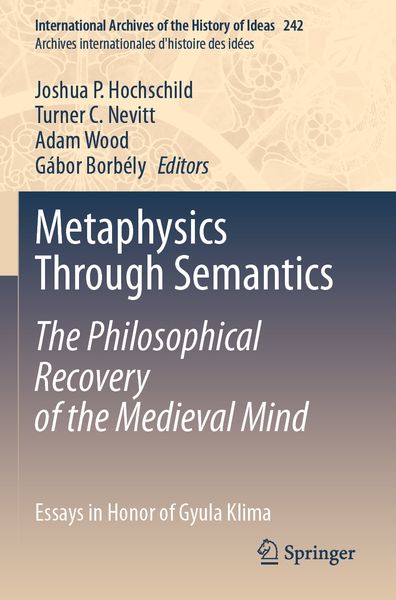
Metaphysics Through Semantics: The Philosophical Recovery of the Medieval Mind Essays in Honor of Gyula Klima
-
- Hardcover
- Taschenbuch ausgewählt
- eBook
-
Sprache:Englisch
136,99 €
UVP
164,99 €
inkl. gesetzl. MwSt.,
Beschreibung
Produktdetails
Einband
Taschenbuch
Erscheinungsdatum
28.04.2024
Abbildungen
XXII, 410 p. 1 illus.
Herausgeber
Joshua P. Hochschild + weitereVerlag
SpringerSeitenzahl
410
Maße (L/B/H)
23,5/15,5/2,4 cm
Gewicht
651 g
Auflage
2023
Sprache
Englisch
ISBN
978-3-031-15028-9
“More than any other living scholar of medieval philosophy, Gyula Klima has influenced the way we read and understand philosophical texts by showing how the questions they ask can be placed in a modern context without loss or distortion. The key to his approach is a respect for medieval authors coupled with a commitment to regarding their texts as a genuine source of insight on questions in metaphysics, theology, psychology, logic, and the philosophy of language—as opposed to assimilating what they say to modern doctrines, or using medieval discussions as a foil for ‘new and improved’ conceptual schemes.”
Jack Zupko, University of Alberta
“Gyula Klima is widely recognized as one of the world’s leading experts on thirteenth and fourteenth-century Latin philosophy, with his own, distinctive analytic approach, which brings out both the similarities and differences between medieval and contemporary logic and semantics.”
John Marenbon, Trinity College, University of Cambridge
“Gyula Klima has been a towering figure in the field of medieval philosophy for decades. His influence comprises not only the scholarly results of his work, but also intense and generous mentorship of students and junior colleagues. This volume is a perfect reflection of the esteem that he enjoys around the world, collecting excellent pieces by established as well as up-and-coming scholars of medieval philosophy.”
Catarina Dutilh Novaes, Vrije Universiteit Amsterdam
“For four decades now, Gyula Klima has been setting the standard among medievalists for philosophical sophistication and historical rigor. This collection of wide-ranging studies from leading scholars in the field offers a worthy tribute to that legacy.”
Robert Pasnau, University of Colorado Boulder
Gyula Klima is Professor of Philosophy at Fordham University, and Senior Research Fellow, Consultant, and the Director of Institute for the History of Ideas of the Hungarian Research Institute in Budapest. In 2022, the President of Hungary awarded him the Knight’s Cross of the Hungarian Order of Merit, “in recognition of his outstanding academic career, significant research work and exemplary leadership.” In this volume, colleagues, collaborators, and students celebrate Klima’s project with new essays on Plotinus, Anselm, Aquinas, Buridan, Ockham and others, exploring specific questions in philosophy of mind, philosophy of language, metaphysics, and logic.
No contemporary surpasses Kripke and Klima in semantics and metaphysics, but only Gyula Klima’s thought ranges flawlessly over classical philosophy as well. The volume is a fitting tribute to the master.
David Twetten, Marquette University
Noch keine Bewertungen vorhanden
Verfassen Sie die erste Bewertung zu diesem Artikel
Helfen Sie anderen Kundinnen und Kunden durch Ihre Meinung.
Kurze Frage zu unserer Seite
Vielen Dank für Ihr Feedback
Wir nutzen Ihr Feedback, um unsere Produktseiten zu verbessern. Bitte haben Sie Verständnis, dass wir Ihnen keine Rückmeldung geben können. Falls Sie Kontakt mit uns aufnehmen möchten, können Sie sich aber gerne an unseren Kund*innenservice wenden.
zum Kundenservice