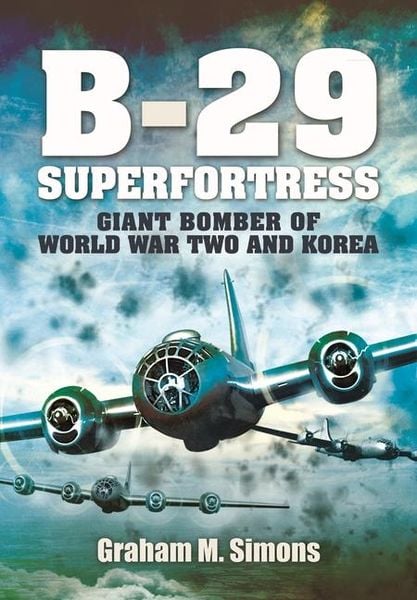
B-29: Superfortress Giant Bomber of World War 2 and Korea
-
- Taschenbuch ausgewählt
- eBook
-
Sprache:Englisch
21,99 €
inkl. gesetzl. MwSt.,
- Kostenlose Lieferung ab 30 € Einkaufswert
- Versandkostenfrei für Bonuscard-Kund*innen
Beschreibung
Produktdetails
Einband
Taschenbuch
Erscheinungsdatum
21.05.2024
Verlag
Pen & Sword Books LtdSeitenzahl
256
Maße (L/B/H)
23,3/15,8/2,1 cm
Gewicht
570 g
Sprache
Englisch
ISBN
978-1-399-07880-1
"In its 256 pages, there are numerous illustrations and drawings showing both exterior and interior details. There is a lot of detail given on a variety of subjects, including flight-refuelling and the TU-4. Personal accounts of crew members add a human level and this well-written history of a history-changing aircraft is highly recommended." -- Aeromilitaria
The Boeing B-29 Superfortress was a four-engined heavy bomber flown primarily by the United States in World War Two and the Korean War. The B-29 remained in service in various roles throughout the 1950s. The British Royal Air Force flew the B-29 and used the name Washington for the type, and the Soviet Union produced an unlicensed copy as the Tupolev Tu-4. The name "Superfortress" was derived from that of its well-known predecessor, the B-17 Flying Fortress. The B-29 was the progenitor of a series of Boeing-built bombers, reconnaissance aircraft, trainers and tankers including the variant, B-50 Superfortress.
The B-29 was one of the largest aircraft to see service during World War Two. A very advanced bomber for its time, it included features such as pressurized cabins, an electronic fire-control system and remote-controlled machine-gun turrets. Though it was designed as a high-altitude daytime bomber, in practice it actually flew more low-altitude nighttime incendiary bombing missions. It was the primary aircraft in the American firebombing campaign against Japan in the final months of World War Two, and carried the atomic bombs that destroyed Hiroshima and Nagasaki. Unlike many other World War Two-era bombers, the B-29 remained in service long after the war ended, with a few even being employed as flying television transmitters. The type was finally retired in the early 1960s, with 3,960 aircraft in all built.
Without doubt there is a clear, strong requirement to put the record straight using primary source documentation to record the undoubted achievements alongside and in context with the shortcomings to the types design and operation that have otherwise received scant attention. The book will cover all variants and is profusely illustrated.
Noch keine Bewertungen vorhanden
Verfassen Sie die erste Bewertung zu diesem Artikel
Helfen Sie anderen Kundinnen und Kunden durch Ihre Meinung.
Kurze Frage zu unserer Seite
Vielen Dank für Ihr Feedback
Wir nutzen Ihr Feedback, um unsere Produktseiten zu verbessern. Bitte haben Sie Verständnis, dass wir Ihnen keine Rückmeldung geben können. Falls Sie Kontakt mit uns aufnehmen möchten, können Sie sich aber gerne an unseren Kund*innenservice wenden.
zum Kundenservice