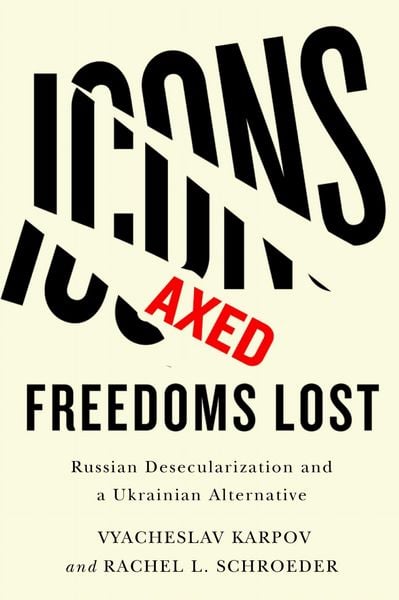
"This book offers an insightful analysis of the political ethos of Orthodoxy in Russia and how it has been shaped by imperial and Soviet legacies. The authors trace the dynamics giving rise to neo-traditionalist and neo-secularist camps in Russia and contrast this with attitudes to religious and secular authorities in Ukraine. The comparison is fruitful and theoretically innovative. This a timely and much-needed study of a powerful undercurrent in Eurasian politics." - Catherine Wanner (author of Everyday Religiosity and the Politics of Belonging in Ukraine)
"This study beautifully combines an important theoretical achievement with a thoroughly researched, helpful, and penetrating comparison between the desecularization dynamics in Ukraine and Russia. For too long religious studies tended to ignore Ukraine or regard it as a subspecies of Russian culture. Karpov and Schroeder's study parts ways with this outdated perspective. This timely book can be recommended to every reader who seeks a deeper understanding of the religious background of the current violent clash between two radically different cultural projects-that of Russia and that of Ukraine."
- Yury Avvakumov (associate professor of theology and the history of Christianity at University of Notre Dame) "Contrary to the prediction of many social scientists, religion has remained important in people's lives and is at the center of many conflicts worldwide. Here Karpov and Schroeder expertly examine a unique case of a desecularizing Russia and the battle between a church that is a pawn of the state and a society that is losing its freedom to the tightening tentacles of religious restrictions. The book convincingly shows why Ukraine-unlike Russia-chose a path towards religious freedom and pluralism. A must read for anyone interested in the complex role of religion in today's world, especially those trying to make sense of religion, politics, and society in Russia and Ukraine." - Christopher Marsh (author of Religion and the State in Russia and China: Suppression, Survival, and Revival) "Karpov and Schroeder have written a refreshing account of post-Soviet Russia's desecularization. What started as a bottom-up process has succeeded only as a top-down, state-controlled, and state-dosed injection of religion into political and public life." - Dmytro Vovk (visiting associate professor at Benjamin N. Cardozo School of Law)