Gutscheinbedingungen

**Gültig bis 06.07.2026 auf fremdsprachige Bücher online auf thalia.at, in der Thalia App ab einem Mindestbestellwert von 30€ und in allen Thalia Buchhandlungen in Österreich. In den Buchhandlungen nur gültig auf lagernde Ware. Einzelne Artikel können ausgeschlossen sein. Ausgenommen sind preisgebundene Artikel & eBooks. Pro Einkauf einmal einlösbar. Nur gültig gegen Vorlage oder im Onlineshop hinterlegter Bonuscard. Infos zur Einlösung in der Buchhandlung sind auf der Bonuscard-Vorteilspreisseite zu finden. Click & Collect nur bei Onlinevorabzahlung möglich. Keine Einlösung bei Scan & Go-Bezahlung. Keine Barauszahlung. Nicht kombinierbar mit anderen Aktionen und Gutscheinen. Gutschein wird auf max. 500€ Bestellwert angerechnet. Nicht gültig für Versandkosten und Services.

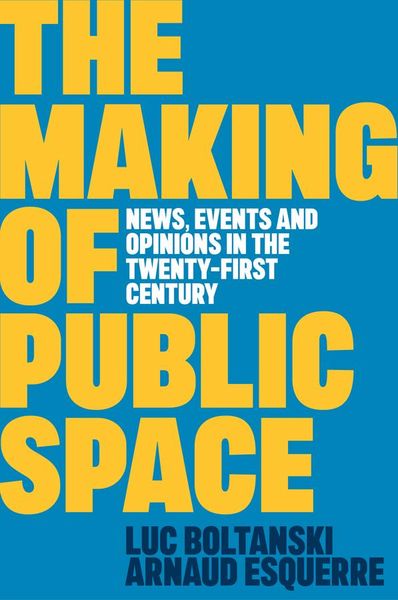
Produktbild: The Making of Public Space

The Making of Public Space News, Events and Opinions in the Twenty-First Century

28,99 €

inkl. gesetzl. MwSt., zzgl. Versandkosten


  • Kostenlose Lieferung ab 30 € Einkaufswert
  • Versandkostenfrei für Bonuscard-Kund*innen

Produktdetails

Einband

Taschenbuch

Erscheinungsdatum

06.12.2024

Verlag

Wiley

Seitenzahl

304

Maße (L/B/H)

15,1/22,8/2,7 cm

Gewicht

454 g

Sprache

Englisch

ISBN

978-1-5095-6278-7

Produktdetails

Einband

Taschenbuch

Erscheinungsdatum

06.12.2024

Verlag

Wiley

Seitenzahl

304

Maße (L/B/H)

15,1/22,8/2,7 cm

Gewicht

454 g

Sprache

Englisch

ISBN

978-1-5095-6278-7

Herstelleradresse

Libri GmbH
Europaallee 1
36244 Bad Hersfeld
DE

Email: gpsr@libri.de

Noch keine Bewertungen vorhanden

Verfassen Sie die erste Bewertung zu diesem Artikel

Helfen Sie anderen Kundinnen und Kunden durch Ihre Meinung.

Kundinnen und Kunden meinen

Bewertungen (0)

Die Leseprobe wird geladen.
  • Produktbild: The Making of Public Space
  • Acknowledgments

    Introduction
    News as a global culture
    The corpuses of data on which this work has focused 
    The empirical analysis of the politicization and formation of 'opinions'
    Crowds, masses, networks
    Democracy as it is


    Being immersed in the news

    Chapter 1. The presence and periodization of the inaccessible
    The consistency of the Now
    Knowing by experience or by hearsay
    The accessible and the inaccessible
    What news in which history?
    Time's arrow
    Some problems of historical periodization
    The formation of planes of news items
    The news in the eyes of its critics (1): inauthenticity
    The news in the eyes of its critics (2): fake democracy

    Chapter 2. The process of the event
    News, History and the need to select  
    Selection and censorship
    The truth of facts, the adequacy of interpretations
    Trouble with events
    The coalescence of facts in the plane of news items   
    The de-composition and deconstruction of events
    Precedents
    Primary facts and derived facts: the worth and force of an event
    Political facts as a series

    Document 1. History (with a capital H) and history
    Chapter 3. Political events and the formation of generations
    The salience of events
    Break or continuity: a question of scale
    At what scale does Le Monde view the world (le monde)? The obituary test
    Breaks in institutional continuity
    The role of major political events in the formation of generations
    Structural collectives and generational collectives
    'Our generation!'
       

    II
    Politicization

    Document 2. Plot

    Chapter 4. Political discussion
    Conversation or discussion
    The risks of political discussion

    Document 3. Medias

    Chapter 5. Le Monde and its readers: between news and History
    Le Monde as a news organ and quasi-institution
    Le Monde and History
    Journalists and their readers

    Document 4. Censured

    Chapter 6. The structure of comments on the news

    Pre-texts and comments
    The constraints on utterance
    Contesting the truth of the facts: the 11 September 2001 attacks, with comments made on INA Société
    Discussion, moderation and commercial censorship 
    Commenting is not denouncing
    The irony of the commentators

    Document 5. What are their names?

    Chapter 7. The work of 'one'
    The intense pleasure of comment
    States of mind
    Anonymity and mishmash
    The 'one' of the news

    Document 6. Readers' replies

    Chapter 8. Politicizing the news
    What are they thinking of?
    What is a political problem?
    The process of politicization
    Medically assisted procreation, from the non-political to politics
    Political shifts
    Talking about Islam
    Different shifts in the notion of environmentalism
    When politics proves to be 'inextricable'

     
    Document 7. 'Generations'

    Chapter 9. The dynamics of politicization
    Shifting positions and generation conflicts
    Political problems and ideologies
    Threats and remedies
    Feeding into politicization

    Document 8. 'Democracy'

    Conclusion. The meaning of History
    Interpretation: between adequacy and violence
    'On the right' or 'on the left': the political description of interpretations
    Towards the extreme
    Politics and desolation
    The digitalization of struggles

    Appendices

    Conceptual lexicon
    Bibliography
    Notes
    Index