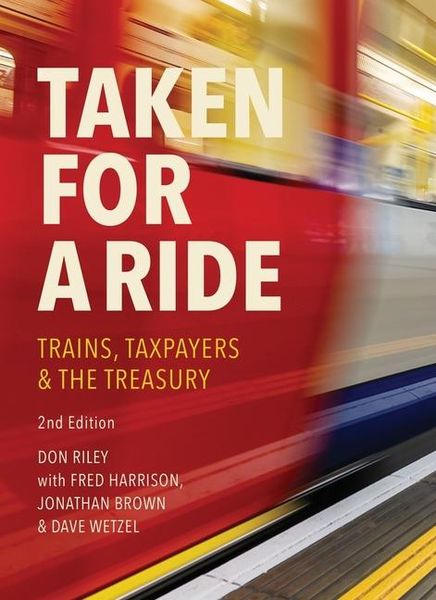
Taken for a Ride Taxpayers, Trains & the Treasury
-
- Englisch ausgewählt
21,99 €
inkl. gesetzl. MwSt.,
- Kostenlose Lieferung ab 30 € Einkaufswert
- Versandkostenfrei für Bonuscard-Kund*innen
Beschreibung
Produktdetails
Einband
Taschenbuch
Erscheinungsdatum
31.07.2024
Verlag
Shepheard-Walwyn Publishers LtdSeitenzahl
134
Maße (L/B/H)
15,2/22,9/1,3 cm
Gewicht
272 g
Auflage
2 Revised edition
Sprache
Englisch
ISBN
978-1-916517-03-5
There are few books that can claim to have changed the transport policy for London and the UK. Don Riley's Taken for a Ride is one such book. Don Riley, a New Zealand-born entrepreneur, began buying property and land in and around the London Bridge area in Southwark in the 1970s. Initially, this was to house his own employees, but given his skills and how much he enjoyed improving buildings, it eventually became his main business. He was committed to the area and had a front row seat when the Thatcher government decided to extend the Jubilee underground from Waterloo Station to the new financial centre in Docklands. Several of his commercial buildings were within a few yards of the holes dug beneath what would become the Jubilee Line Underground stations in Southwark. Riley not only monitored the progress but ventured below ground to witness the boring of the tunnels. His goal was to chart the impact on the rents he could charge his tenants. The nearer to the completion date, the greater the increase in rents, which could be attributed to the Jubilee extension. Riley was pleased to monitor the unfolding events in real time. He was not pleased, however, with the fact that he could make more money out of owning land than rehabilitating old buildings. First published in 2001, a year after the opening of the then controversial Jubilee Line Extension, Taken for a Ride documented how new transport systems deliver extraordinary profits. As Riley explains, taxpayers provide the funds from which private landowners profit. Riley knew of the extraordinary gains available from good transport projects because he made massive profits on his properties from the Jubilee Line Extension. In this quietly revolutionary book, Riley lays out a coherent case for unleashing an entrepreneurial revolution by changing the tax system so that people are rewarded for their efforts. Riley's research and his attacks on what he deemed to be a deeply unfair tax system was surprisingly influential and struck a chord with many people from across the political spectrum. Who would not be intrigued to hear that an entrepreneur turned property developer complained about making too much money from his property investments? And then goading the government to do something about it - namely change the tax system? Don understood what really drove an economy and community forward was ensuring people were encouraged to work hard and be rewarded fairly for that hard work. He castigates politicians for underpaying public sector workers who had done so much to improve a community, who were then priced out of their home communities because their pay increases failed to keep up with housing costs. How can we build communities if the people who help create them can't afford to live in them? For Don Riley, this was an example of people creating benefits for the economy and being punished for doing so. Taken for a Ride offers a way to re-imagine transport systems in ways that are still relevant today. Over the past two centuries, mass transit systems have contributed enormously to the environmental crisis. At the same time, transportation can be a core element of sustainable solutions. Taken for a Ride illustrates the issues in the sphere of economics and high finance. UK politicians used the information provided in Taken for a Ride to convince the Treasury to invest in Crossrail, a new railway for London and the South East. Taken for a Ride has been fully updated with a new introduction by Fred Harrison, one of the world's top economists, a postscript by Dave Wetzel, former vice chair of Transport for London, and an in-depth interview with Steve Norris, the transport minister who gained approval for the Jubilee Line Extension. Crossrail data demonstrates that Don Riley was right twenty years ago, and that we, as taxpayers, are being robbed of the gains that come from well-designed transport projects.
Noch keine Bewertungen vorhanden
Verfassen Sie die erste Bewertung zu diesem Artikel
Helfen Sie anderen Kundinnen und Kunden durch Ihre Meinung.
Kurze Frage zu unserer Seite
Vielen Dank für Ihr Feedback
Wir nutzen Ihr Feedback, um unsere Produktseiten zu verbessern. Bitte haben Sie Verständnis, dass wir Ihnen keine Rückmeldung geben können. Falls Sie Kontakt mit uns aufnehmen möchten, können Sie sich aber gerne an unseren Kund*innenservice wenden.
zum Kundenservice