Gutscheinbedingungen

**Gültig bis 06.07.2026 auf fremdsprachige Bücher online auf thalia.at, in der Thalia App ab einem Mindestbestellwert von 30€ und in allen Thalia Buchhandlungen in Österreich. In den Buchhandlungen nur gültig auf lagernde Ware. Einzelne Artikel können ausgeschlossen sein. Ausgenommen sind preisgebundene Artikel & eBooks. Pro Einkauf einmal einlösbar. Nur gültig gegen Vorlage oder im Onlineshop hinterlegter Bonuscard. Infos zur Einlösung in der Buchhandlung sind auf der Bonuscard-Vorteilspreisseite zu finden. Click & Collect nur bei Onlinevorabzahlung möglich. Keine Einlösung bei Scan & Go-Bezahlung. Keine Barauszahlung. Nicht kombinierbar mit anderen Aktionen und Gutscheinen. Gutschein wird auf max. 500€ Bestellwert angerechnet. Nicht gültig für Versandkosten und Services.

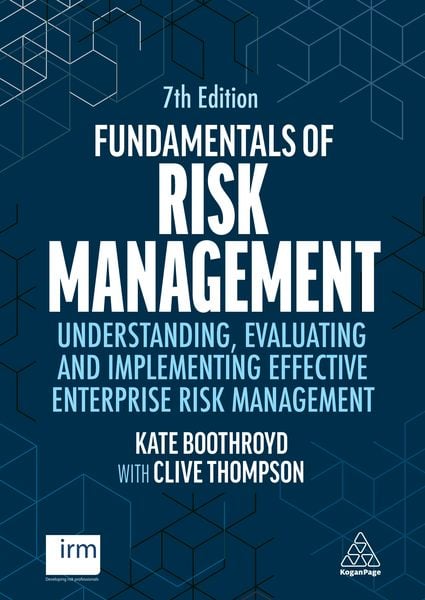
Produktbild: Fundamentals of Risk Management

Fundamentals of Risk Management Understanding, Evaluating and Implementing Effective Enterprise Risk Management

56,99 €

inkl. gesetzl. MwSt., Versandkostenfrei


Beschreibung

Produktdetails

Einband

Taschenbuch

Erscheinungsdatum

03.12.2024

Verlag

Kogan Page Ltd

Seitenzahl

472

Maße (L/B/H)

24,4/17/2,5 cm

Gewicht

808 g

Auflage

7. Auflage

Sprache

Englisch

ISBN

978-1-398-61865-7

Beschreibung

Produktdetails

Einband

Taschenbuch

Erscheinungsdatum

03.12.2024

Verlag

Kogan Page Ltd

Seitenzahl

472

Maße (L/B/H)

24,4/17/2,5 cm

Gewicht

808 g

Auflage

7. Auflage

Sprache

Englisch

ISBN

978-1-398-61865-7

Herstelleradresse

Libri GmbH
Europaallee 1
36244 Bad Hersfeld
DE

Email: GPSR Kontakt

Noch keine Bewertungen vorhanden

Verfassen Sie die erste Bewertung zu diesem Artikel

Helfen Sie anderen Kundinnen und Kunden durch Ihre Meinung.

Kundinnen und Kunden meinen

Bewertungen (0)

Weitere Artikel finden Sie in

  • Produktbild: Fundamentals of Risk Management
    • Section - ONE: Introduction to risk management;
      • Chapter - 01: What is risk and why is it important?;
      • Chapter - 02: Risk as an opportunity as well as a threat;
      • Chapter - 03: Risk management standards;
      • Chapter - 04: The four steps of risk management;
    • Section - TWO: Enterprise risk management;
      • Chapter - 05: Risk management in context;
      • Chapter - 06: Enterprise risk management;
      • Chapter - 07: The background, aims and principles of risk management;
      • Chapter - 08: Risk architecture and strategy;
      • Chapter - 09: Roles, responsibilities, and documentation;
      • Chapter - 10: Implementing enterprise risk management;
      • Chapter - 11: Processes for risk management;
    • Section - THREE: Defining context and objectives and assessing risk;
      • Chapter - 12: The context for ERM;
      • Chapter - 13: Setting objectives for ERM;
      • Chapter - 14: Assessing risks: Risk identification, considerations, causes, and consequences;
      • Chapter - 15: Classifying risks;
      • Chapter - 16: Assessing risks: Risk analysis;
      • Chapter - 17: Different lenses for considering risk;
      • Chapter - 18: Assessing risks: Risk evaluation;
    • Section - FOUR: Risk response: monitor, review, and report;
      • Chapter - 19: Managing and responding to risk;
      • Chapter - 20: Controlling downside risk;
      • Chapter - 21: Risk treatment controls for threats;
      • Chapter - 22: Controlling upside risk;
      • Chapter - 23: Ongoing monitoring and review;
      • Chapter - 24: Reporting on risk management;
    • Section - FIVE: Decision making: Risk culture, appetite and tolerance;
      • Chapter - 25: Culture and behaviours;
      • Chapter - 26: Risk appetite and tolerance;
    • Section - SIX: Corporate governance and assurance;
      • Chapter - 27: Introducing corporate governance;
      • Chapter - 28: Stakeholders, ethics, and corporate social responsibility;
      • Chapter - 29: Different approaches to risk management;
      • Chapter - 30: The control environment;
      • Chapter - 31: Internal audit activities;
      • Chapter - 32: Risk assurance techniques;
    • Section - SEVEN: Organisational environment: Resilience and sustainability;
      • Chapter - 33: Strategy and the risk environment;
      • Chapter - 34: The organization’s business model, visions and values;
      • Chapter - 35: Resilience;
      • Chapter - 36: Surviving shocks and disruption: ERM, BCP and resilience;
      • Chapter - 37: Sustainability;
    • Section - EIGHT: Different approaches;
      • Chapter - 38: Insurance;
      • Chapter - 39: Banking, legal, supply chain, and IT approaches to risk management;
      • Chapter - 40: New approaches to the four steps of risk management;
    • Section - NINE: Adding value;
      • Chapter - 41: How risk management adds value;
      • Chapter - 42: Maturity and continual improvement;
      • Chapter - 43: Risk practitioner competencies;
      • Chapter - 44: How risk practitioners add value