KI-Beratung Beta

Gutscheinbedingungen

**Gültig bis 30.11.2026 auf Spielzeug, Schreibwaren, Filme, Geschenke & Trends, Musik, tolino eReader & Zubehör, Hörbücher und Hörbuch-Downloads, nicht preisgebundene Bücher und Kalender online auf thalia.at und in der Thalia App. Einzelne Artikel können ausgeschlossen sein. Aufgrund der Buchpreisbindung sind deutschsprachige Bücher und eBooks ausgenommen. Zusätzlich ausgenommen sind Abos & Flatrates, Games, Geschenkkarten/-boxen, Shelfies, Software, Zeitschriften sowie einzelne Artikel von tonies®. Pro Einkauf einmal einlösbar. Nur gültig mit im Onlineshop hinterlegter Bonuscard. Click & Collect nur bei Onlinevorabzahlung möglich. Keine Barauszahlung. Nicht kombinierbar mit anderen Aktionen und Gutscheinen. Gutschein wird auf max. 500€ Bestellwert angerechnet. Nicht gültig für Versandkosten und Services.

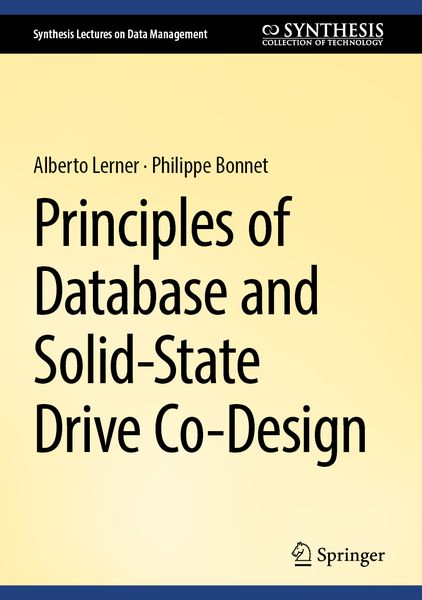
Produktbild: Principles of Database and Solid-State Drive Co-Design
- 19%

Principles of Database and Solid-State Drive Co-Design

19% sparen

39,99 € UVP 49,49 €

inkl. gesetzl. MwSt., Versandkostenfrei


Beschreibung

This book offers a comprehensive resource on Solid-State Drives (SSD) as the field undergoes a radical evolution characterized by the incredible variety of SSD forms and their rapid diversification. It proposes a new classification system to help readers navigate the SSD landscape. For years, the evolution...

Beschreibung

This book offers a comprehensive resource on Solid-State Drives (SSD) as the field undergoes a radical evolution characterized by the incredible variety of SSD forms and their rapid diversification. It proposes a new classification system to help readers navigate the SSD landscape. For years, the evolution of SSDs was obscured by the unchanging abstractions of block devices and POSIX I/O, but it is apparent that these abstractions have become a problematic hinderance to performance and also fail to reduce software complexity. The book explores how such a state of affairs impacts the database community in at least two ways. First, it considers how using SSDs through legacy interfaces that hide internal mechanisms invariably results in erratic performance. While the blame often goes to the notoriously expensive garbage collection of SSDs, the authors argue that in truth, several other complex processes result in nonlinear effects on latency and bandwidth. The book describes these processes and how they are implemented in modern devices, knowledge that will help system designers better choose SSDs and shape database workloads to match their performance characteristics. Second, the book explores how the inadequacy of the traditional I/O abstractions opens up an entire research field focused on the co-design of database management systems and SSD. Such research aims at devising mechanisms and policies coupling the storage manager of database and SSD internals, e.g., placing an SSD FTL under the control of database, changing SSD sub-systems in response to the workload, or executing logic within an SSD on a database’s behalf. The book introduces these principles of DBMS/SSD co-design and argues that a more seamless integration of databases and storage solutions as well as the study of SSD variations adapted to database computations are central to the development of the next generation of database systems. 

Produktdetails

Einband

Gebundene Ausgabe

Erscheinungsdatum

07.12.2024

Abbildungen

XV, 135 p. 65 illus., 49 illus. in color.

Verlag Springer

Produktdetails

Einband

Gebundene Ausgabe

Erscheinungsdatum

07.12.2024

Abbildungen

XV, 135 p. 65 illus., 49 illus. in color.

Verlag Springer
Seitenzahl

135

Maße (L/B/H)

24,6/17,3/1,4 cm

Gewicht

416 g

Sprache

Englisch

ISBN

978-3-031-57876-2

Herstelleradresse

Springer-Verlag KG
Sachsenplatz 4-6
1201 Wien
AT

Email: ProductSafety@springernature.com

Noch keine Bewertungen vorhanden

Verfassen Sie die erste Bewertung zu diesem Artikel

Helfen Sie anderen Kundinnen und Kunden durch Ihre Meinung.

Kundinnen und Kunden meinen

Bewertungen (0)

  • Produktbild: Principles of Database and Solid-State Drive Co-Design
  • Introduction.- Internal Interfaces.- External Interfaces.- Computational Storage.- Reprogrammed Devices.- Co-Designed Devices.- Conclusion.