
KI-Beratung Beta

Gutscheinbedingungen

**Gültig bis 30.11.2026 auf Spielzeug, Schreibwaren, Filme, Geschenke & Trends, Musik, tolino eReader & Zubehör, Hörbücher und Hörbuch-Downloads, nicht preisgebundene Bücher und Kalender online auf thalia.at und in der Thalia App. Einzelne Artikel können ausgeschlossen sein. Aufgrund der Buchpreisbindung sind deutschsprachige Bücher und eBooks ausgenommen. Zusätzlich ausgenommen sind Abos & Flatrates, Games, Geschenkkarten/-boxen, Shelfies, Software, Zeitschriften sowie einzelne Artikel von tonies®. Pro Einkauf einmal einlösbar. Nur gültig mit im Onlineshop hinterlegter Bonuscard. Click & Collect nur bei Onlinevorabzahlung möglich. Keine Barauszahlung. Nicht kombinierbar mit anderen Aktionen und Gutscheinen. Gutschein wird auf max. 500€ Bestellwert angerechnet. Nicht gültig für Versandkosten und Services.

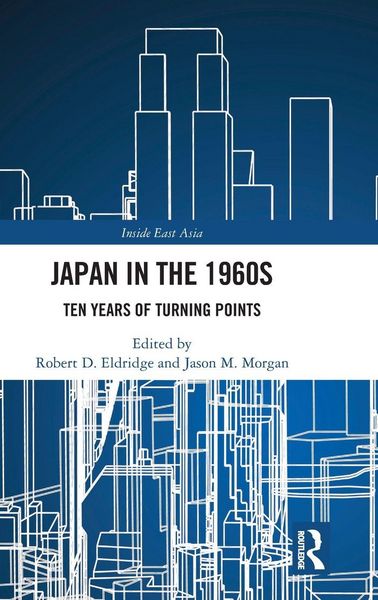
  • Produktbild: Japan in the 1960s
  • Produktbild: Japan in the 1960s

Japan in the 1960s Ten Years of Turning Points

Aus der Reihe Inside East Asia

229,99 €

inkl. gesetzl. MwSt., Versandkostenfrei


Beschreibung

Eldridge and Morgan set a new paradigm for East Asian contemporary historiography by viewing the decade of the 1960s as hermeneutically powerful. From street battles over Japan's security treaty with the United States, to a peace treaty with the former Japanese territory of South Korea, to Japan's hosting...

Beschreibung

Eldridge and Morgan set a new paradigm for East Asian contemporary historiography by viewing the decade of the 1960s as hermeneutically powerful. From street battles over Japan's security treaty with the United States, to a peace treaty with the former Japanese territory of South Korea, to Japan's hosting the 1964 Summer Olympics, the 1960s in Japan was a decade of turning points.

This book is the first to see the 1960s as a historical subject in its own right and argues that the specificity and internal complexity rooted in East Asia during this period showed how East Asians were dynamic agents in shaping the decade. In this volume, contributors consider Japanese responses to a 1961 coup in the Republic of Korea; the Sat Eisaku administration's approach to nuclear deterrence and to the question of Okinawa's return from American control; U.S.-Japan intellectual exchange during the Cold War; support by Japanese businesspeople for the Self-Defense Forces; the "soft power" of Japanese cinema in the 1960s; Japan's understanding of 1960s United Nations peacekeeping operations; changes in "national polity" discourse in the 1960s; the Dalai Lama's 1967 visit to Japan; economic development in and cultural exchange between 1960s Japan and Spain; Japan's science and technology interactions with the United States; and the earliest known, and suspected, cases of North Korean abduction of Japanese citizens. Much of the information in this volume has never appeared in English before.

This is an important volume for historians, political scientists, sociologists, and other scholars specializing in the twentieth century and those interested in cutting-edge history-writing about a transformative 10-year period in East Asia.

Produktdetails

Einband

Gebundene Ausgabe

Erscheinungsdatum

05.08.2024

Abbildungen

2 SW-Abb., 2 SW-Fotos, 2 Tabellen

Herausgeber Robert D. Eldridge + weitere

Produktdetails

Einband

Gebundene Ausgabe

Erscheinungsdatum

05.08.2024

Abbildungen

2 SW-Abb., 2 SW-Fotos, 2 Tabellen

Herausgeber
Verlag Taylor & Francis
Seitenzahl

210

Maße (L/B/H)

24/16,1/1,8 cm

Gewicht

588 g

Sprache

Englisch

ISBN

978-1-03-279648-2

Herstelleradresse

Libri GmbH
Europaallee 1
36244 Bad Hersfeld
DE

Email: gpsr@libri.de

Noch keine Bewertungen vorhanden

Verfassen Sie die erste Bewertung zu diesem Artikel

Helfen Sie anderen Kundinnen und Kunden durch Ihre Meinung.

Kundinnen und Kunden meinen

Bewertungen (0)

Die Leseprobe wird geladen.
  • Produktbild: Japan in the 1960s
  • Produktbild: Japan in the 1960s
  • Table of Contents

    Introduction Robert D. Eldridge and Jason M. Morgan

    Chapter 1 Japan's Response to South Korea's May 16, 1961, Coup

    Chizuko T. Allen

    Chapter 2 Japan and North Korea in 1963: The Origins of the Abduction Issue

    Araki Kazuhiro

    Chapter 3 The Sat¿ Eisaku Administration and Extended Nuclear Deterrence: Nuclear Intimidation and Domestic Politics in Japan, 1964-1968

    Arai Takafumi

    Chapter 4 "The Postwar Is Not Over for Japan Unless Okinawa's Return to Its Home Country Is Realized": Prime Minister Sat¿'s 1965 Visit to Okinawa, Japan-U.S. Relations, and Domestic Dynamics

    Robert D. Eldridge

    Chapter 5 Japan-U.S. Intellectual Exchange during the Cold War: The Shimoda Conference in 1967

    Kusunoki Ayako

    Chapter 6 Postwar Japan, Businessmen, and the Self-Defense Forces: The Growth of Support Networks for Japan's Postwar "Military" during the 1960s

    Nakahara Masato

    Chapter 7 The Phantom United Nations Cooperation Bill: Japan's Lost Potential to Become a "Middle Power" in the 1960s

    Murakami Tomoaki

    Chapter 8 New Waves: 1960s Japanese Cinema in the Eyes of the World

    Tom Mes

    Chapter 9 The Individual in (as) the Body Politic: Seich¿ no Ie and Anti-Abortion Kokutai
    Spiritualism in 1960s Japan

    Jason M. Morgan

    Chapter 10 Tibetans in Japan in the 1960s: The Story of a 12-Year-Old Refugee

    Pema Gyalpo

    Chapter 11 Japan and Spain in the 1960s: International Relations, Economy, and Culture

    Eduardo González de la Fuente

    Chapter 12 Japan's Economic, Scientific, and Technological Engagement with the United States and International Economic Organizations in the 1960s

    Erik M. Jacobs