KI-Beratung Beta

Gutscheinbedingungen

**Gültig am 25.11.2026 auf fremdsprachige Bücher online auf thalia.at und in der Thalia App. Einzelne Artikel können ausgeschlossen sein. Ausgenommen sind preisgebundene Artikel & eBooks. Pro Einkauf einmal einlösbar. Click & Collect nur bei Onlinevorabzahlung möglich. Keine Barauszahlung. Nicht kombinierbar mit anderen Aktionen und Gutscheinen. Gutschein wird auf max. 500€ Bestellwert angerechnet. Nicht gültig für Geschenkkarten, Versandkosten und Services.

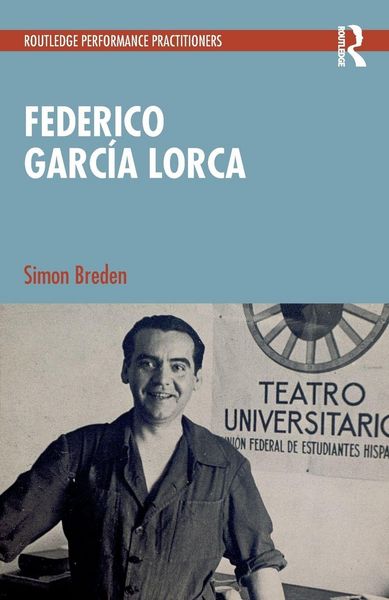
  • Produktbild: Federico García Lorca
  • Produktbild: Federico García Lorca

Federico García Lorca

56,99 €

inkl. gesetzl. MwSt., Versandkostenfrei


Beschreibung

Lauded as one of the most important poets and playwrights of the twentieth century, Federico García Lorca was also an accomplished theatre director with a clear process and philosophy of how drama should be staged. Directing both his own work and that of others, Lorca was also closely involved in the...

Beschreibung

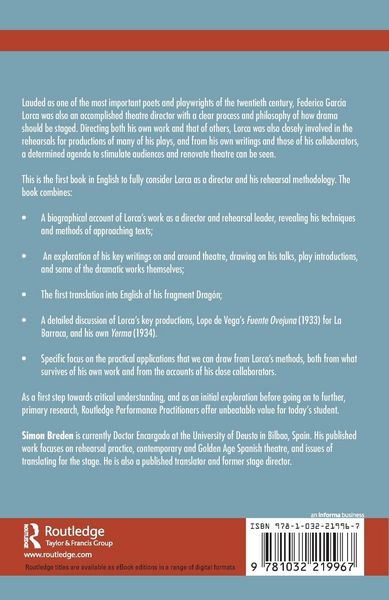
Lauded as one of the most important poets and playwrights of the twentieth century, Federico García Lorca was also an accomplished theatre director with a clear process and philosophy of how drama should be staged. Directing both his own work and that of others, Lorca was also closely involved in the rehearsals for productions of many of his plays, and from his own writings and those of his collaborators, a determined agenda to stimulate audiences and renovate theatre can be seen.

This is the first book in English to fully consider Lorca as a director and his rehearsal methodology. The book combines:

- A biographical account of Lorca's work as a director and rehearsal leader, revealing his techniques and methods of approach texts;

- An exploration of his key writings on and around theatre, drawing on his talks, play introductions, and some of the dramatic works themselves;

- The first translation into English of his fragment Dragón;

- A detailed discussion of Lorca's key productions, Lope de Vega's Fuente Ovejuna (1933) for La Barraca, and his own Yerma (1934).

- Specific focus on the practical applications that we can draw from Lorca's methods, both from what survives of his own work and from the accounts of his close collaborators.

As a first step towards critical understanding, and as an initial exploration before going on to further, primary research, Routledge Performance Practitioners offer unbeatable value for today's student.

Produktdetails

Einband

Taschenbuch

Erscheinungsdatum

26.08.2024

Abbildungen

10 SW-Abb., 10 SW-Fotos

Verlag Taylor & Francis

Produktdetails

Einband

Taschenbuch

Erscheinungsdatum

26.08.2024

Abbildungen

10 SW-Abb., 10 SW-Fotos

Verlag Taylor & Francis
Seitenzahl

182

Maße (L/B/H)

19,8/12,9/1 cm

Gewicht

201 g

Sprache

Englisch

ISBN

978-1-03-221996-7

Herstelleradresse

Libri GmbH
Europaallee 1
36244 Bad Hersfeld
DE

Email: GPSR Kontakt

Noch keine Bewertungen vorhanden

Verfassen Sie die erste Bewertung zu diesem Artikel

Helfen Sie anderen Kundinnen und Kunden durch Ihre Meinung.

Kundinnen und Kunden meinen

Bewertungen (0)

Die Leseprobe wird geladen.
  • Produktbild: Federico García Lorca
  • Produktbild: Federico García Lorca
  • Contents

    List of figures

    Acknowledgements

    A note on translations

    Prologue

    1. LORCA'S LIFE IN THE THEATRE

    Formative experiences

    La Barraca

    Anfistora

    Mainstream success

    2. KEY WRITINGS AND IDEAS

    A Talk About Theatre

    The modern director

    Lorca's ideas on theatre

    Social commitment and theatre

    Rhythm and harmony

    Imagination and inspiration

    Multidisciplinarity

    Prologues, Dragón

    El público, Comedia sin título

    3. KEY PRODUCTIONS

    Fuente Ovejuna

    Lorca and the Spanish Golden Age

    Rehearsing Fuente Ovejuna

    Casting

    Co-directing: Ugarte and Maortua de Ucelay

    Rehearsals and actor training

    Working on verse

    Co-directing: Rivas Cherif

    Acting work

    4. PRACTICAL EXERCISES: LORCA AND RIVAS CHERIF

    Observations of Lorca's rehearsals

    Casting

    The rehearsal period

    Verse work

    Breathing

    Verse form

    Punctuation and thought

    Annotating the text

    Improvisation

    Character work

    Conclusion

    Bibliography

    Index